· Marcus Delgado · Growth · 16 min read
Short-Form Video for Charlotte Staffing Agencies: The Reels & TikTok Recruiting Playbook (2026)
Charlotte's talent market lives on a phone screen — 86% of hourly job applications happen on mobile, and most candidates find their next job through social. Here's the step-by-step playbook to turn 30-second Reels and TikToks into a booked-interview pipeline for your staffing agency, with the real reach and application data behind it.

Short answer: a Charlotte staffing agency turns short-form video into placements by filming 30-second job Reels and TikToks on a phone, posting them 5 days a week across every channel, attaching a comment keyword that fires an auto-DM, and letting an AI agent qualify and book the interview straight into GoHighLevel. Job boards charge you per applicant and put you in a bidding war with every other agency in the Charlotte–Concord–Gastonia metro. A short-form video shows a warehouse floor, a nurse’s shift, or a recruiter’s face — and it reaches candidates who were never searching a job board at all. This is the step-by-step playbook, the reach and application data behind it, and the honest limits.
Key takeaways
- Your candidates are on social, not the classifieds. In CareerArc’s recruiting research, 86% of job seekers use social media in their search (CareerArc Future of Recruiting Study). And the trend is accelerating with younger workers: 46% of Gen Z say they’ve secured a job or internship through TikTok (Zety 2025 Gen Z Career Trends Report).
- And they apply from a phone. 62% of all job applications — and 86% of hourly and gig applications — were submitted on mobile (Appcast 2024 Recruitment Marketing Benchmark Report). Vertical video is the native format of the exact device your candidates use.
- Reels and TikTok are built to reach non-followers. Short-form video is the format the algorithm pushes into discovery feeds, so a single clip can reach candidates who have never heard of your agency (Socialinsider 2026 Instagram Benchmarks).
- Charlotte is a deep, video-friendly labor pool. The metro holds roughly 1.43 million jobs, growing 2.7% year over year, with transportation & material moving (10.5%) and office & administrative support (10.8%) among the largest occupation groups (U.S. BLS, 2025) — high-volume, hourly-heavy work that short-form video recruits well.
- Speed closes the loop. Answering a new candidate within 5 minutes vs. 30 minutes makes you 21x more likely to qualify them (Lead Response Management study, MIT). An auto-DM plus AI reply answers in seconds — a comment you check tomorrow answers never.
- Consistency beats production value. Posting 5 days a week across 9 channels compounds; one polished video a month does not. The engine is the point, not the cinematography.
Table of contents
- Why Charlotte staffing agencies need short-form video
- What “short-form video recruiting” actually means
- The data: where Charlotte candidates actually are
- The 6-step short-form video recruiting engine
- What to film: 7 Reel ideas that fill reqs
- How it connects to GoHighLevel
- Done-for-you vs. doing it yourself
- Compliance: consent, EEOC, and honesty
- What short-form video won’t do
- FAQ
Why Charlotte staffing agencies need short-form video
Charlotte is one of the fastest-growing labor markets in the country. The Charlotte–Concord–Gastonia metro added roughly 37,600 jobs in a single year — a 2.7% gain — to reach about 1.43 million total nonfarm jobs (U.S. BLS Charlotte Area Economic Summary, 2025). In fact, Charlotte posted the largest over-the-year employment gain of any U.S. metro area with more than one million residents for the year ended November 2025 (U.S. BLS, The Economics Daily, 2026). Transportation and material moving is 10.5% of local employment and office and administrative support is 10.8% (BLS OEWS Charlotte, May 2025) — exactly the high-turnover, high-volume categories a staffing desk lives on.
Here’s the problem: every agency filling those roles is fishing in the same job-board pond, paying the same cost-per-applicant, and sending the same “We’re hiring!” text blasts. The candidates you actually need — the warehouse associate who isn’t refreshing Indeed, the CNA who’s happily employed but would move for the right shift — aren’t looking. They’re scrolling.
That’s the entire argument for short-form video. 86% of job seekers use social media during a job search (CareerArc), and among the younger workers who fill most hourly and light-industrial roles, 46% of Gen Z say they’ve landed a job or internship through TikTok (Zety, 2025). A Reel doesn’t wait for someone to search. It lands in a feed, shows what the job actually looks like, and asks for a comment. In a market as competitive as Charlotte, the agency that shows up in the feed first becomes the default — the same speed-wins-placements logic that governs the rest of recruiting.
What “short-form video recruiting” actually means
Short-form video recruiting is the practice of using vertical clips under about 60 seconds — Instagram Reels, TikToks, YouTube Shorts, Facebook Reels — to source, qualify, and book candidates, instead of relying only on job boards and cold outreach.
It is not “make a viral video.” It’s a system with three moving parts:
- Content — consistent, on-niche clips that show the work, the pay, and the people, filmed on a phone.
- Capture — a comment keyword or link in every post that pulls an interested viewer into a direct message.
- Conversion — an automation that qualifies the candidate, captures consent, and books the interview without a human touching it.
Miss any one part and it breaks. Great videos with no capture mechanism just get likes. A slick capture funnel with no content has nobody to capture. The agencies that win treat short-form video as a pipeline, not a post.
The data: where Charlotte candidates actually are
Before you film anything, look at where your candidates already spend their attention — and how they apply.
Two numbers do most of the work here. 86% of hourly and gig applications happen on a phone (Appcast), and vertical short-form video is the phone’s native content. And 86% of job seekers use social media to look for work (CareerArc). You are not choosing whether to meet candidates on social — you’re choosing whether you show up there or cede it to the agency across town.
Format matters too. Across Socialinsider’s analysis of tens of millions of Instagram posts, Reels are the format the platform pushes hardest into discovery — feeds of people who don’t already follow you — which is precisely what a recruiter wants when the goal is reaching passive candidates, not entertaining existing followers (Socialinsider 2026 Instagram Benchmarks). Carousels can win on engagement inside your existing audience, but for pure reach into new talent, short-form video is the workhorse.
The 6-step short-form video recruiting engine
Here’s the whole system, start to finish. Every step is repeatable, and steps 3–5 run on automation so your recruiters never touch a DM inbox.
Step 1 — Film on your phone. No studio, no agency budget. A recruiter holding a phone on the warehouse floor beats a stock video every time, because candidates trust real over polished. Keep it under 30 seconds: the role, the shift, the pay range, and one line about why the job doesn’t suck.
Step 2 — Post 5 days a week across every channel. One video, repurposed to Instagram Reels, TikTok, Facebook Reels, YouTube Shorts, and the rest. Consistency is the whole game — the algorithm rewards accounts that show up daily, and a steady cadence compounds reach in a way a monthly “hero video” never will.
Step 3 — Attach a comment keyword. Every caption ends with a call to action: “Comment JOBS and I’ll DM you the details.” This is the capture mechanism. It turns a passive viewer into an inbound lead with a single tap, and it trains the algorithm (comments are a strong engagement signal) to push the video further.
Step 4 — Auto-DM and AI qualify. The instant someone comments the keyword, an automation fires a private message. An AI agent then holds the conversation — asking role interest, shift availability, ZIP code, and work authorization — and screens out anyone who isn’t a fit, 24/7. Speed matters enormously here: answering within 5 minutes instead of 30 makes you 21x more likely to qualify the lead (Lead Response Management study, MIT). Automation answers in seconds.
Step 5 — Book the interview into GoHighLevel. Qualified candidates get a booking link, consent is captured inside the flow, and the screen lands on a recruiter’s calendar — already in your pipeline, already tagged by source video. Your team walks in to booked interviews, not a pile of comments to sort.
Step 6 — Measure and repeat. Because every candidate is tagged to the Reel that sourced them, you learn which content actually books — not which gets vanity likes. Double down on the winners, kill the duds, and the engine gets more efficient every month.
What to film: 7 Reel ideas that fill reqs
The hardest part is knowing what to point the camera at. These seven formats consistently source hourly and light-industrial candidates:
- “A day in the life” of a role you’re filling — 20 seconds on the floor, showing the actual work.
- Pay-and-perks callout — “$19/hr, weekly pay, first shift, no experience needed. Comment JOBS.”
- Recruiter talking head — a real face explaining one open req in plain language. People apply to people.
- Placed-candidate testimonial — a worker you placed saying what the job’s really like (with permission).
- Behind-the-scenes at a client site — warehouses, clinics, kitchens; show the environment.
- Myth-busting — “Three things people get wrong about temp work,” answering real objections.
- Fast FAQ — one common candidate question answered in 15 seconds (“How fast can I start?”).
Notice none of these require a script or a videographer. They require a phone, a recruiter, and a system that publishes them daily and captures the interest they generate.
How it connects to GoHighLevel
The video is only the top of the funnel. What makes it a recruiting engine — rather than a marketing hobby — is the GoHighLevel automation underneath it. Here’s the wiring:
- Comment-to-DM automation listens for your keyword on Instagram and Facebook and fires the first message instantly. (We cover the DM side in depth in Instagram & Facebook auto-DM recruiting.)
- An AI chat/DM agent qualifies the candidate against your real criteria and captures TCPA-compliant SMS consent before any texts fire.
- The calendar and pipeline book the interview and drop the candidate into the right stage automatically — the same pipeline logic behind using GoHighLevel as an ATS.
- Reminder cadences cut interview no-shows with automated SMS and email — the difference between a booked screen and a wasted slot, as we break down in interview no-show recovery.
Every candidate a Reel sources lands in the same system as your job-board and referral candidates, so your recruiters work one pipeline, not five inboxes. That single-pipeline discipline is what separates a real recruiting operation from a scattered one — and it’s the reason short-form video pays off instead of just adding noise.
Done-for-you vs. doing it yourself
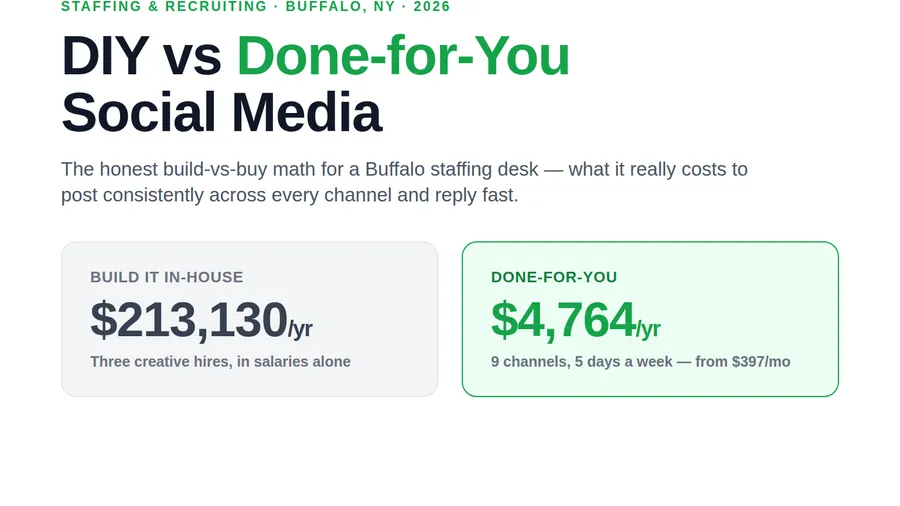
You can absolutely run this in-house. The honest question is whether you will. Posting 5 days a week across 9 channels, editing vertical video, writing captions with the right keyword, and maintaining the automation is a real job — a designer, a video editor, a social manager, and a community manager rolled together, which typically runs $4,000–$8,000/month in salary if you hire it out piece by piece.
The failure mode we see most often isn’t bad content. It’s inconsistency: an agency posts hard for two weeks, gets busy filling reqs, and goes dark. The algorithm punishes the gap, reach collapses, and they conclude “social doesn’t work for staffing.” It works — but only if it runs every day, which is exactly the kind of repeatable, unglamorous cadence that a done-for-you engine is built to sustain. Our done-for-you recruiting social package exists for precisely this: it keeps the cadence and the automation running from $397/mo per brand (up to four brands for $997/mo — useful for multi-location Charlotte agencies or recruiters building personal brands), so the engine never goes dark because your desk got busy.
If your bottleneck is the website those candidates land on rather than the content, that’s a different fix — see Astro vs GoHighLevel websites for staffing. And if you’d rather have a person running your whole GHL account, a GoHighLevel VA may be the better lever.
Compliance: consent, EEOC, and honesty
Automation that outruns the rules is a liability, not an advantage. Three guardrails matter when a Reel funnel starts texting candidates:
- TCPA and consent. The moment the conversation moves to SMS, capture explicit opt-in inside the DM flow before any texts fire — build the consent language into the automation, don’t bolt it on. We walk through the specifics in TCPA compliance for recruiting texts.
- EEOC and fair screening. The AI agent should qualify on job-related criteria only — role fit, shift availability, work authorization, pay expectations — never on protected characteristics. Keep the script auditable and identical for every candidate.
- Disclosure and honesty. Tell candidates when they’re talking to an automated assistant, and make reaching a human easy. And film honestly: show the real shift and the real pay. Bait-and-switch content burns the trust that makes the channel work in the first place.
Get those three right and the funnel is both faster and more defensible than an inconsistent inbox — every conversation is scripted, consented, and logged.
What short-form video won’t do
We name limits honestly. Short-form video is a top-of-funnel sourcing and capture channel. It is not a magic wand.
It won’t fill a niche executive-search req where the total addressable pool is 40 people nationwide — that’s still a phone-and-relationship game. It won’t work if you post twice and quit; the entire mechanism depends on consistency. And it won’t replace a recruiter’s judgment on whether a qualified candidate is actually right for a client. Those are human calls, and they should stay human.
What it will do is put your open roles in front of the Charlotte candidates who aren’t searching job boards, capture the interested ones automatically, and book them into your pipeline while your team sleeps. Used that way — as the always-on top of a GoHighLevel funnel — it turns a phone and a recurring posting cadence into one of the cheapest candidate sources a staffing desk has.
Frequently asked questions
Does short-form video actually work for staffing and recruiting?
Yes, when it’s run as a system rather than a one-off post. The reason it works is where candidates already are: 86% of job seekers use social media in their search, 46% of Gen Z say they’ve landed a job or internship through TikTok, and 86% of hourly applications happen on a phone. Vertical Reels and TikToks are the native format of that phone, and they’re built to reach people who aren’t following you yet — exactly the passive candidates a staffing desk needs.
How often does a Charlotte staffing agency need to post?
Aim for 5 days a week, every week. Short-form video rewards consistency far more than production value — the algorithm pushes accounts that show up daily, and a steady cadence compounds reach. The most common reason agencies conclude “social doesn’t work” is that they post in bursts and then go dark, which collapses reach. A done-for-you engine exists to keep the cadence from breaking when your desk gets busy.
What do I actually film?
Real, unpolished clips shot on a phone: a day-in-the-life of the role, a pay-and-perks callout, a recruiter talking head explaining one open req, a placed-candidate testimonial, or a fast FAQ. None of it requires a videographer or a script — it requires a phone, a recruiter, and a system that publishes daily and captures the interest each clip generates.
How does a video turn into a booked interview?
Through a comment keyword and automation. Each caption ends with a call to action like “Comment JOBS and I’ll DM you details.” When someone comments, an auto-DM fires instantly, an AI agent qualifies them on role, shift, ZIP, and work authorization, captures SMS consent, and books the interview straight into GoHighLevel — tagged to the video that sourced them. No recruiter touches the DM inbox.
Is DM and text automation TCPA compliant?
It can be, when it’s built correctly. Capture explicit SMS opt-in inside the DM flow before any texts fire (TCPA), qualify only on job-related criteria and keep the script identical for every candidate (EEOC), and disclose when a candidate is talking to an automated assistant with an easy path to a human. A scripted, logged automation is often more defensible than an inconsistent human inbox.
How much does done-for-you short-form video cost for a Charlotte staffing agency?
Our done-for-you recruiting social package is $397/mo per brand — content published 5 days a week across 9 channels plus 3 AI agents for comments, DMs, and web chat. Up to four brands is $997/mo, which suits multi-location Charlotte agencies or a team of recruiters building personal brands. It’s white-label and never requires your account passwords. The fastest way to a real number is to book a call.
About the author
Marcus Delgado is the Staffing Agency Growth Lead behind the Hiring Snapshot, based in Tampa, FL. He ran a light-industrial staffing desk before joining the snapshot team to focus on agency growth, and he thinks in placement economics — fill rates, redeploys, and gross margin per requisition. His posts lean on real desk math, not vanity metrics.
Related reading
- Instagram & Facebook Auto-DM Recruiting for Miami Staffing Agencies
- Facebook & Meta Ads for Staffing Agencies: The Recruiting Lead-Gen Playbook
- How to Use GoHighLevel as an ATS: Build a Recruiting Pipeline That Fills Reqs Faster
- Cutting Interview No-Show Rate From 22% to 6% (The Cadence That Works)
- Astro vs GoHighLevel Websites for Dallas Staffing Agencies: Page Speed & SEO Compared
Ready to turn Charlotte’s feed into a candidate pipeline? Get done-for-you recruiting social, scope a custom GHL build, or see how the Hiring Snapshot works.