· Marcus Delgado · Growth · 24 min read
Staffing Agency Fee Agreement: The 7 Clauses That Protect Your Placement Fee (2026)
A handshake and an invoice is not a fee agreement, and the day a client disputes your placement is the day you find out. Here are the seven clauses that decide whether you actually get paid, with the real sample language you can adapt and the places each one breaks.
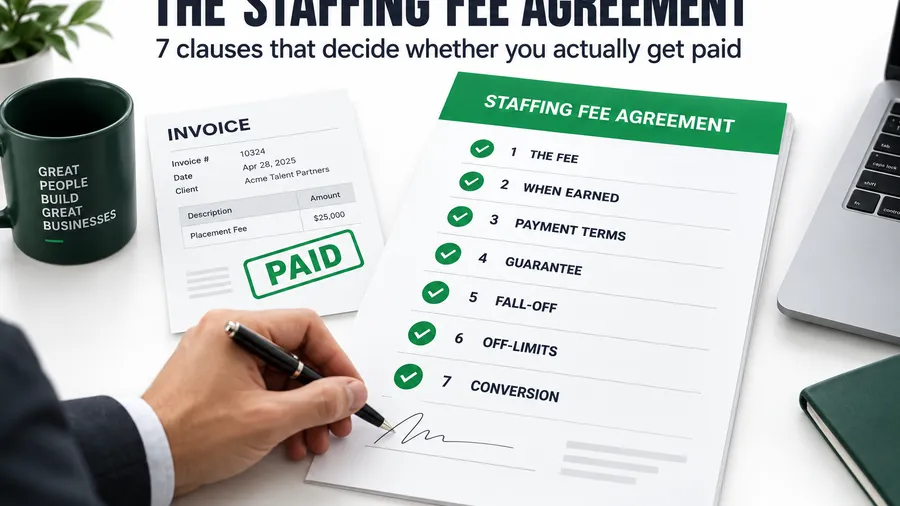
It is the end of the month and you are chasing a $9,400 invoice. You placed a warehouse supervisor six weeks ago, the client was thrilled, everyone shook hands. Then the hire quit on day 38, the client hired someone off Indeed instead, and now the accounts-payable contact is telling you the fee is “under review” because your email never actually said what happens when a placement does not stick. You have the Indeed receipts. You do not have a signed agreement that says you get paid anyway. Guess who wins that argument.
The short answer: a staffing fee agreement is the one document that decides whether your spread is money you keep or money you hope for. It is not a formality you send after the win. It is the thing you get signed before you source a single candidate, and it has to answer seven questions in writing: what the fee is, when it is earned, when it is due, what happens if the hire leaves, what happens if the candidate backs out, whether the client can poach your placed workers, and what it costs to convert a temp to permanent. Miss any one of those and you have left a door open for a client to walk through on the day they least want to pay you. Here is each clause, the sample language you can adapt, and exactly how it breaks when it is weak.
Key takeaways
- Get it signed first, not last. The edge you have before you present a candidate is the only edge you get. After the client has met someone they want to hire, every clause you add is a negotiation you are losing.
- Fee basis is not one number. Permanent placements run 15 to 25% of first-year base salary, retained search runs 25 to 31% staged in thirds, and temp or contract work is a markup on pay rate that averages 35 to 41%. Your agreement has to name which one applies and to what.
- “Earned when” is the clause clients attack. Spell out whether the fee is earned at offer acceptance or on the start date. Leaving it vague is the single biggest reason fees get disputed.
- The guarantee is a trade, not a giveaway. 90 days is the most common window, offered by 59% of recruiters in one Top Echelon poll. Make it a replacement first, a prorated refund second, and tie it to the client having paid on time.
- Net-30 on paper is net-60 in practice. US B2B invoices already run around a 47-day DSO, and staffing terms keep drifting toward net-60 and net-90. If your agreement has no late-payment teeth, you are financing the client for free.
Table of contents
- Why a weak fee agreement quietly costs you the most
- The anatomy of a fee agreement that holds up
- Clause 1: The fee and how it is calculated
- Clause 2: When the fee is earned (the trigger)
- Clause 3: Payment terms with actual teeth
- Clause 4: The guarantee and replacement period
- Clause 5: The fall-off and candidate backout clause
- Clause 6: Off-limits and no-poaching
- Clause 7: Temp-to-hire conversion (the buyout)
- Three real scenarios: solo, light-industrial temp, retained search
- The compliance and liability language you cannot skip
- Common objections, answered
- FAQ
Why a weak fee agreement quietly costs you the most
There are roughly 27,000 staffing and recruiting companies in the United States running close to 54,000 offices, and together they put nearly 2.0 million temporary and contract workers to work in an average week in 2025 (American Staffing Association). Every one of those desks lives on a spread, and the spread is only real once it clears the bank. A fee agreement is the paperwork that turns a placement into collected cash instead of a dispute.
Most small agencies treat the agreement as an afterthought because the painful cases are rare. You place twenty people, nineteen of them go smoothly, and the agreement never gets read. Then the twentieth placement quits, or the client slow-pays to day 75, or they hire a second candidate you sent for free, and suddenly the one document you skimmed is the only thing standing between you and eating the loss. The math is brutal: a single disputed $9,000 fee can wipe out the margin on several clean placements. You are not writing the agreement for the nineteen. You are writing it for the one.
The timing problem makes it worse. Staffing agencies pay their workers weekly or biweekly while clients stretch to net-30, net-60, and increasingly net-90, which is why the industry leans so hard on payroll funding and factoring (Advance Partners). On the temp side you have already paid the worker before the client pays you. An agreement without real payment terms does not just risk a bad debt, it turns your desk into an unpaid lender. If you want the full picture on terms and factoring, we covered it in the staffing cash-flow and net-60 playbook.
The anatomy of a fee agreement that holds up
A fee agreement that survives a dispute is not long, but it is complete. The clauses that matter line up with the five terms recruiting-contract veterans flag most often: a clear guarantee, a no-poaching rule, compliance language, indemnification, and defined candidate ownership with a dispute process (BountyJobs). Add the fee basis and the earned trigger and you have the seven-part spine below. Every one of them exists to answer a question a client will otherwise answer in their own favor.
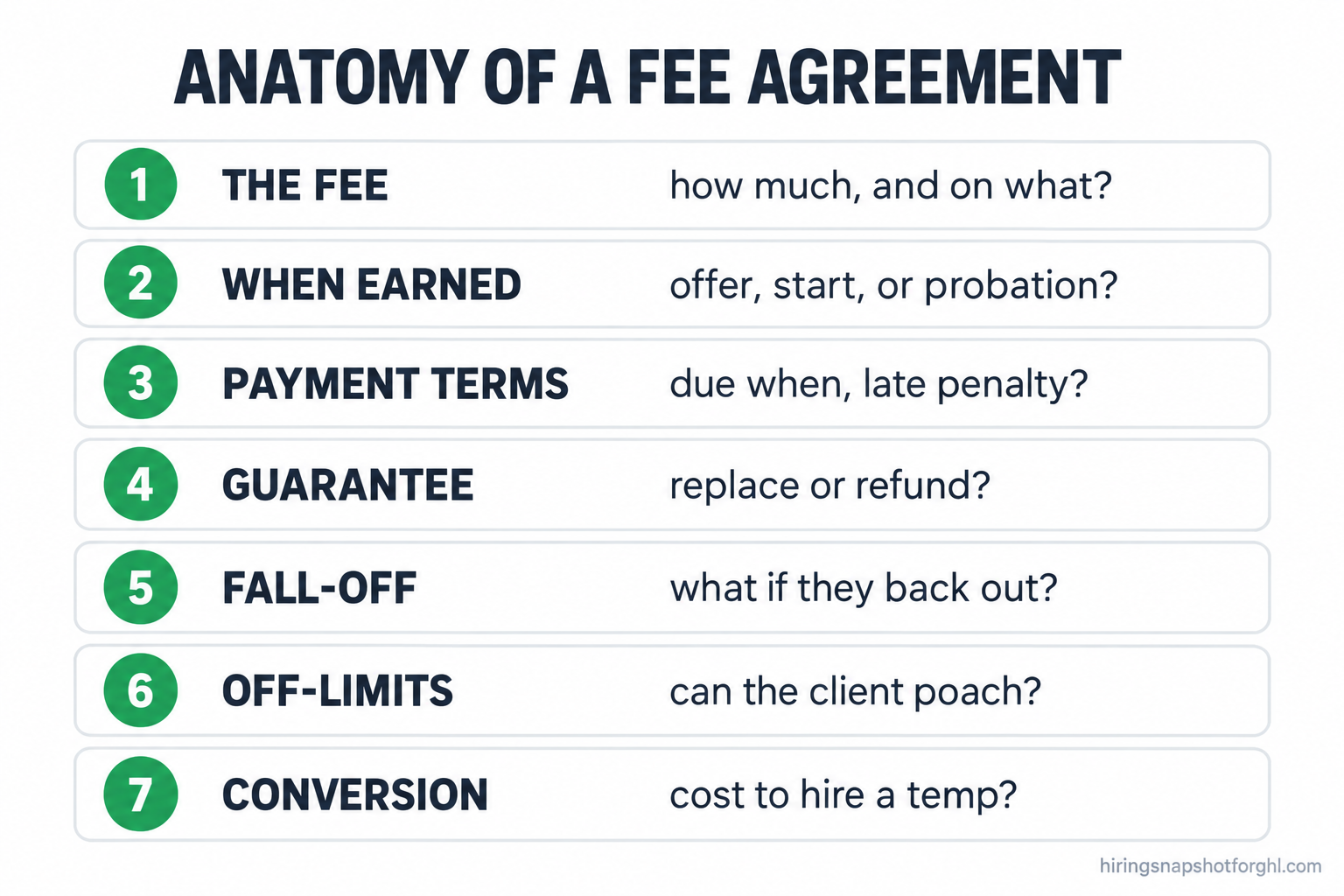
Before the clauses, one rule that outranks all of them: get it signed before you present a candidate. The moment a client has met someone they want, your negotiating position is gone, and anything you try to add reads as a shakedown. The signed agreement is what lets you source in good faith. The rest of this guide assumes it is on file before any resume goes out.
Clause 1: The fee and how it is calculated
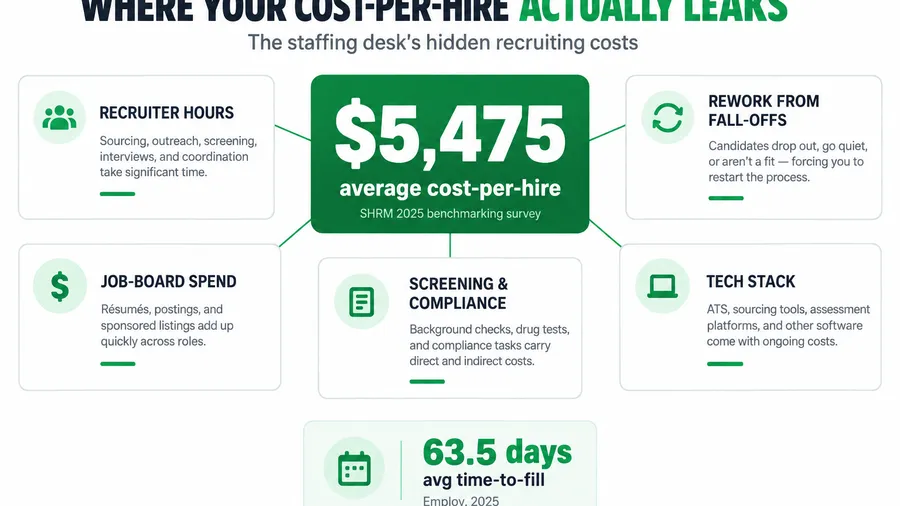
The fee clause has to name three things: the basis, the number, and what the number applies to. For a permanent placement the basis is a percentage of the candidate’s first-year compensation, and the market norm sits at 15 to 25% of first-year base salary, with retained search running higher at 25 to 31% of projected first-year compensation (RecruitBPM). For temp and contract placements the fee is not a flat number at all, it is a markup applied to the worker’s pay rate, and that math deserves its own treatment in the bill rate and markup guide.
The detail that gets agencies burned is the phrase “first-year compensation.” Does it mean base salary only, or does it include a signing bonus, a guaranteed commission, a car allowance, relocation? A 20% fee on a $90,000 base is $18,000. A 20% fee on a $90,000 base plus a $20,000 guaranteed bonus is $22,000. Clients will read it the cheap way unless you define it.
How it breaks: you write “20% of salary,” the client reads “20% of base,” and you lose the bonus you were counting on. Define the base, in writing.
Sample language (adapt and have counsel review): “Client agrees to pay Agency a placement fee equal to twenty percent (20%) of the Candidate’s total first-year cash compensation, defined as annualized base salary plus any guaranteed bonus, commission, or sign-on payment, for any Candidate introduced by Agency whom Client or an affiliate hires within twelve (12) months of introduction.”
That last clause, the twelve-month window on anyone you introduced, is what stops a client from parking your candidate and hiring them “independently” three months later.
Clause 2: When the fee is earned (the trigger)
This is the clause clients attack, because it is the one most agreements leave fuzzy. The fee can be earned at one of three moments: when the offer is accepted, when the candidate starts, or after a probation period. The biggest red flag in any agreement is uncertainty about exactly when the placement fee is earned, so the contract has to pick one and say it plainly.
Most contingency desks earn the fee on the start date, which is clean and defensible: the candidate showed up, the placement happened, the fee is due. Earning it at offer acceptance is more aggressive and harder to collect, because a candidate can accept and then never start. Earning it only after probation means you are fronting the client weeks of your own risk. Pick the start date unless you have a reason not to, and write it so there is no room to argue.
How it breaks: your agreement says the fee is earned “upon placement” without defining placement. The candidate accepts, then takes a counteroffer and never starts, and the client says no placement happened, so no fee. You cannot point to the line that settles it because there is no line. If counteroffers are a recurring problem on your desk, the candidate-backout playbook is worth a read alongside this clause.
Sample language: “The placement fee is earned in full on the Candidate’s first day of employment with Client. A Candidate who accepts an offer but does not commence employment does not trigger the fee, and Agency will present a replacement at no additional charge.”
Clause 3: Payment terms with actual teeth
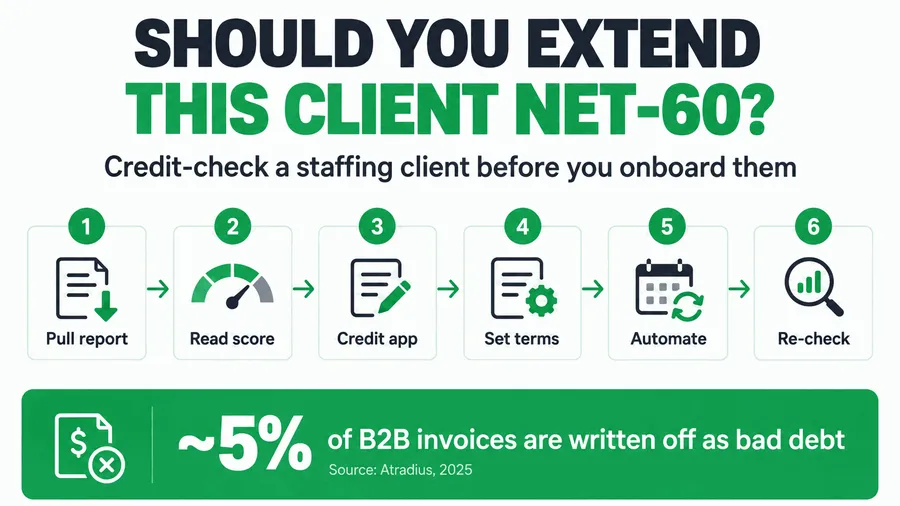
A payment-terms clause that says “net-30” and nothing else is a suggestion, not a term. US B2B invoices already run around a 47-day days-sales-outstanding average, and staffing terms keep drifting from net-30 toward net-60 and net-90, especially with larger buyers (Advance Partners). If your agreement has no consequence for late payment, the client’s accounts-payable system will treat your due date as optional.
Give the clause teeth. State the net term, state a late-payment interest rate (1.5% per month is common and enforceable in most states), and state that the guarantee does not apply if the client has not paid on time. That last link is the quiet enforcer: a client who wants the protection of your replacement guarantee has a direct reason to pay the invoice before day 30. Many recruiting contracts void the guarantee entirely if payment arrives after the due date.
How it breaks: you offer a 90-day guarantee and net-45 terms with no interest clause. The client pays on day 80, the hire quits on day 85, and the client demands a free replacement. You are now doing unpaid work for a client who financed themselves on your dime for three months. Tie the guarantee to on-time payment and that stops.
Sample language: “Invoices are due net thirty (30) days from the invoice date. Balances unpaid after the due date accrue interest at one and one-half percent (1.5%) per month. The replacement guarantee in this agreement is void for any placement where the corresponding invoice was not paid in full within the net term.”
If late-paying clients are a pattern, the real fix starts before you sign, with a client credit check before onboarding.
Clause 4: The guarantee and replacement period
The guarantee is what makes a client comfortable signing, so it is worth getting right rather than copying someone else’s. The most common window is 90 days: in one Top Echelon poll of recruiters who offer a guarantee, 90 days accounted for 59.2%, 60 days for 22.3%, and 30 days for 14.6% (Top Echelon). Shorter windows protect you more; longer windows win you more business. For light-industrial and high-volume roles a 30 or 60-day window is defensible because turnover shows up fast. For professional and executive placements, 90 days is the expectation.
Structure the remedy as a ladder, not a blank check. Replacement first: you source a new candidate at no charge. Prorated refund second, only if you cannot replace: refund a share of the fee based on how far into the window the hire left, for example 1/90th of the fee per day remaining in a 90-day window. A full cash refund should be the rare exception, not the default, because a replacement keeps you whole while a refund hands the client free recruiting.
How it breaks: your guarantee promises a “full refund” with no replacement option. Every fall-off becomes a cash clawback instead of a chance to re-place and keep the fee. You trained your clients to ask for money back when they could have taken a better candidate.
Sample language: “If the placed Candidate leaves or is terminated for cause within ninety (90) days of the start date, Agency will provide one replacement search at no additional fee. If Agency cannot fill the role within thirty (30) days of notice, Client receives a prorated refund equal to the unused portion of the guarantee period. This guarantee applies only if the invoice was paid within the net term.”
Clause 5: The fall-off and candidate backout clause
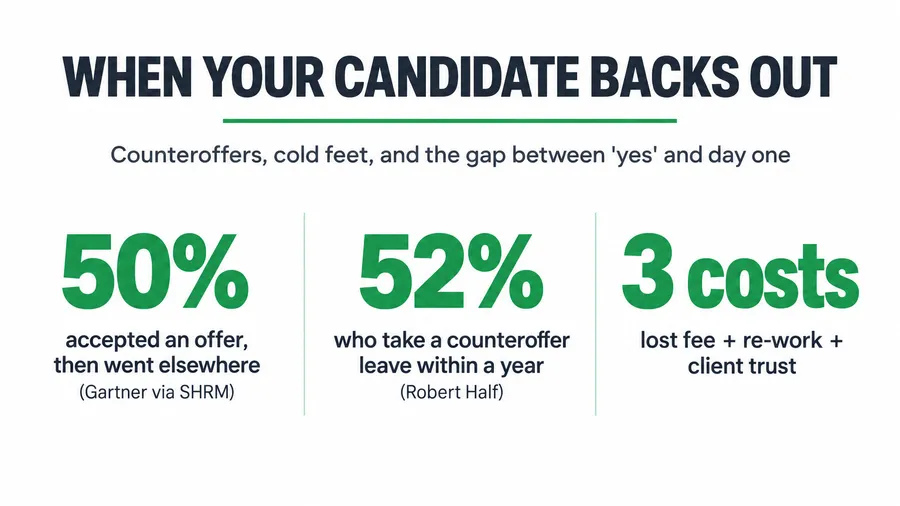
A fall-off is any placement that comes apart after the fee is earned, and it is the most expensive event on a staffing desk because you pay to source the seat twice. The guarantee clause handles what happens after a start. This clause handles the gap before it: the candidate who accepts the offer and then backs out for a counteroffer, a better commute, or cold feet. Without language here, the client argues that a no-start means no fee and no obligation, and you have burned the sourcing cost for nothing.
Define the backout as its own event and attach a remedy that keeps you working rather than refunding. The standard is simple: a candidate who accepts but does not start triggers a free replacement, not a fee, which keeps you honest and keeps the client from owing money for a seat that was never filled. The separate, protective half is the twelve-month lookback from Clause 1: if the client later hires that same backed-out candidate directly, the fee is due in full. That stops the oldest trick in the book, where a candidate “declines,” waits a month, and shows up on the client’s payroll through the side door.
How it breaks: you have no backout clause, a placed candidate takes a counteroffer before day one, and three weeks later you learn the client hired them anyway without telling you. No clause, no fee, no recourse.
Sample language: “If a Candidate accepts an offer and does not commence employment, Agency will present a replacement at no charge and no fee is due. If Client or an affiliate subsequently employs that Candidate within twelve (12) months in any capacity, the full placement fee becomes immediately due.”
Clause 6: Off-limits and no-poaching
The off-limits clause protects two different things, and strong agreements name both. The first is your placed workers: a client should not be able to poach the temps you have on assignment elsewhere, or recruit your internal staff they met during the engagement. The no-poaching term is one of the five that recruiting-contract veterans say belongs in every agreement, precisely because the agency sees so much of a client’s hiring picture during a search (BountyJobs).
The second thing it protects is your candidates. If you introduce three candidates for a role and the client hires one, the other two are still yours for the lookback period. Without an ownership clause, a client can pass on all three, then quietly hire your second candidate for a different opening and call it their own sourcing. Define candidate ownership as “any candidate Agency submitted in writing” and set the window, usually twelve months, so there is a clear record of who belongs to whom.
A word of honesty on enforceability: non-solicitation and no-poach terms vary in how well they hold up by state, and some aggressive versions do not survive a court. The point of the clause is less about litigating and more about setting a clear expectation and giving you standing to send an invoice. Keep it reasonable in scope and duration so it reads as fair rather than punitive.
How it breaks: no ownership clause, you submit a strong candidate, the client “passes,” and you find out two months later they hired that exact person. You submitted them in writing, but your agreement never said that submission creates a claim, so you have an email and no leg to stand on.
Sample language: “For twelve (12) months following introduction, any Candidate submitted by Agency in writing is deemed Agency’s candidate. Client will not directly employ, nor refer to a third party for employment, any such Candidate or any worker on active assignment through Agency, without payment of the applicable fee.”
Clause 7: Temp-to-hire conversion (the buyout)
If you place temp or contract workers, the conversion clause is where a lot of money is won or lost. A client who likes a temp will want to hire them permanently, and the agreement has to say what that costs. The common structures are a declining buyout that shrinks as the worker logs hours, or a percentage of the worker’s first-year salary. One widely used approach charges a percentage of projected first-year pay and steps it down across hour bands, for example starting near 30% and dropping to 25%, 20%, and 15% as hours accumulate, while some agencies let the worker convert free once they cross a threshold like 1,040 hours on assignment (FoxHire, KORE1).
The declining structure is fair to everyone: early on, you have not recovered your recruiting cost, so the buyout is high; once the client has paid your markup for months, the buyout fades to zero. The failure is having no clause at all, which is how you end up with a client who simply hires your temp off the assignment and stops using you, taking a worker you sourced and screened for free.
How it breaks: your agreement is silent on conversion, a client loves your temp, and they hire them directly after six weeks. You lose the ongoing markup and get nothing for the placement. A conversion clause turns that into either a paid buyout or a continued assignment.
Sample language: “If Client hires a temporary worker placed by Agency, a conversion fee applies: 30% of the worker’s projected first-year compensation during the first 480 hours of assignment, 20% from 481 to 1,000 hours, and 10% thereafter. No conversion fee applies after the worker has completed 1,040 hours on assignment through Agency.”
Three real scenarios: solo, light-industrial temp, retained search
The same seven clauses get tuned differently depending on the desk you run.
The solo contingency recruiter charging 20 to 25%. Your whole agreement can be two pages, but the earned trigger and the twelve-month lookback are non-negotiable. You live and die on direct-hire fees, so the two things that will cost you are a client disputing when the fee was earned and a client hiring a backed-out candidate through the side door. Set the fee earned on the start date, define first-year compensation to include guaranteed bonus, and keep a hard written record of every submission so the ownership clause has teeth. Your guarantee can be 90 days with a replacement-first remedy, because one fall-off a quarter is survivable only if you re-place rather than refund.
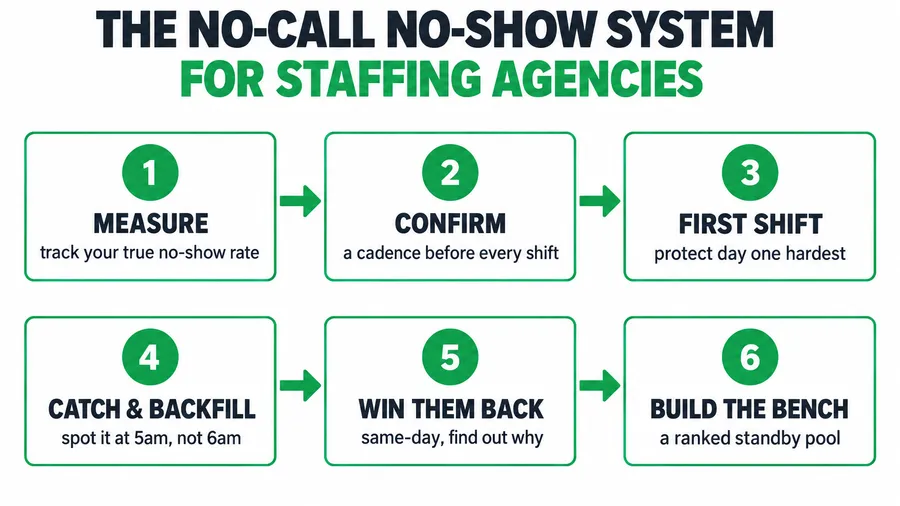
The 10 to 30-person light-industrial or healthcare temp agency. Your money is in markup and conversion, not one-time fees, so Clauses 3 and 7 carry the weight. Net terms with real teeth matter more here than anywhere, because you have already paid the worker before the client pays you, and a client stretching to net-75 can break your payroll. Make the guarantee short, 30 to 60 days, because attendance and no-shows surface in the first weeks, and tie it to on-time payment. The conversion clause is your retention insurance: a declining buyout keeps clients from pulling your best temps off assignment for free. Margin pressure from clients pushing back on rates is a related fight worth preparing for separately in the margin-compression playbook.
The retained or executive-search desk. You are staging the fee in thirds, roughly one-third on engagement, one-third at shortlist, one-third at placement, against a 25 to 31% fee. Your agreement needs an engagement-fee clause the other two desks do not, and your guarantee stretches to 90 days or beyond because senior hires take longer to prove out. The risk you are managing is a client canceling mid-search after you have done the work, so define what is non-refundable at each stage. Fewer placements, far larger fees, so every clause is worth lawyer time.
The compliance and liability language you cannot skip
Two clauses sit outside the fee math but protect you from the expensive surprises. The first is indemnification, which shifts liability for the client’s own hiring decisions back to the client, since you are representing their role in the market but you do not control who they hire or how they treat the worker on their floor. The second is a co-employment carve-out for temp and contract placements, making clear that the agency is the employer of record for payroll, tax withholding, and workers’ compensation, while the client directs the day-to-day work. Getting that boundary wrong is how a staffing agency ends up on the hook for a client’s workplace claim, which we broke down in the co-employment risk guide.
If your placements involve background checks, the agreement should reference compliance with the Fair Credit Reporting Act, which governs disclosure and adverse-action steps when you use a consumer report to screen a candidate (FTC). Spell out who runs the check, who pays for it, and who owns the adverse-action process, because an agency that skips the FCRA steps can create liability for both itself and the client.
One plain disclaimer, because it matters: the sample language in this guide is a starting point drawn from common market practice, not legal advice. Staffing law and the enforceability of non-solicitation terms vary by state. Have an employment attorney in your state review your agreement before you rely on it. The cost of one review is a rounding error against one disputed fee.
Common objections, answered
“My clients trust me, asking them to sign feels like I don’t trust them.” The agreement is not about trust, it is about turnover, on their side and yours. The person who hired you may leave, the accounts-payable contact changes, the company gets acquired, and the new people have no memory of your handshake. A signed agreement is how your terms survive the people who agreed to them. Framing it as “here is how I work so there are no surprises for either of us” lands as professional, not suspicious.
“A long contract will scare off a small client who just wants one hire.” Then do not send a long contract. A clean two-page agreement with the seven clauses reads faster than most clients expect and signals that you have done this before. Length is not the thing that scares clients, ambiguity is, because a vague agreement makes them wonder what you are leaving yourself room to do. Clear and short beats long and hedged every time.
“I already lost the fee once, is it even worth chasing the paperwork now?” It is worth it for the next placement, not the last one. The agreement does not recover the fee you already lost, it stops the next three losses you have not had yet. Every clean month you run without an agreement is a month you got lucky, and luck is not a collection strategy. Put the agreement in place this week and the next disputed placement is the client’s problem, not yours.
“Can’t I just use a template I found online?” A template is a fine skeleton, but the numbers and the state-specific enforceability are yours to get right, and that is exactly the part a generic template leaves blank or wrong. Use a template to see the structure, fill in your real fee, trigger, net terms, and guarantee, then have an attorney in your state confirm the non-solicit and indemnification language holds up. The structure is free. The parts that protect you are worth paying for once.
FAQ
What is a staffing agency fee agreement?
A staffing agency fee agreement is the contract between your agency and a client that defines how you get paid for a placement. It names the fee and how it is calculated, when the fee is earned, the payment terms, the guarantee or replacement period if a hire does not work out, candidate ownership and no-poaching rules, and, for temp placements, the cost to convert a worker to permanent. It is the document that turns a placement into collected cash instead of a dispute, and it should be signed before you present any candidate.
What is a standard recruiting placement fee?
For permanent direct-hire placements, contingency fees typically run 15 to 25% of the candidate’s first-year base salary, and retained or executive search runs higher at roughly 25 to 31% of projected first-year compensation, usually staged in thirds. Temp and contract work is not a flat fee at all, it is a markup applied to the worker’s pay rate that averages around 35 to 41% depending on skill level and market. Your agreement should name which basis applies and define exactly what compensation the percentage is calculated on.
When is a recruiting fee earned?
The fee can be earned at offer acceptance, on the candidate’s start date, or after a probation period, and the agreement must state which one. Most contingency desks earn the fee on the start date because it is the cleanest to defend: the candidate showed up, so the placement happened. Leaving the trigger undefined is the single most common reason fees get disputed, because a vague “upon placement” gives a client room to argue that a no-start or an early quit means no fee is owed.
How long should a placement guarantee be?
Ninety days is the most common guarantee window, offered by about 59% of recruiters who provide one in a Top Echelon poll, with 60-day and 30-day windows also common. Shorter windows protect the agency more and suit light-industrial and high-volume roles where turnover surfaces fast. Longer windows win more business and are expected for professional and executive placements. Structure the remedy as a replacement first and a prorated refund only if you cannot re-place, and tie the guarantee to the client having paid the invoice on time.
What is a temp-to-hire conversion fee?
A conversion or buyout fee is what a client pays to hire a temporary worker you placed onto their own payroll. It is commonly structured as a declining percentage of the worker’s projected first-year pay that shrinks as the worker logs hours on assignment, since the longer the client has paid your markup, the more of your recruiting cost you have already recovered. Many agencies let the worker convert at no charge after a threshold such as 1,040 hours. Without a conversion clause, a client can simply hire your temp directly and stop paying you.
Do I need a lawyer to write a staffing fee agreement?
You can draft the structure yourself from a template, but you should have an employment attorney in your state review it before you rely on it. The enforceability of non-solicitation, no-poaching, and indemnification language varies by state, and getting those wrong is exactly what costs money in a dispute. One attorney review is inexpensive compared with a single contested placement fee, and it is a cost you pay once while the agreement protects every deal after it.
About the author
Marcus Delgado is the Staffing Agency Growth Lead behind the Hiring Snapshot. He ran a light-industrial staffing desk before joining the team to focus on agency growth, and he thinks in placement economics: fill rates, redeploys, and gross margin per requisition. His posts lean on real desk math, not vanity metrics.
Related reading
- Staffing Agency Bill Rate & Markup: The Margin Math That Keeps a Desk Profitable
- The Staffing Agency Cash-Flow Trap: Surviving Net-60 Without Factoring Eating Your Margin
- Running a Client Credit Check Before Onboarding a Staffing Account
- Margin Compression and Rate Pushback: How to Defend Your Spread
- Co-Employment Risk for Staffing Agencies: Where Liability Actually Lands
- When a Candidate Backs Out: The Counteroffer and Fall-Off Recovery System