· Adrienne Boyd · Growth · 16 min read
DIY vs Done-for-You Social Media for Buffalo Staffing Agencies: What Actually Fills Reqs (2026)
Doing your staffing agency's social media yourself looks free — until you price the time and the three full-time hires it really takes. Building the same output in-house runs about $213,130 a year in salaries alone; done-for-you runs about $4,764. Here's the honest build-vs-buy math for a Buffalo desk, with the real numbers.
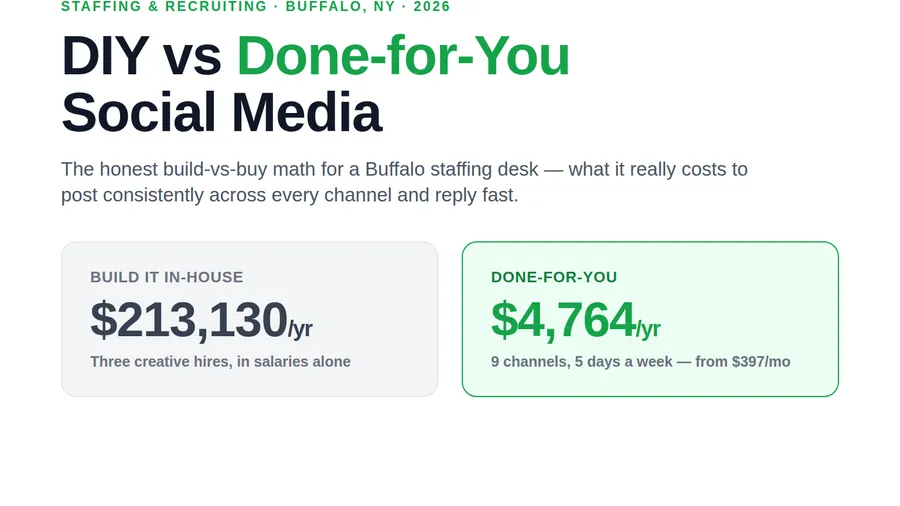
Short answer: for almost every Buffalo staffing agency, doing social media yourself is the more expensive option once you honestly price it. “DIY” isn’t free — it’s either your billable hours or a hire. Reproducing the output of a real recruiting social presence in-house means roughly a social/PR manager, a graphic designer, and a video editor, which run about $74,750, $62,960, and $75,420 a year respectively — about $213,130 in salaries alone before benefits, taxes, and tools (U.S. Bureau of Labor Statistics, Occupational Outlook Handbook, May 2025). A done-for-you plan that ships content five days a week across nine channels and answers comments and DMs automatically runs about $4,764 a year — roughly one forty-fifth of the in-house salary bill. Do it yourself only if you have the time to post consistently every week and answer fast; otherwise, buy it. Here’s the full build-vs-buy math for a Buffalo desk, and how to decide.
Key takeaways
- DIY is not free — it’s time or a hire. The output of a serious recruiting social presence (posts, graphics, and short-form video) maps to three roles that cost about $213,130/year in median salaries alone (BLS OOH, May 2025).
- Done-for-you is about 1/45th the cost. A managed plan at $397/month is ~$4,764/year — content across 9 channels, 5 days a week, plus AI agents for comments, DMs, and web chat.
- Consistency is the whole game, and it’s what DIY loses first. The typical user spends 2 hours 21 minutes a day on social (DataReportal, Digital 2025) — but they only see agencies that show up every day, and the owner-run account is the one that goes quiet during a busy placement week.
- Video is where the reach is. 78% of people prefer a short video to learn about something (Wyzowl, 2025), and short-form is the format an owner with a phone almost never produces on schedule.
- Speed after the comment decides the placement. Responding in 5 minutes instead of 30 makes you about 21× more likely to qualify a lead (MIT / InsideSales Lead Response Study, 2007) — a bar no human inbox clears, but an AI agent does.
- Buffalo makes it sharper. With metro unemployment around 4.3% (BLS, Aug 2025), candidates are scarce and hear from several agencies — the desk that posts and replies consistently wins them.
Table of contents
- What “DIY” and “done-for-you” actually mean
- What DIY social media really costs a Buffalo desk
- What building it in-house costs
- What done-for-you costs — and what you get
- DIY vs done-for-you: the side-by-side
- Why consistency and speed are the whole game
- The Buffalo angle: a tight market punishes silence
- A simple decision framework
- How this connects to GoHighLevel
- What social media won’t fix
- FAQ
What “DIY” and “done-for-you” actually mean
Before the math, define the two options honestly, because “DIY” hides a lot.
DIY (do-it-yourself) covers three real sub-options that people lump together:
- The owner or a recruiter posts between placements — free in cash, expensive in time and consistency.
- You hire a freelancer or part-timer to run it — cheaper than staff, but usually one person who can’t design, edit video, write, and reply all day.
- You build an in-house team — a social manager, a designer, a video editor — the full version most agencies quietly discover they can’t justify.
Done-for-you means an outside team owns the whole output: strategy, writing, graphics, short-form video, publishing across every channel, and answering the comments and DMs that come back. You approve; they ship.
The mistake is comparing done-for-you to the free version of DIY (the owner posting occasionally) when the fair comparison is done-for-you versus the version of DIY that actually produces the same result. That’s where the numbers get honest.
What DIY social media really costs a Buffalo desk
Start with the “free” version, because it’s the most common and the most misleading. When the owner or a recruiter runs social between placements, the cost isn’t zero — it’s the most valuable hours in the building.
A recruiter’s time is worth what it bills. An hour spent fighting a carousel template or re-cutting a Reel is an hour not spent on a candidate call or a client req. And social done properly is not a small time sink: planning, writing, designing, filming, editing, scheduling, and replying across even a few channels realistically runs 6–10 hours a week for one brand done consistently. That’s a full recruiting day, every week, taken from the work that actually closes placements.
Worse, it’s the first thing that gets dropped. The week a big order lands or a client escalates, the posting stops — and social media punishes gaps harder than almost any channel. The “free” DIY account isn’t free; it’s a recruiter-day a week that quietly disappears exactly when you’re busiest, leaving a half-built presence that never compounds.
What building it in-house costs
So say you decide to do it right and hire for it. Here’s the uncomfortable part: one person rarely covers the job. A serious recruiting social presence needs someone to write and manage it, someone to design the graphics and carousels, and someone to shoot and edit short-form video — and short-form video is now the format that earns reach.
Using national median wages for the closest U.S. Bureau of Labor Statistics occupations, here’s the salary bill — before benefits, payroll taxes, software, and management overhead, which typically add 25–40% on top.
That’s about $213,130 a year in salaries alone (BLS OOH: Public Relations Specialists $74,750; Graphic Designers $62,960; Film and Video Editors $75,420, May 2025). Even if you don’t hire all three full-time — most small desks don’t — the point stands: matching the output of a real social operation is a six-figure line item, whether you pay it in salary, in freelancer invoices, or in the owner’s own time.
And here’s the honest counterpoint, because we’d rather you trust the math than feel sold: if your agency is large enough to keep three creative hires fully utilized across many brands and campaigns, in-house can absolutely be worth it. The problem is that a typical Buffalo staffing desk isn’t. You need the output of that team a few hours a day — not three salaries sitting idle between campaigns.
What done-for-you costs — and what you get
Now the other side of the ledger. Our done-for-you social media service is $397/month for one brand — about $4,764 a year. For that, every week per brand you get one Q&A-style text post, one image post, two carousels, and one short-form video (up to 30 seconds), published five days a week across nine channels: Facebook, Instagram, Google Business Profile, LinkedIn, TikTok, YouTube, Pinterest, Threads, and Bluesky — each cropped and captioned per platform.
It also includes three AI agents — for comments, DMs, and web chat — that reply in your agency’s voice within seconds and book candidate and client calls straight to your calendar. It’s white-label, needs no passwords, has no setup fee, and you can cancel with 15 days’ notice.
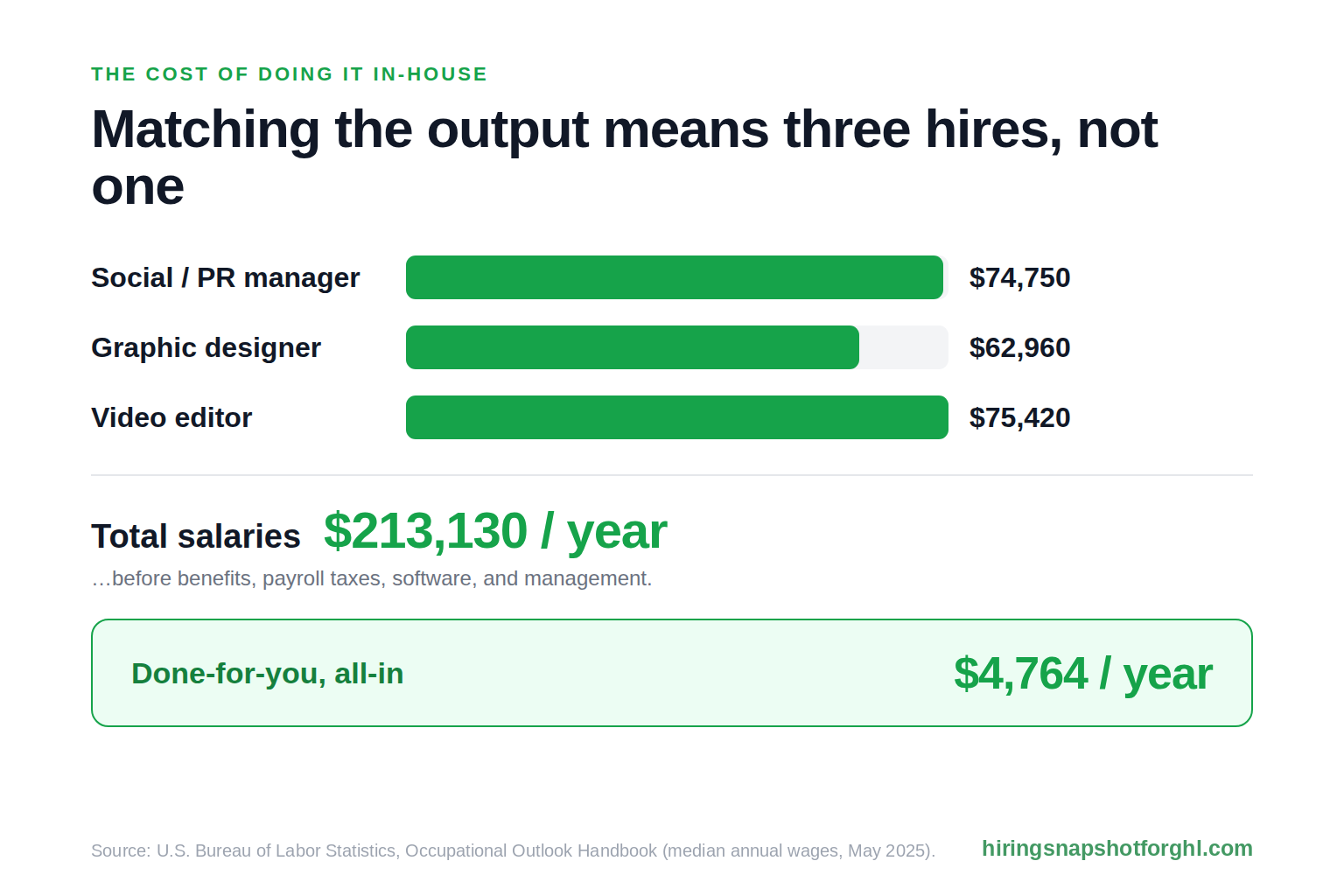
Put the two numbers next to each other and the decision stops being subtle: $213,130 a year in salaries to build it, versus about $4,764 a year to have it done. That’s roughly 1/45th the salary cost — and the done-for-you number already includes the design, the video, the publishing, and the replies you’d otherwise be hiring three people to cover.
DIY vs done-for-you: the side-by-side
Cost is only one axis. Here’s how the realistic options compare across what actually matters to a staffing desk.
| Factor | Owner/recruiter DIY | Freelancer / part-timer | Full in-house team | Done-for-you (from $397/mo) |
|---|---|---|---|---|
| Annual cost | ”Free” — but ~6–10 hrs/wk of billable time | ~$1.5k–$5k/mo | ~$213k+/yr in salaries | ~$4,764/yr |
| Consistency | Drops the week you get busy | Depends on one person | High, if fully staffed | Ships 5 days/week, every week |
| Channels covered | Usually 1–2 | 1–3 | As many as staffed | 9 channels |
| Short-form video | Rarely, and rarely on time | Sometimes | Yes | Yes, weekly |
| Comment & DM replies | Whenever you check | Business hours, if that | Business hours | AI agents, in seconds, 24/7 |
| Ramp time | Immediate but shallow | Weeks to hire + train | Months to hire + train | Live in days |
| Who carries the risk | You (time + gaps) | You (turnover) | You (payroll) | The agency |
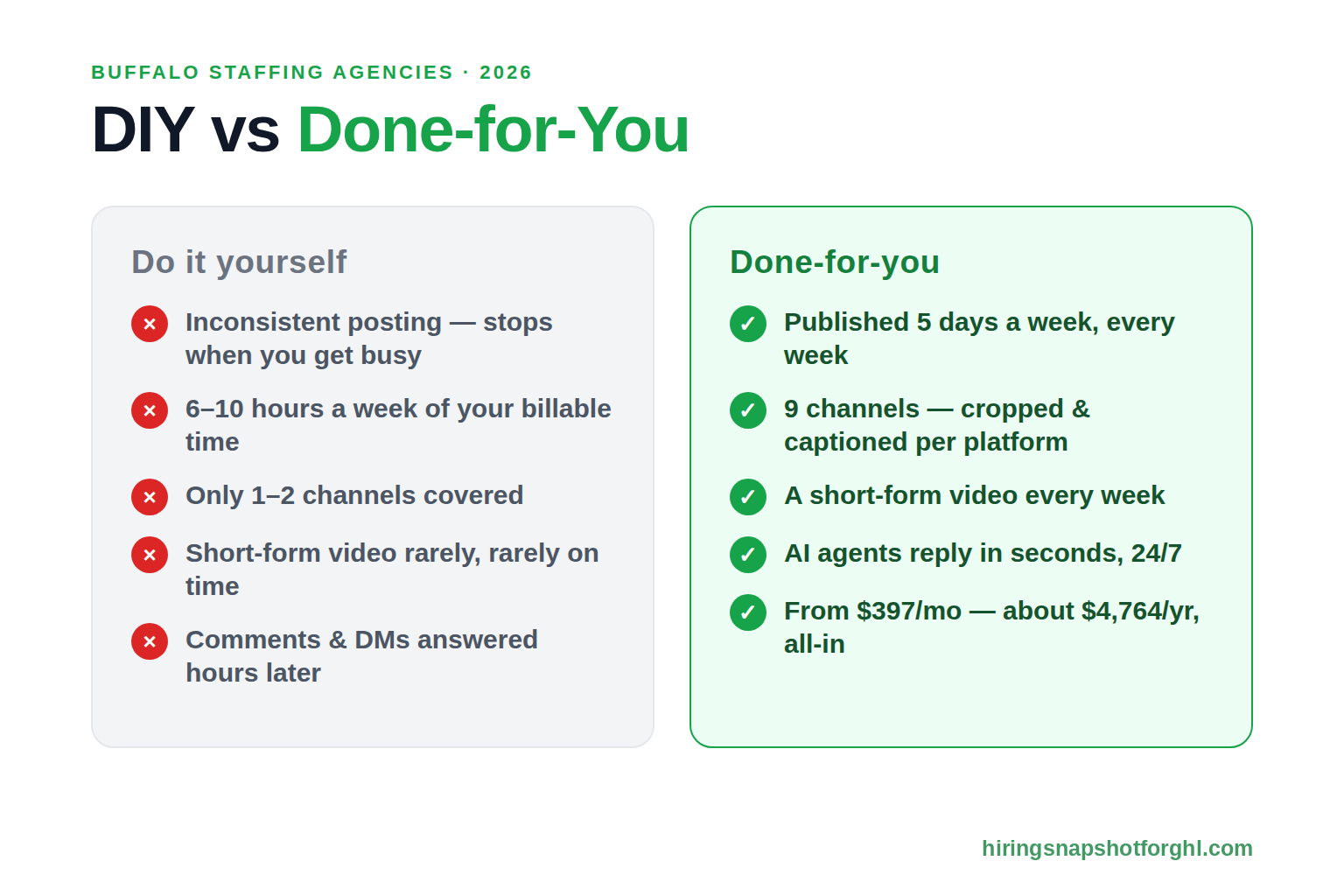
The pattern is consistent: DIY wins only on cash outlay in month one, and loses on the two things that decide whether social actually fills reqs — consistency and speed of reply.
Why consistency and speed are the whole game
Two forces make the DIY account underperform no matter how talented the owner is.
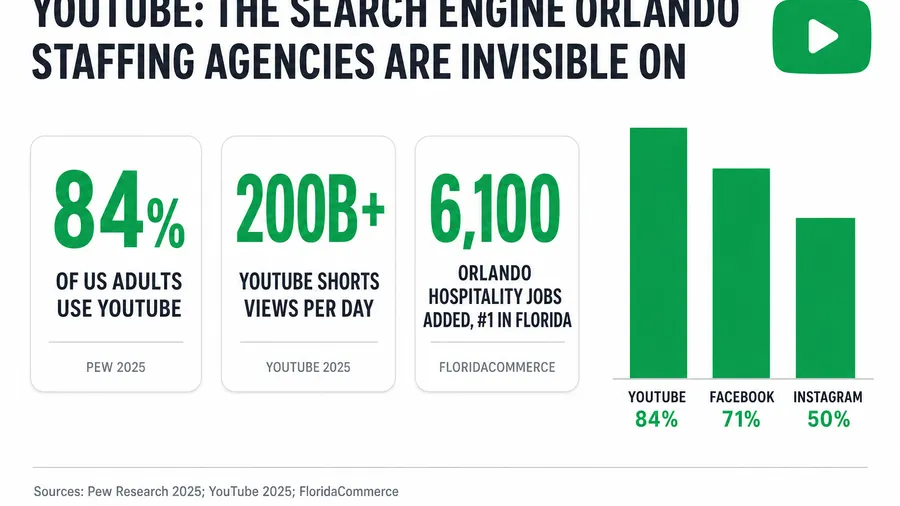
First, attention lives where you have to show up daily. The typical user spends 2 hours and 21 minutes a day on social media (DataReportal, Digital 2025), and candidates are spread across platforms — among U.S. adults, 84% use YouTube, 71% Facebook, 50% Instagram, and 37% TikTok (Pew Research Center, 2025). You don’t get to pick one and be seen; you get seen by posting where they already are, repeatedly. The account that goes dark for two weeks during a busy stretch simply isn’t in the feed when a warehouse worker or a nurse starts looking.
And reach increasingly runs through short-form video: 78% of people say they’d rather watch a short video to learn about something than read about it (Wyzowl, 2025). A weekly Reel is exactly the deliverable a busy owner films with good intentions and never edits — the short-form video engine that fills reqs only works if something produces it on schedule.
Second, speed of reply is where placements are won or lost. A comment or DM is a candidate raising their hand, and the clock starts immediately. The classic MIT/InsideSales lead-response study found that responding within five minutes instead of thirty made a firm about 21× more likely to qualify the lead, with the odds of even making contact dropping roughly 100× as the delay grew (MIT / InsideSales, 2007). No owner watching a job board and three inboxes replies in five minutes at 9 p.m. An AI agent does — which is why the auto-DM and comment automation and the AI chat widget matter as much as the posts themselves.
A candidate comments 'interested' on your job Reel at 9 p.m.
It sits until a recruiter opens the app the next morning, sees it under 40 other notifications, and DMs a generic reply at 10:14 a.m. By then the candidate has already been messaged and half-booked by two other agencies. The comment goes cold.
An AI agent replies in seconds — thanks them by name, answers the pay/shift question, confirms consent to text, and drops a self-book interview link. The recruiter wakes up to a booked candidate instead of a missed one.
The Buffalo angle: a tight market punishes silence
Buffalo makes this decision sharper, not softer. Metro unemployment sits around 4.3% as of August 2025 (BLS, Buffalo-Cheektowaga), and the area’s average hourly wage is $31.96 against a national $33.54 for the same period. Two things follow for a Buffalo desk.
One: candidates are scarce and have options. In a 4.3% market, the light-industrial worker in Cheektowaga or the CNA near the Buffalo-Niagara medical corridor is hearing from several agencies at once. The one they remember — and reply to — is the one showing up in their feed consistently and answering the moment they raise their hand.
Two: margins are real but not lavish. With local wages running a bit below the national average, you can’t out-spend the problem with a $213k in-house team or a fat ad budget. The leverage is efficiency — getting the output of a full creative team, across nine channels, with instant replies, for the price of a slow week’s billing. That’s precisely the case for buying it rather than building it, and it pairs naturally with ranking in local search so the candidates you reach on social can also find you on Google.
A simple decision framework
You don’t need a spreadsheet. Answer three questions honestly.
- Can you post something good five days a week, every week, even during your busiest placement stretch? If yes, DIY can work. If you hesitated, that hesitation is the answer — consistency is the one thing DIY loses first.
- Can you (or someone on the desk) produce a decent short-form video every week and reply to comments and DMs within minutes, at night and on weekends? That’s two specialized skills plus round-the-clock coverage. Almost no small desk clears this bar with in-house time.
- Is your time worth more on a candidate or client call than on a carousel? For a recruiter, it almost always is. Every hour on design is an hour off the phone.
Choose DIY if you’re pre-revenue, testing whether social moves the needle, and you genuinely have the weekly hours. Choose a freelancer if you need help but only on one or two channels and can tolerate the turnover risk. Choose in-house only if you’re large enough to keep three creative hires busy across many brands. Choose done-for-you if you want the full output — nine channels, weekly video, instant replies — without the payroll, the ramp time, or the risk that it all stops the week you get busy. For most Buffalo desks, that’s the answer, and it’s the same logic behind hiring a GoHighLevel VA instead of another recruiter: buy the capacity, keep your people on placements.
How this connects to GoHighLevel
Social media only pays off if the interest it creates lands somewhere that closes. That’s the GoHighLevel layer underneath. When an AI agent books a candidate from a comment or DM, that booking should drop straight into your CRM, fire an SMS-first follow-up cadence, and land on a recruiter’s calendar — not into a social inbox nobody checks on Monday.
Done-for-you social and the Hiring Snapshot are built to work together: the content and AI agents fill the top of the funnel across nine channels, and GoHighLevel captures, qualifies, and books everything they generate. The posts get you seen; the automation makes sure a raised hand becomes a booked interview instead of a cold notification. If you’re weighing the broader build-vs-buy question across your whole stack, our industry benchmarks put the numbers in context.
What social media won’t fix
Honesty first, because the brand voice demands it. Social media — DIY or done-for-you — is a top-of-funnel amplifier, not a cure-all. It will not fix uncompetitive pay, a broken apply flow, or a reputation problem; a great Reel that sends candidates to a slow, 15-minute application still loses them. It won’t replace real recruiting judgment, and results compound over roughly 3–5 months rather than overnight — anyone promising a viral breakout next week isn’t being straight with you.
What consistent, multi-channel social does do is make sure the scarce candidates in a 4.3%-unemployment market see you, remember you, and get answered fast when they respond. The build-vs-buy question is only about the cheapest, most reliable way to produce that — and for the vast majority of Buffalo staffing desks, the math points to done-for-you.
FAQ
Is it cheaper to do my staffing agency’s social media in-house or hire it out?
Hire it out, for almost every small-to-midsize desk. Reproducing the output of a real recruiting social presence in-house means roughly a social/PR manager, a graphic designer, and a video editor — about $213,130 a year in median salaries alone (BLS, May 2025), before benefits and tools. A done-for-you plan at $397/month is about $4,764 a year — roughly one forty-fifth of the salary cost — and includes the design, video, publishing, and replies.
How much time does DIY social media actually take?
Done consistently for one brand, planning, writing, designing, filming, editing, scheduling, and replying realistically runs 6–10 hours a week — about a full recruiting day. For a recruiter, that time is usually worth far more spent on candidate and client calls, which is a big part of why “free” DIY isn’t free.
What do I get with done-for-you social media for $397 a month?
Per brand, every week: one text post, one image post, two carousels, and one short-form video, published five days a week across nine channels (Facebook, Instagram, Google Business Profile, LinkedIn, TikTok, YouTube, Pinterest, Threads, and Bluesky), plus three AI agents that answer comments, DMs, and web chat and book calls to your calendar. It’s white-label, has no setup fee, and you can cancel with 15 days’ notice.
Does social media really help a staffing agency in a tight market like Buffalo?
Yes — arguably more, not less. With Buffalo metro unemployment around 4.3% (BLS, Aug 2025), candidates are scarce and hear from multiple agencies. Consistent, multi-channel presence plus fast replies is how you stay visible and get chosen. It won’t fix uncompetitive pay or a broken apply flow, and results build over 3–5 months rather than overnight.
When does doing it yourself actually make sense?
When you’re early-stage and still testing whether social moves the needle, you only need one or two channels, and you genuinely have 6–10 hours a week to post consistently and reply fast — including nights and weekends. The moment consistency slips during busy weeks, the DIY account stops compounding, which is when most desks switch to done-for-you.
About the author
Adrienne Boyd is the Recruiting Automation Strategist behind the Hiring Snapshot, based in Austin, TX. She spent a decade building applicant-capture funnels and SMS-first nurture cadences for staffing agencies before moving full-time into GoHighLevel automation. She writes the playbooks and field reports, and she is happiest when a “manual, three-person process” collapses into a single trigger.
Related reading
- Social Media for Philadelphia Staffing Agencies: Why Recruiters Lose Candidates to Louder Competitors
- Short-Form Video for Staffing Agencies: The Reels & TikTok Recruiting Playbook
- How Staffing Agencies Can Use Instagram & Facebook Auto-DM to Recruit Hourly Workers
- How to Add an AI Chat Widget to Your Staffing Agency Website
- Why Staffing Agencies Are Hiring a GoHighLevel VA Instead of Another Recruiter
Deciding whether to build or buy your agency’s social? See done-for-you social media, check pricing, or book a walkthrough.