· Marcus Delgado · Growth · 15 min read
Social Media for Philadelphia Staffing Agencies: Why Recruiters Lose Candidates to Louder Competitors (2026)
A Philadelphia staffing desk doesn't lose candidates because its roles are worse — it loses them because a competitor showed up on the feed and answered the DM first. Here's what an inconsistent, slow-to-reply social presence quietly costs your agency every month, with the real data, and the done-for-you fix.
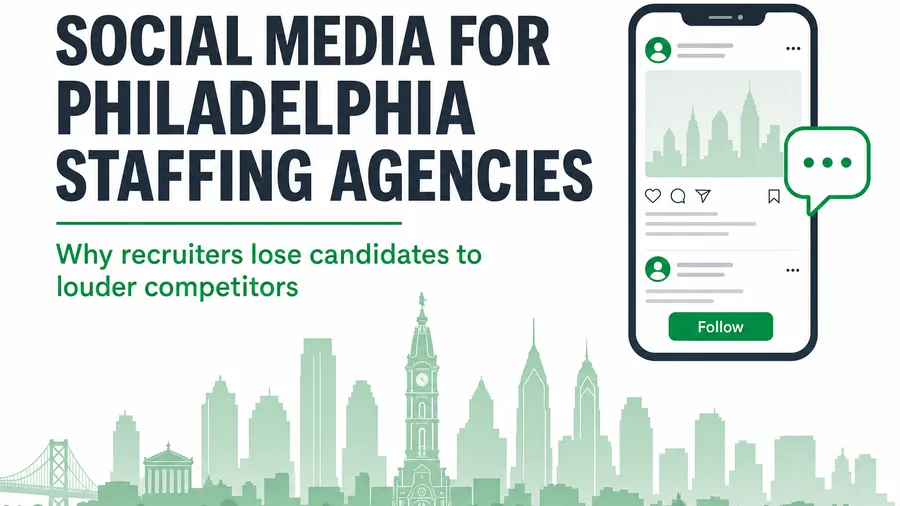
Short answer: most Philadelphia staffing agencies don’t lose candidates because their jobs pay less or their clients are worse — they lose them because a competitor posted this week, showed up in the feed, and answered the “is this still open?” DM in minutes while your profile sat quiet. In a market of 3.1 million jobs, candidates and hiring managers pick the recruiter who is visibly active and replies fast. An empty, off-brand social presence and a comment inbox nobody watches is a slow, invisible leak in your pipeline. This is what that leak actually costs, the sourced data behind it, and how a done-for-you social engine plugs it — without adding a second job to your week.
Key takeaways
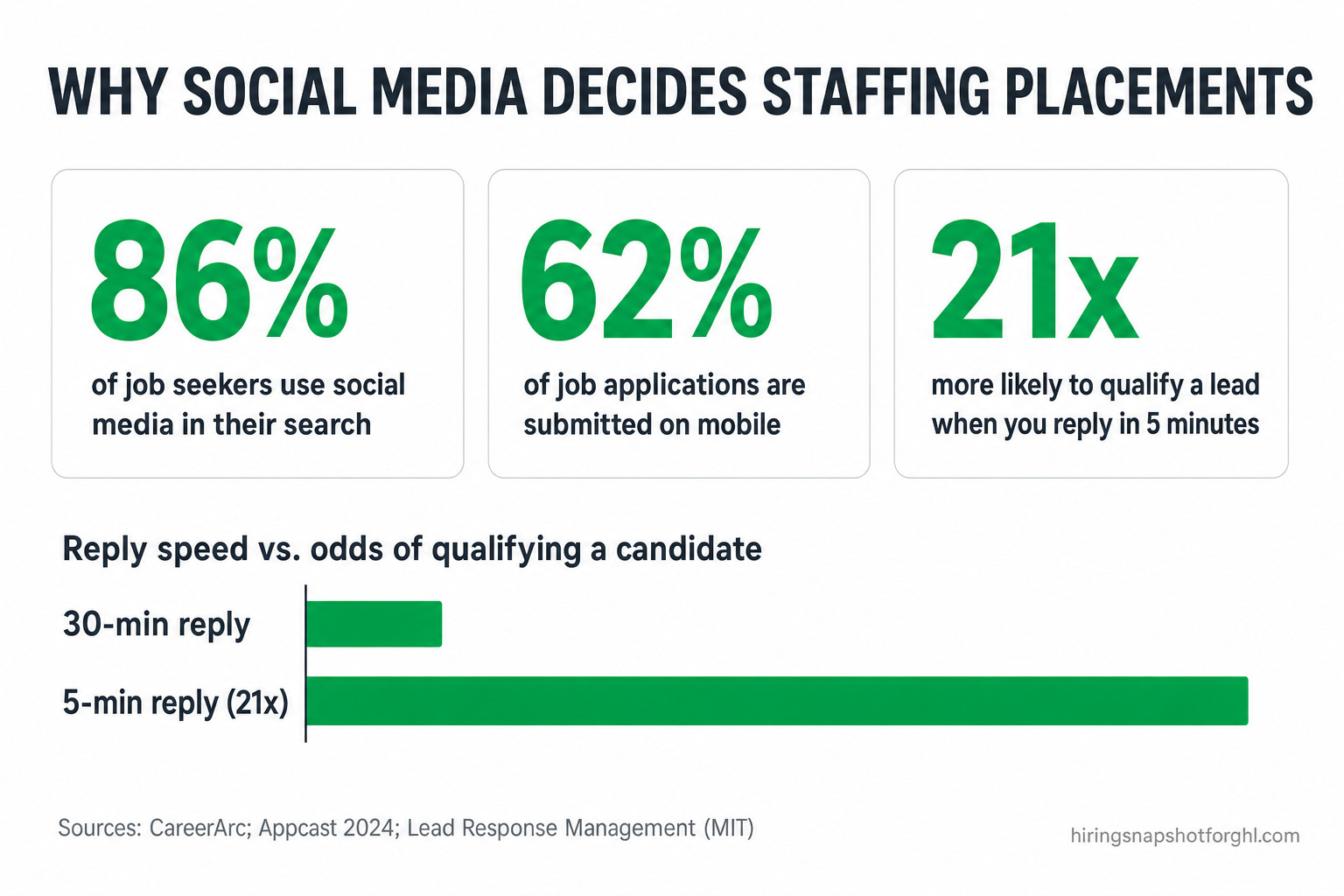
- Your candidates are on social before they’re on a job board. 86% of job seekers use social media in their search, and 58% use it to research potential employers before they apply (CareerArc Future of Recruiting Study).
- Silence reads as “closed.” 73% of consumers expect a brand to respond on social within 24 hours or sooner, and most say they’ll take their business to a competitor when they’re ignored (2025 Sprout Social Index).
- Speed-to-reply is the whole game in staffing. Answering a new lead within 5 minutes vs. 30 minutes makes you 21x more likely to qualify them (Lead Response Management study, MIT/InsideSales).
- And they apply from a phone. 62% of job applications are submitted on mobile (Appcast 2024 Recruitment Marketing Benchmark Report) — the same device your social feed lives on.
- A strong presence is a hiring discount. Employers with a strong brand see up to 50% lower cost-per-hire and 28% lower turnover (LinkedIn, Why Your Employer Brand Matters).
- Philadelphia’s biggest hiring engine is health care — education & health services added 28,400 jobs in a year (U.S. BLS, March 2025) — exactly the high-volume, hard-to-fill demand social recruiting reaches.
Table of contents
- Why Philadelphia recruiters lose candidates on social
- The real cost of an inconsistent presence
- Where Philadelphia candidates actually are
- The four leaks in a staffing agency’s social presence
- Silence is the most expensive channel
- What “done-for-you” actually replaces
- How this plugs into GoHighLevel
- What social media won’t fix
- FAQ
Why Philadelphia recruiters lose candidates on social
Philadelphia is a big, competitive labor market. The Philadelphia–Camden–Wilmington metro carried about 3,116,400 nonfarm jobs as of March 2025, and its single strongest engine — education and health services — added 28,400 jobs over the year, with health care and social assistance alone up 28,800 (U.S. Bureau of Labor Statistics). Office and administrative support and transportation and material moving remain among the region’s largest occupational groups (BLS OEWS Philadelphia) — the high-turnover, high-volume categories a staffing desk lives on.
That demand is good news and a trap at the same time. Every agency chasing those CNAs, warehouse associates, and admin temps is fishing in the same pond, running the same job-board spend, and sending the same “We’re hiring!” blasts. The candidate you actually need — the medical assistant who isn’t refreshing Indeed but is scrolling Instagram on break — never sees your req. They see whoever posted today.
Here’s the uncomfortable part: it usually isn’t the agency with the best roles that wins them. It’s the agency that shows up consistently and answers fast. When a candidate is deciding who to trust with their next job, or a plant manager is deciding who to hand a 30-person ramp, they do the same thing everyone does now — they check your feed. 58% of workers use social media to research a potential employer before engaging (CareerArc). A grid that’s three months stale, off-brand, or empty tells them your desk went cold. You never hear about the loss; it just quietly happens.
The real cost of an inconsistent presence
“Post more” sounds like a vanity chore until you translate it into placement economics, which is the only language a staffing owner should care about.
Start with reach. Organic reach compounds only with consistency; it collapses without it. Instagram brand engagement fell 28% year over year to a 0.50% median engagement rate in 2025 (Socialinsider 2025 Benchmarks), which means sporadic posting gets buried even harder than it used to. The platforms reward accounts that feed them regularly — roughly a post a day is the cadence active brands actually run (Socialinsider). Post once a month and the algorithm treats you like a dormant account, so even your existing followers stop seeing you.
Now the flip side. A strong, visible employer presence isn’t a soft “brand” nicety — it’s a measurable discount on hiring. LinkedIn’s talent research found that companies with a strong employer brand see up to a 50% lower cost-per-hire and 28% lower employee turnover (LinkedIn, Why Your Employer Brand Matters). For a staffing agency, cost-per-hire is your cost of goods — every dollar you don’t spend re-sourcing a role is margin. A presence that makes candidates come to you is the cheapest source you have.
So the cost of inconsistency isn’t “fewer likes.” It’s a higher cost-per-applicant, a weaker close rate against louder competitors, and a slow erosion of the exact reputation that lets you charge a premium bill rate. It compounds in the wrong direction, month after month.
Where Philadelphia candidates actually are
Before you decide social is optional, look at where your candidates spend attention and how they apply. The data is one-sided.
86% of job seekers use social media during their search (CareerArc), and a majority research employers there before they ever apply. When they do apply, they do it on the same device they scroll: 62% of job applications are submitted on mobile (Appcast 2024). The path from “saw your Reel on the couch” to “tapped apply” is one phone, a few seconds apart — if you’re in the feed at all.
The takeaway isn’t “be everywhere for the sake of it.” It’s that the top of your candidate funnel has quietly moved to social feeds, and a Philadelphia desk that treats social as an afterthought is starving the funnel it depends on. You don’t have to out-produce a media company. You have to be present and consistent where the attention already is.
The four leaks in a staffing agency’s social presence
When we audit a recruiting agency’s social, the same four leaks show up almost every time. Each one is a place candidates and clients slip out.
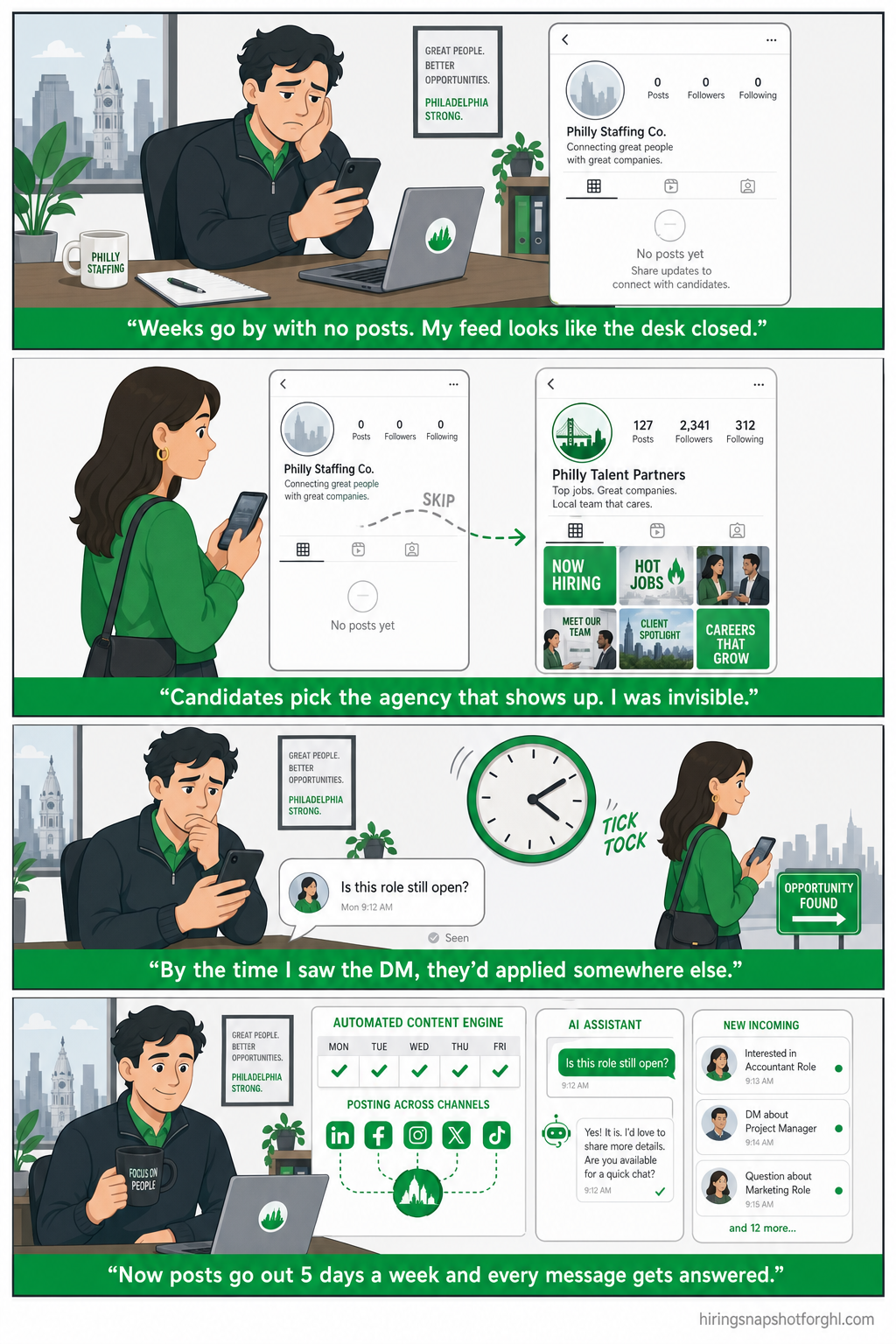
- The “no time to post” leak. Between intake calls, screens, and client updates, “post today” never wins. Weeks go quiet — and to a candidate scrolling recruiter profiles, a quiet feed looks like a desk that closed.
- The “off-brand grid” leak. A hiring manager checks your feed before they sign; a candidate scrolls a dozen recruiter profiles before they apply. An inconsistent, unbranded grid loses both to the agency that looks like it has its act together.
- The “9 apps is a second job” leak. Facebook, Instagram, LinkedIn, TikTok, YouTube, Google Business Profile, Pinterest, Threads, Bluesky — different sizes, captions, and formats. Doing it by hand is a full role no recruiter has the hours for, so most agencies pick one channel and neglect the rest.
- The “cold comments and DMs” leak. Every ignored “is this role still open?” comment or unanswered DM is a candidate who applied elsewhere. In staffing, this is the most expensive leak of all — because speed-to-reply is the single biggest lever you have.
The first three leaks cost you reach. The fourth costs you placements you already earned — a candidate raised their hand, and nobody was there to grab it.
Silence is the most expensive channel
If you fix only one thing, fix response speed. The data on this is brutal and consistent.
The classic MIT/InsideSales Lead Response Management study found that contacting a new lead within 5 minutes instead of 30 makes you about 21x more likely to qualify that lead (summarized in Harvard Business Review). A candidate who comments on your job Reel at 8 p.m. is a lead with a five-minute half-life. Reply tonight and you’re booking an interview; reply tomorrow and they’ve already applied to the agency that answered.
And candidates now expect that speed. In the 2025 Sprout Social Index, 73% of consumers expect a brand to respond within 24 hours or sooner, and most say that when a brand ignores them on social, they’ll simply go buy from — or in your case, apply with — a competitor (Sprout Social). Your unanswered comment section isn’t neutral. It’s actively routing candidates to louder agencies.
This is why the fix can’t just be “post more.” Posting gets you seen; it also generates comments and DMs you now have to answer within minutes, 9 channels wide, at 8 p.m. on a Friday. No human does that reliably. The only version of social recruiting that actually converts pairs consistent posting with instant, automated replies — an AI agent that answers the comment, qualifies the candidate, and books the interview while you sleep. That’s the difference between a feed that looks busy and a feed that fills reqs.
What “done-for-you” actually replaces
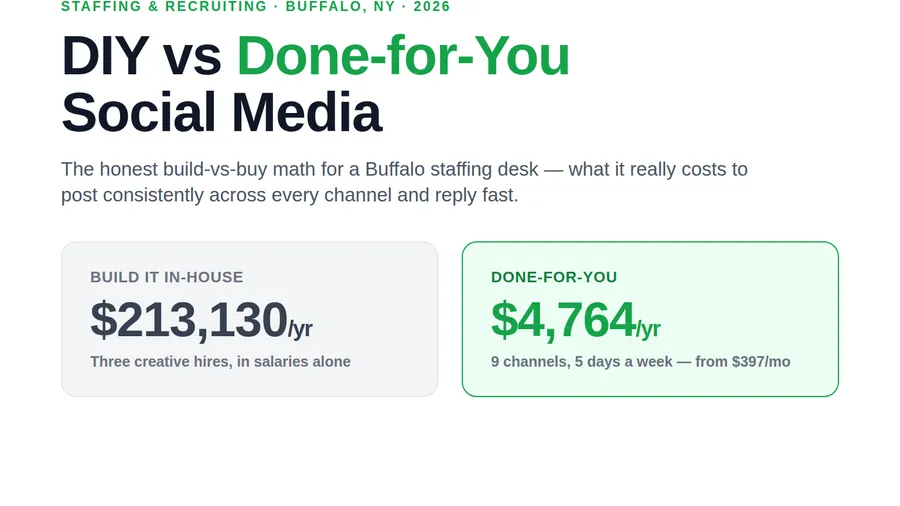
The honest reason most Philadelphia recruiters don’t fix this themselves is that doing it right is a whole team’s worth of work. To run social the way it actually pays off, you need a graphic designer, a video editor, a social media manager, and a community manager who replies within minutes. Hiring even one of those in-house isn’t cheap — the average U.S. social media manager earns around $71,500 a year (Glassdoor), and that’s one seat of the four you’d need.
That’s the gap a done-for-you recruiting social service closes. Instead of another hire, you get the whole function as a system: a weekly content set written in your agency’s voice (a Q&A text post, an image, two carousels, and a short reel), published 5 days a week across all 9 channels, plus three AI agents that reply to comments, answer DMs, and handle your website chat — qualifying candidates and hiring managers and booking calls straight to your calendar. Every lead lands in one CRM you can log into. It’s built specifically for staffing and recruiting, not a generic small-business social package.
The point isn’t to turn you into an influencer. It’s to make sure that when a Philadelphia candidate or client goes looking — and 58% of them look before they apply — your agency is the one that’s visibly active, on-brand, and answers in seconds.
How this plugs into GoHighLevel
Social recruiting only pays off if the conversation it starts lands somewhere it can be worked. That’s where GoHighLevel comes in, and why this pairs with the rest of your stack instead of bolting on beside it.
Every comment reply, DM, and web-chat conversation the AI agents run drops the candidate or hiring manager — with their name, phone, and the full thread — straight into your GHL pipeline. From there the Hiring Snapshot takes over: it captures TCPA consent, qualifies against the req, and books the interview onto your calendar automatically. The AI chat widget catches the traffic that lands on your site, and Instagram and Facebook auto-DM automations turn a comment keyword into a booked call. Social is the top of the funnel; GoHighLevel is the machine that closes it.
If you’d rather not touch any of it, a trained GoHighLevel VA can run the whole back end for you — the same way our get-a-website builds and GHL development work are meant to hand you the outcome, not the homework. And if you’re still filling your first clients, pair this with how to get clients for a staffing agency.
What social media won’t fix
We name limits honestly, because overselling social is how agencies waste six months. Here’s what it won’t do:
- It won’t work overnight. Organic reach compounds over roughly 3–5 months. A single reel can break out sooner, but anyone promising viral results next week is lying. This is a compounding asset, not a slot machine.
- It won’t fix a broken offer. If your bill rates are uncompetitive or your candidate experience is poor, more visibility just spreads that faster. Social amplifies what’s true about your desk.
- It won’t replace relationships. For executive search and high-touch client work, referrals and reputation still carry the load. Social supports those relationships; it doesn’t substitute for them.
- It won’t stay compliant on its own. Every automated candidate touch still has to respect TCPA consent and EEOC fairness. The automation has to be built with that in mind — which is exactly how the Snapshot’s cadences are designed.
Used right, social is the most reliable, lowest-cost top-of-funnel a modern staffing agency has. Used as a vanity project, it’s a time sink. The difference is a system: consistent content, instant replies, and a CRM that actually works the leads.
Frequently asked questions
Why do staffing agencies lose candidates on social media?
Because candidates choose the recruiter who is visibly active and replies fast, not necessarily the one with the best roles. With 86% of job seekers using social media and 58% researching employers there before applying (CareerArc), a stale or empty feed signals a cold desk — and an unanswered comment or DM sends that candidate straight to a competitor who answered first.
How often should a Philadelphia staffing agency post on social media?
Active brands post roughly five days a week, close to once a day, because platforms reward consistency and bury sporadic accounts — Instagram engagement already fell 28% year over year in 2025 (Socialinsider). For recruiting, a steady weekly set of a Q&A post, an image, two carousels, and a short reel across every channel keeps you in the feed where candidates are.
How fast do I really need to reply to candidates on social?
As fast as possible — ideally minutes. Replying within 5 minutes instead of 30 makes you about 21x more likely to qualify a lead (MIT/InsideSales study), and 73% of consumers expect a response within 24 hours (Sprout Social). Since no recruiter can watch 9 channels at 8 p.m., an AI agent that answers, qualifies, and books instantly is what makes this realistic.
Is it worth paying for done-for-you social instead of doing it myself?
For most recruiting owners, yes — doing it right needs a designer, a video editor, a social manager, and a community manager, and one in-house social manager alone averages about $71,500 a year (Glassdoor). A done-for-you service delivers all four functions plus AI reply agents from $397/month, so you stay focused on placements.
Which social channels matter most for recruiting in Philadelphia?
All the big ones, because different candidates live in different apps — LinkedIn for hiring managers and professional roles, Instagram and TikTok for hourly and younger candidates, Facebook and Google Business Profile for local reach, plus YouTube, Pinterest, Threads, and Bluesky. The efficient move is to publish one branded content set to all 9 at once rather than betting on a single platform.
Does social media recruiting work for high-volume roles like warehouse and healthcare?
Especially well. Those are the high-turnover, high-volume categories that dominate Philadelphia’s labor market — education and health services added 28,400 jobs in a year (U.S. BLS) — and their candidates are heavily mobile and social-first. Short vertical video showing the actual work reaches people who were never scanning a job board.
About the author
Marcus Delgado is the Staffing Agency Growth Lead behind the Hiring Snapshot, based in Tampa, FL. He ran a light-industrial staffing desk before joining the snapshot team, and he thinks in placement economics — fill rates, redeploys, gross margin per requisition. His posts lean on real desk math, not vanity metrics, and he’s happiest when a recruiter stops paying per applicant and starts getting inbound instead.
Related reading
- Short-Form Video for Charlotte Staffing Agencies: The Reels & TikTok Recruiting Playbook (2026)
- Instagram & Facebook Auto-DM for Miami Recruiting Agencies
- How to Get Clients for a Staffing Agency: The 2026 Client-Acquisition Playbook
- Why Recruiters Lose Candidates — and How to Stop the Leak
- SMS-First Recruiting: Why Email-Only Agencies Are Losing the 2026 Talent Market
Want your Philadelphia staffing agency to be the loud, fast one candidates trust? See the done-for-you social plan, book a walkthrough, or have a trained GHL VA run it for you.