· Adrienne Boyd · Field Reports · 16 min read
Astro vs GoHighLevel Websites for Dallas Staffing Agencies: Page Speed & SEO Compared (2026)
A Dallas staffing agency's website is its fastest-loading recruiter — or its slowest. Here's the honest Astro vs GoHighLevel comparison on page speed, SEO, and cost, with the real data on what a slow site costs your desk.
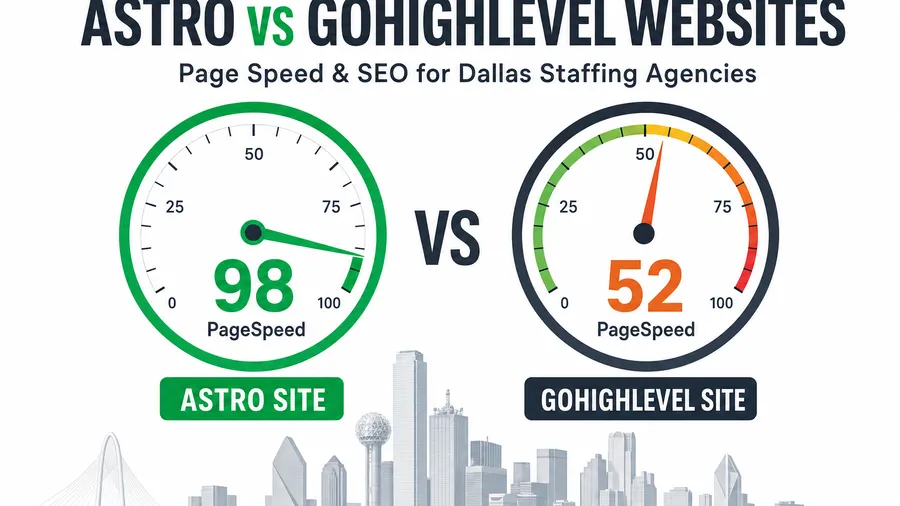
Short answer: build your public marketing website on Astro (or another static framework) and keep GoHighLevel for what it’s genuinely great at — the CRM, pipelines, calendars, and SMS/email automation behind the scenes. A GoHighLevel funnel or site builder is fine for a quick landing page, but as your main website it ships a heavy client-rendered JavaScript bundle that drags mobile PageSpeed down, and it fights you every time you need to edit a title, add schema, or spin up a location page. For a Dallas staffing agency competing for both candidates and job orders on Google, that speed-and-SEO gap is lost placements. This is the honest, numbers-first comparison — page speed, Core Web Vitals, local SEO, editability, and cost — including where GoHighLevel actually wins.
Key takeaways
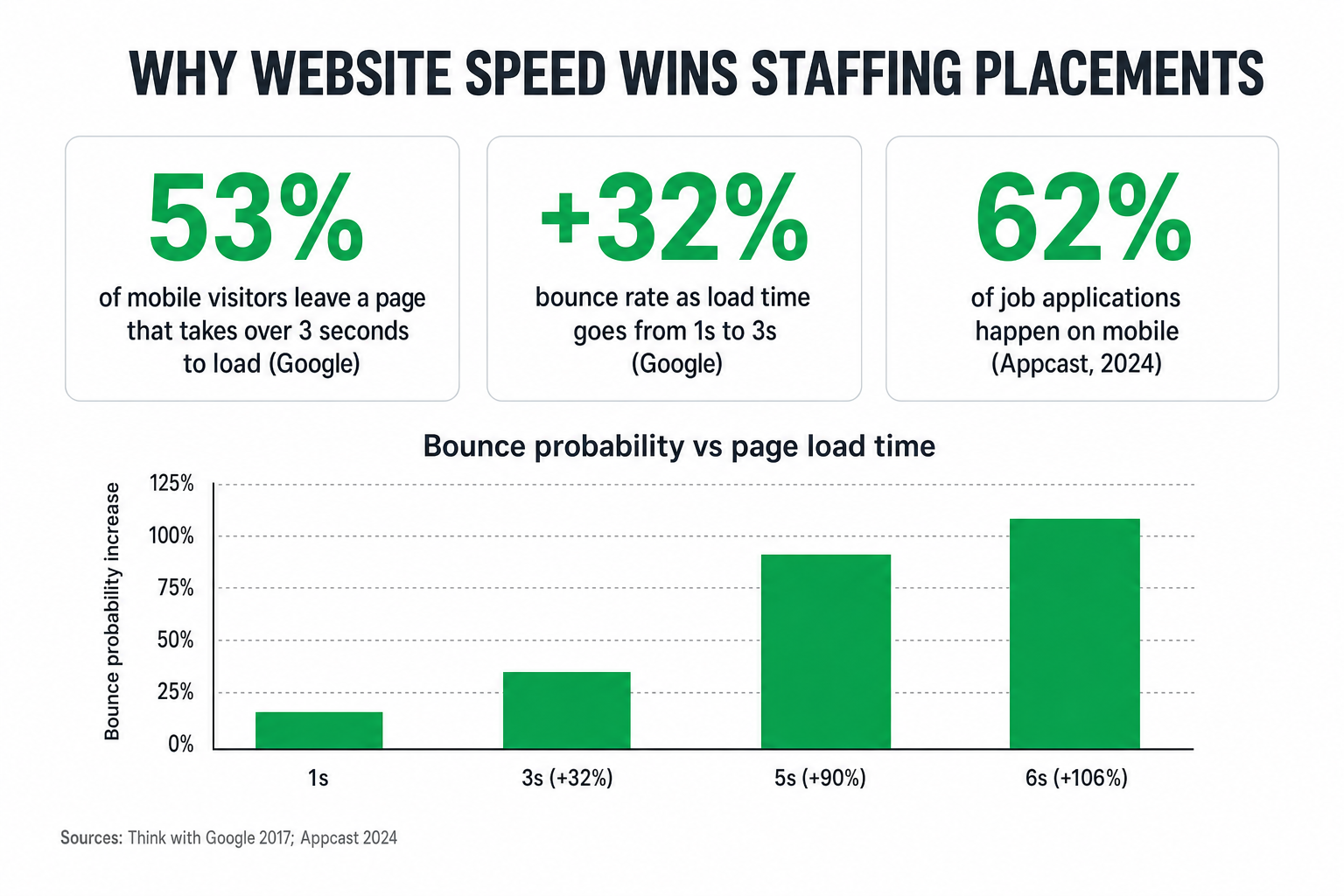
- Speed is a placement lever, not a vanity metric. As mobile load time goes from 1s to 3s, the probability a visitor bounces rises 32% (Think with Google); 53% of mobile visits are abandoned when a page takes over three seconds (Google / Marketing Dive).
- Astro is fast by default; GHL is heavy by default. Astro ships near-zero JavaScript and static HTML from the edge. The median WordPress/page-builder page now weighs 2,000–3,300 KB (HTTP Archive Web Almanac 2024); heavy client-rendered platforms like GHL’s builder carry similar or larger payloads.
- Your candidates are on phones. 62% of job applications were submitted on mobile in 2023 (Appcast 2024) — exactly where a slow site hurts most.
- Core Web Vitals are a Google ranking signal. Page-experience signals (LCP, CLS, INP) officially factor into ranking (Google Search Central) — and a fast site clears them more easily.
- Editability and schema decide SEO/AEO. Astro lets you control every title, meta description, JSON-LD block, and per-city location page. GHL’s builder makes deep meta/schema/
llms.txtwork awkward — GHL itself acknowledges page-speed as a known constraint (GHL help doc).- Where GHL wins: it’s already in your stack, non-technical staff can edit it, and it wires directly to your CRM/automation with zero glue. For a fast internal landing page, that’s a real advantage.
Table of contents
- Why website speed decides placements in Dallas
- What each option actually is
- Page speed head-to-head
- The conversion math: what a slow site costs a Dallas desk
- Why page-builder sites are heavy — and Astro isn’t
- SEO & AEO: editability, schema, and location pages
- Feature comparison
- Where GoHighLevel genuinely wins
- Where an Astro site wins
- Local SEO for a Dallas staffing agency
- How to decide
- FAQ
Why website speed decides placements in Dallas
Dallas–Fort Worth is one of the densest staffing markets in the country — light-industrial, healthcare, logistics, and IT contract desks all competing for the same candidates and the same job orders. When a warehouse manager searches “staffing agency in Dallas” or a nurse looks for “healthcare recruiter near me,” your website has about three seconds to load before they’re gone.
That isn’t a figure of speech. Google’s mobile benchmark data found that 53% of mobile site visits are abandoned if a page takes longer than three seconds to load, and that as load time climbs from one second to three, the probability of a bounce increases by 32% (Think with Google). Push to five seconds and bounce probability rises 90%.
For a staffing desk, a bounce isn’t an abstract metric — it’s a candidate who applied with your competitor instead, or a hiring manager who filled the req somewhere faster. And your audience is overwhelmingly mobile: 62% of job applications were submitted on a phone in 2023, with gig and hourly roles hitting 86% (Appcast 2024 Recruitment Marketing Benchmark Report). The slowest, heaviest version of your site is exactly the one most of your candidates see.
What each option actually is
This distinction decides everything, so it’s worth being precise.
A GoHighLevel website is built inside GHL’s drag-and-drop funnel/site builder. It renders pages largely in the browser from a sizable JavaScript bundle, and it’s designed to be edited by non-technical users inside the GHL dashboard. Its strength is integration: a form on a GHL page drops a contact straight into your pipeline and fires your automations with no glue code. Its weakness is that it was built for quick funnels, not for a fast, deeply-optimized marketing site — GoHighLevel itself publishes guidance and carries open feature requests acknowledging that funnel/website page speed is a known constraint (GHL help doc, GHL Ideas).
An Astro website is built on the Astro framework, which renders your pages to static HTML at build time and ships almost no JavaScript to the browser by default. Pages are served from a global CDN edge, so they open in a blink. You control every byte: titles, meta descriptions, JSON-LD schema, canonical tags, per-city location pages, sitemap.xml, robots.txt, and llms.txt. The trade-off is that it’s a developer-built site — you don’t edit the layout by dragging boxes; a change goes through a build. That’s exactly what our Get a Website service exists to handle for agencies that don’t want to touch code.
So the fair framing isn’t “GoHighLevel is bad.” It’s “an integrated funnel builder” vs. “a purpose-built, speed-and-SEO-first marketing site.” One optimizes for in-dashboard editability and CRM proximity; the other optimizes for load speed, search visibility, and control.
Page speed head-to-head
Run Google PageSpeed Insights on a typical GoHighLevel funnel page and a typical static Astro page and the pattern is consistent: heavy client-rendered builders (GHL, and most WordPress page-builder stacks) commonly land in the 40–65 range on mobile, while a lean static Astro build regularly scores 90–100. On our own Get a Website builds we guarantee a 90+ PageSpeed score — often a perfect 100 — because static-first architecture makes that achievable by design, not by heroics.
Why the gap is structural, not incidental: a GHL page has to download, parse, and execute a large JavaScript bundle before it can render meaningfully. An Astro page is already HTML — the browser paints it immediately and hydrates only the tiny interactive bits (if any). On a mid-range Android phone on Dallas 4G, that difference is the three-second cliff Google measured above.
And speed now feeds ranking directly. Google’s Core Web Vitals — Largest Contentful Paint, Cumulative Layout Shift, and Interaction to Next Paint — are an official page-experience ranking signal (Google Search Central). A static Astro site clears those thresholds far more easily than a JavaScript-heavy builder page, so the fast site isn’t just converting better — it’s ranking higher to begin with.
The conversion math: what a slow site costs a Dallas desk
Speed isn’t a feeling — it’s measurable revenue. The most rigorous public study, Deloitte and Google’s Milliseconds Make Millions, found that a 0.1-second improvement in mobile site speed increased retail conversion rates by 8.4% and lifted average order value by 9.2% across 37 brands (web.dev case study). Portent’s analysis of roughly 94 million page views found that a B2B page loading in one second converts about three times higher than one loading in five seconds (Portent).
Translate that to a Dallas staffing desk. Say your site sends you 40 candidate applications and 8 employer inquiries a month from search. If a slow, builder-based site is quietly costing you even a third of that traffic to bounces before the page renders — a conservative read of the 32%-more-bounce figure — you’re losing roughly 13 applications and 2–3 employer conversations every month, forever, to load time you could have fixed once. At a typical placement fee, a single recovered job order pays for a fast website many times over.
This is precisely why our Get a Website offer leads with a guaranteed 90+ PageSpeed rather than a prettier template: the speed is the ROI.
Why page-builder sites are heavy — and Astro isn’t
The speed gap traces back to how much code the page has to load. The HTTP Archive Web Almanac’s 2024 data shows how bloated the typical builder page has become: the median WordPress page weighs about 2,252 KB on desktop; Wix around 2,560 KB; Squarespace about 3,323 KB (Web Almanac 2024, CMS). The median page ships around 600 KB of JavaScript, and jQuery still loads on 74% of pages (Web Almanac 2024, JavaScript) — most of it dragged in by themes, plugins, and page builders.
GoHighLevel’s site builder sits in the same weight class: it’s a client-rendered app that has to boot in the browser. Astro takes the opposite approach — it strips unused JavaScript at build time and ships static HTML, so a lean recruiting site can come in a fraction of that page weight. Less to download means a faster first paint, which means fewer bounces and better Core Web Vitals.
SEO & AEO: editability, schema, and location pages
Speed gets you ranked; structure gets you found and quoted. This is where an Astro site pulls decisively ahead for a staffing agency that wants Google — and AI answer engines like ChatGPT, Perplexity, and Google’s AI Overviews — to surface it.
On an Astro site you control, cleanly and per-page:
- Every title and meta description — keyworded for “Dallas staffing,” “light-industrial recruiter Fort Worth,” and so on, not locked to a builder template.
- Valid JSON-LD schema —
LocalBusiness,Service,FAQPage,BreadcrumbList— the structured data that makes you eligible for rich results and easy for AI engines to cite. - A real location-page architecture — a distinct, individually-optimized page for every city and specialty you staff (Dallas, Fort Worth, Arlington, Plano; light-industrial, healthcare, IT). This is the single biggest lever for local recruiting visibility.
sitemap.xml,robots.txt, andllms.txtgenerated automatically, so both search crawlers and AI crawlers can read your whole site.
GoHighLevel’s builder can do basic SEO fields, but deep, per-page meta and schema control, and a scalable location-page system, are exactly the kind of work it makes awkward — and manual llms.txt maintenance is on you. When your visibility depends on getting all of this exactly right at scale, a framework built for it beats a builder that tolerates it. (For the automation behind those pages — the AI chat widget, review harvesting, CRM — GHL is still the right engine; see our GHL development work.)
Feature comparison
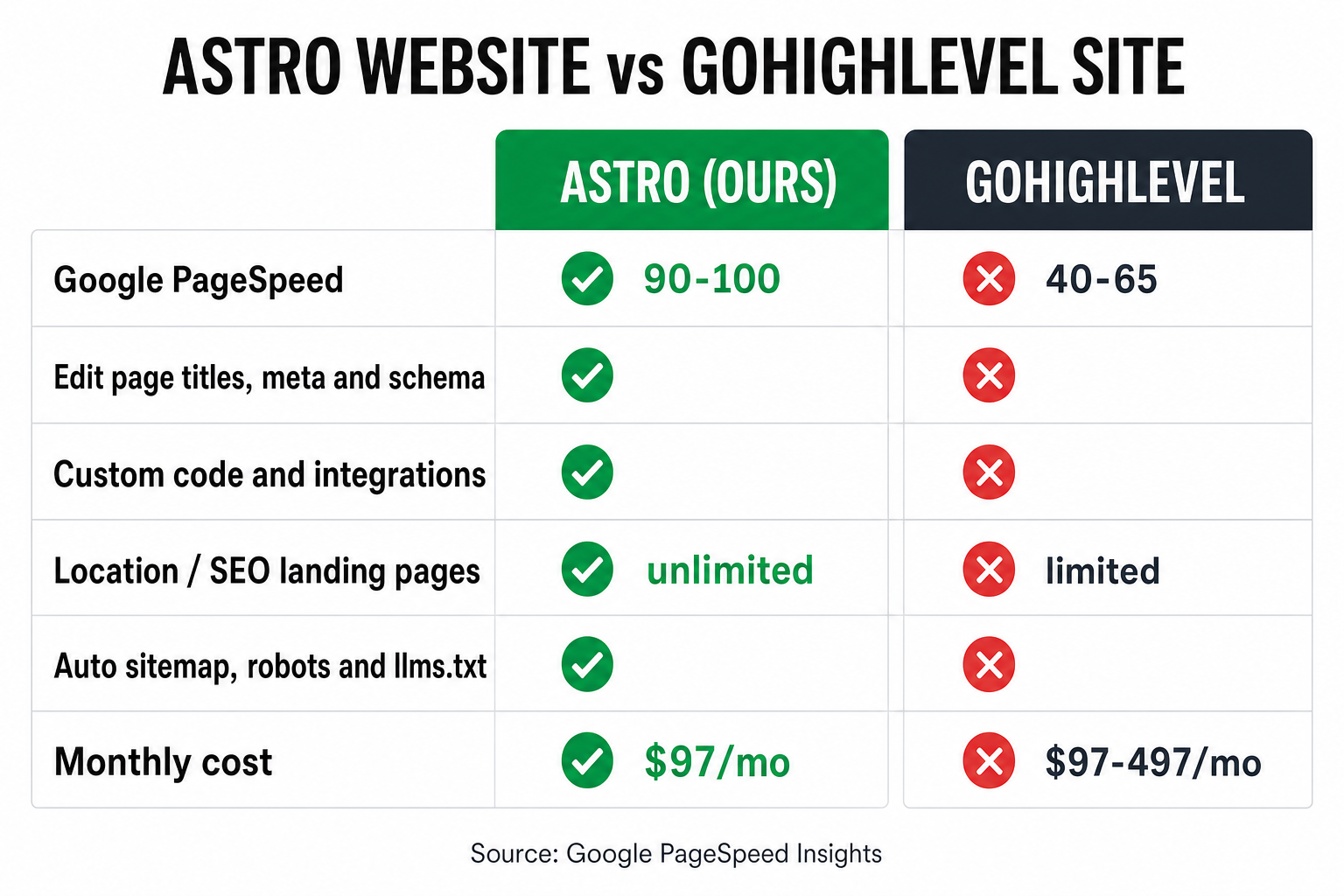
A fair side-by-side for a staffing agency’s public marketing website.
| Capability | Astro site | GoHighLevel site |
|---|---|---|
| Google PageSpeed (mobile) | 90–100 (static, edge-served) | Commonly 40–65 (client-rendered) |
| Core Web Vitals pass rate | Clears easily | Harder on heavy pages |
| Edit titles / meta / canonical per page | Full control | Basic fields |
| Valid JSON-LD schema at scale | Full control | Limited / manual |
| Location & specialty SEO pages | Unlimited, individually optimized | Awkward to scale |
Auto sitemap / robots / llms.txt | Built-in | Manual / partial |
| Custom code & integrations | Anything | Constrained to the builder |
| Non-technical in-dashboard editing | Via a managed service | Native drag-and-drop |
| Native CRM / pipeline / automation wiring | Via forms + API | Built-in, zero glue |
| Best role | Public marketing site | Internal funnels + the CRM engine |
The pattern is clear: Astro wins the public, search-facing website; GoHighLevel wins the CRM, automation, and quick internal funnels behind it. The smartest staffing setups use both — a fast Astro marketing site out front, feeding a GoHighLevel back end.
Where GoHighLevel genuinely wins
We name tools honestly. GoHighLevel is excellent at several things, and if these are your priority, a GHL page is the right call:
- It’s already in your stack. If you run your recruiting on GHL, a landing page that lives in the same account needs zero integration — the form-to-pipeline handoff is instant.
- Non-technical editing. Your coordinator can change a headline or swap an image in the dashboard without a developer. For a fast-moving internal campaign page, that speed of iteration matters.
- Perfect for funnels and campaigns. A single-purpose landing page for a job fair, a paid-ads campaign, or a client-facing offer is exactly what the builder was made for. It doesn’t need to rank; it needs to convert a known audience.
- Automation proximity. SMS/email cadences, calendars, and workflows fire directly off page actions with no middleware.
If your only web presence is a couple of campaign funnels feeding your CRM, GoHighLevel is fine — don’t over-engineer it. The trade this article recommends is specifically about your main, search-facing marketing website, where speed and SEO decide whether Dallas even finds you.
Where an Astro site wins
For that main marketing site, the automation-and-speed math tips hard toward static:
- Guaranteed 90+ PageSpeed, often 100 — fast on the mid-range Android phones most Dallas candidates actually use.
- Better rankings and richer results from clean Core Web Vitals, per-page schema, and a real location-page system.
- AEO/GEO-ready — structured so AI answer engines can quote you, not just Google’s blue links.
- No plugin bloat, no surprise bills — no plugin renewals, no “$150/hr for a one-line edit,” and managed edge hosting included.
- A better-looking, trust-building site — first impressions decide whether a candidate trusts you with their career or a manager trusts you with their req.
Crucially, none of this means leaving GoHighLevel. The Astro site feeds your GHL back end — its forms drop candidates and employers straight into your pipeline, where the Hiring Snapshot qualifies them in seconds and books interviews. You get the fast front door and the automated engine. If you’d rather someone run the GHL side for you, that’s what a dedicated GHL VA is for.
Local SEO for a Dallas staffing agency
Local intent is where speed and structure compound. Google found that 76% of people who run a “near me” search on their phone visit a related business within a day, and 28% of those searches lead to a purchase (Think with Google). For “staffing agency Dallas” or “warehouse recruiter near me,” that’s a candidate or client ready to act today — if your page loads and your local signals are clean.
An Astro site lets you build the exact structure that local search rewards: a dedicated, fast page for Dallas, Fort Worth, Arlington, Irving, and Plano, each with its own LocalBusiness/Service schema, areaServed markup, and locally-worded copy about the roles you fill there. That per-city depth — plus 90+ PageSpeed on mobile — is how a local recruiting firm wins the map. It’s the same playbook we use for clients in our Get a Website builds, and it pairs naturally with the client-acquisition system in how to get clients for a staffing agency.
How to decide
Skip the feature-checklist paralysis and answer these in order:
- Is this your main, search-facing website or a single campaign funnel? Main site that must rank in Dallas → Astro. One-off funnel feeding your CRM → GoHighLevel is fine.
- How much of your traffic is mobile? Most of it (and for staffing, it’s the majority) → speed matters enormously → Astro.
- Do you need per-city location pages and deep schema? Yes → Astro’s editability wins. No, just a homepage → the gap narrows.
- Who edits it, how often? Constant in-dashboard edits by non-technical staff → GHL’s builder is convenient. Occasional, professionally-managed updates → a managed Astro site removes the bloat and the surprise bills.
- Where does the lead go? Either way, into GoHighLevel. That’s the point — the Astro site is the fast front door; GHL is the engine room.
For most Dallas staffing agencies, the answer is both, in their right roles: a fast Astro marketing site that Google and AI engines love, feeding a GoHighLevel back end that qualifies and books candidates automatically. You stop losing placements to a three-second load, and you keep every automation you already rely on.
Frequently asked questions
Is a GoHighLevel website bad for SEO?
Not inherently — GHL pages can rank — but they start at a disadvantage. The builder produces heavy, client-rendered pages that commonly score lower on mobile PageSpeed, and Core Web Vitals are an official Google ranking signal (Google Search Central). Deep per-page meta, schema at scale, and a large location-page architecture are also harder in the builder. For a single funnel it’s fine; for a main marketing site that must rank locally, a static Astro site has structural advantages.
How much faster is an Astro site than a GoHighLevel site?
Astro renders static HTML and ships almost no JavaScript, so it typically scores 90–100 on Google PageSpeed, while heavy client-rendered builders (GHL and most WordPress page-builder stacks) commonly land in the 40–65 range on mobile. Since 53% of mobile visitors abandon a page that takes over three seconds to load (Think with Google), that difference directly affects how many candidates and clients you keep.
Do I have to leave GoHighLevel to get a fast website?
No — and you shouldn’t. The best setup is a fast Astro marketing site out front, feeding your GoHighLevel back end. The Astro site’s forms drop contacts straight into your GHL pipeline, where your automations, calendars, and the Hiring Snapshot take over. You keep every workflow you rely on and add a front door that loads instantly and ranks.
Why does website speed matter so much for a staffing agency specifically?
Because your audience is mobile and impatient: 62% of job applications happen on a phone (Appcast 2024), and as mobile load time rises from one to three seconds, bounce probability climbs 32% (Think with Google). In a competitive market like Dallas, the first agency whose site actually loads usually gets the candidate or the job order.
What does a fast Astro staffing website cost?
Our Get a Website service is $497 one-time plus $97/month, which covers a guaranteed 90+ PageSpeed Astro build, per-city location pages, schema/AEO/GEO, an AI chat widget, review automation, and managed Cloudflare hosting (domain, SSL, and maintenance included). Add auto-blogging for $197/month total, or up to five sites for $1,200 one-time plus $297/month for multi-brand or multi-location agencies.
Can an Astro site have location pages for every city I staff?
Yes — that’s one of its biggest advantages. You get a distinct, individually-optimized, fast-loading page for each city and specialty (Dallas, Fort Worth, Arlington, Plano; light-industrial, healthcare, IT), each with its own LocalBusiness/Service schema and areaServed markup. That per-city depth is the single strongest lever for local recruiting visibility.
About the author
Adrienne Boyd is the Recruiting Automation Strategist behind the Hiring Snapshot, based in Austin, TX. She spent a decade building applicant-capture funnels and SMS-first nurture cadences for staffing agencies before moving full-time into GoHighLevel automation. She writes the playbooks and field reports, and she is happiest when a slow, manual process collapses into a single fast trigger.
Related reading
- GoHighLevel vs Bullhorn for Staffing Agencies (2026): An Honest Comparison
- How to Get Clients for a Staffing Agency: The 2026 Client-Acquisition Playbook
- SMS-First Recruiting: Why Email-Only Agencies Are Losing the 2026 Talent Market
- How to Reduce Time-to-Fill: The GoHighLevel Playbook
- Staffing Industry Benchmarks 2026: The Recruiting Metrics That Actually Matter
Want a staffing website that loads in a blink and ranks in Dallas? Get a faster website, see how the Hiring Snapshot works, or have a trained GHL VA run it for you.