· Adrienne Boyd · Field Reports · 15 min read
GoHighLevel Custom Development for Raleigh Staffing Agencies: When a Half-Built CRM Costs You Placements (2026)
A half-built GoHighLevel doesn't announce itself — it just quietly leaks placements through broken triggers, double data entry, and reports leadership can't trust. Here's what that costs a Raleigh staffing desk, with sourced data, and where custom GHL development pays for itself.
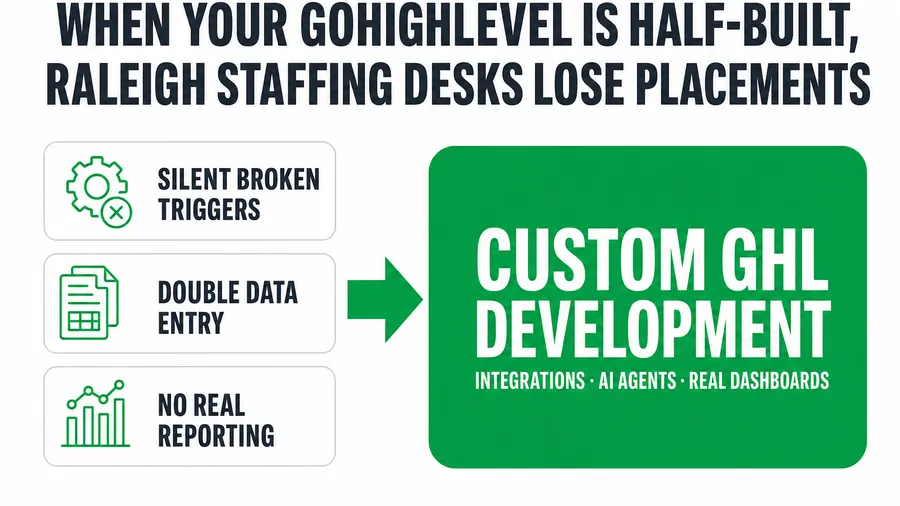
Short answer: if your Raleigh staffing agency runs on a GoHighLevel account that’s half-built — triggers that silently stop firing, candidate data retyped between GHL and your ATS, and dashboards nobody trusts — you don’t have a software problem, you have an unfinished build. The fix isn’t another off-the-shelf snapshot or a third-party bot; it’s targeted custom GoHighLevel development that wires your job boards, ATS, background-check, and payroll systems into one pipeline, replies to candidates in minutes, and reports the numbers your leadership actually runs on. This is the honest breakdown of what a half-built CRM costs a Triangle staffing desk — with sourced data — and where a custom build is worth the money.
Key takeaways
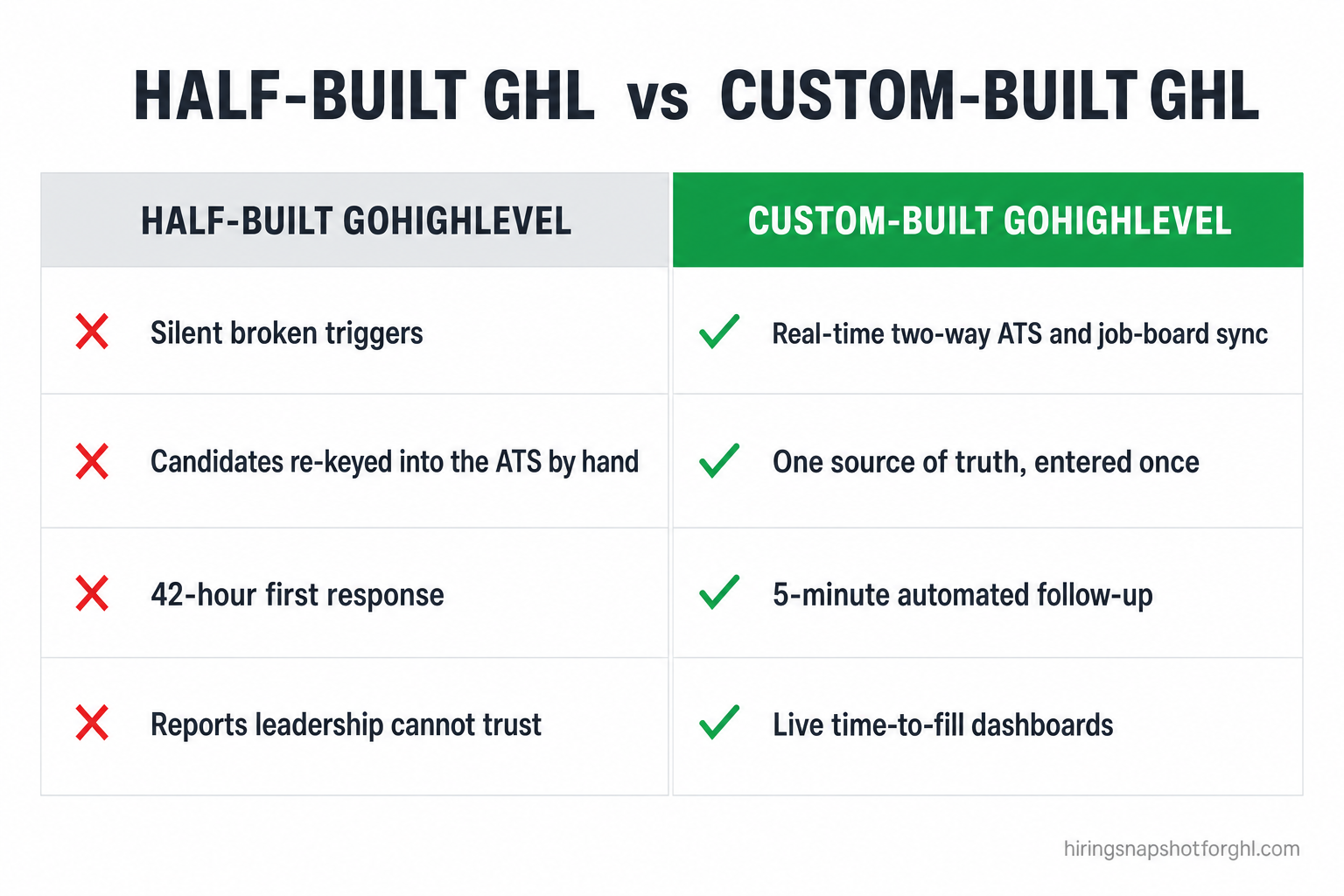
- Speed is the placement, and a half-built CRM is slow. Responding to a web lead in 5 minutes instead of 30 makes you 21× more likely to qualify it (MIT / InsideSales Lead Response Management study). Yet the average company’s first response takes 42 hours, and only 37% reply within an hour (Harvard Business Review).
- Double data entry is the tax. Knowledge workers lose about 17.3 hours a week to manual, automatable tasks — and moving data from one app to another is the single most-dreaded one (Zapier). Every unlinked system on your desk is that tax, running.
- Your closers aren’t closing. Sales professionals spend under 30% of their week actually selling; the rest disappears into admin and data entry (Salesforce). Recruiting on a broken CRM is worse.
- Slow, blind desks fill roles later. Median time-to-fill now sits near 44 days and has climbed meaningfully since 2021 (SHRM 2025 Benchmarking), with an average cost-per-hire of $4,129 (SHRM).
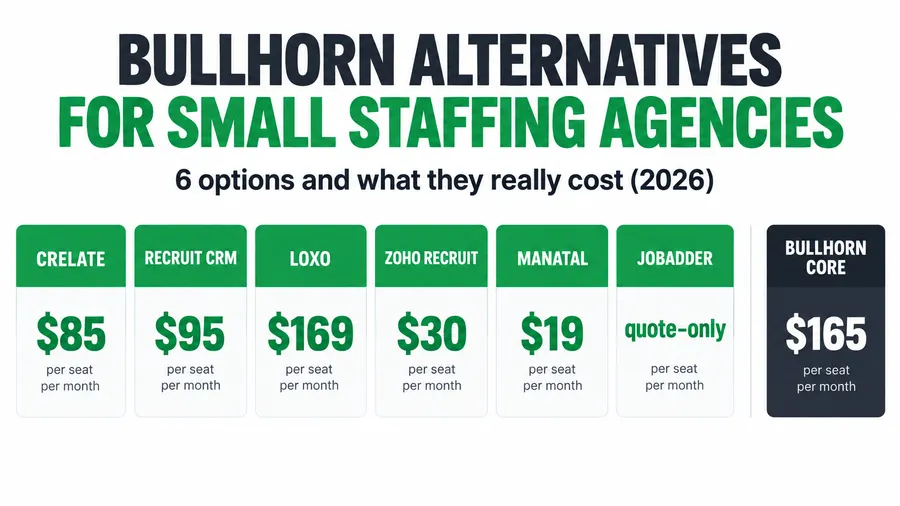
- The fix is a build, not a bandage. Custom GHL development connects any platform (Bullhorn, JobAdder, Crelate, Loxo, LinkedIn Recruiter, VMS, job boards, background-check and payroll) two-way, adds custom AI recruiter agents and real dashboards, and is scoped per desk — get a quote.
Table of contents
- The real problem: your GoHighLevel is half-built
- Pain point 1: automations that silently half-work
- Pain point 2: double data entry between disconnected tools
- Pain point 3: leadership is flying blind
- Pain point 4: the DIY and off-the-shelf trap
- What custom GoHighLevel development actually builds
- Why this hits Raleigh staffing desks especially hard
- When to invest in custom development
- FAQ
The real problem: your GoHighLevel is half-built
Almost every staffing agency we meet in the Raleigh–Durham Research Triangle is already on GoHighLevel. They bought a snapshot, watched a few setup videos, wired up the obvious pieces, and went live. That’s the trap. GoHighLevel is powerful enough that a half-configured account still works — candidates come in, some texts go out, a pipeline exists — so nobody calls it broken. It just quietly underperforms.
A half-built CRM doesn’t crash. It leaks. A trigger stops firing after a workflow edit and no one notices for three weeks. A candidate who applied through Indeed lands in GHL but not in your ATS, so a recruiter re-keys them by hand. Your “time-to-fill” report is a spreadsheet someone updates on Fridays, so leadership is always looking at last week. None of these show up as an error message. They show up as placements your competitor made instead.
The instinct is to blame the software, or to buy another tool to paper over the gap. Both are wrong. GoHighLevel is fully capable of running a modern staffing desk — but only when the account is finished: integrated with the systems around it, automated end to end, and reporting in real time. Getting from “half-built” to “finished” is exactly what custom GHL development is for. Let’s put real numbers on the four pain points that unfinished build creates.
Pain point 1: automations that silently half-work
In staffing, the first agency to respond usually wins the candidate and the job order. The data on response speed is brutal, and it’s the exact thing a half-built automation quietly breaks.
The landmark Lead Response Management study (Dr. James Oldroyd with MIT Sloan and InsideSales, spanning 15,000+ leads and 100,000+ dial attempts) found that contacting a web lead within 5 minutes instead of 30 made a firm 21× more likely to qualify that lead into a real conversation. Wait longer and the odds fall off a cliff. Yet the Harvard Business Review audit of 2,241 U.S. companies found the average first-response time was 42 hours, only 37% responded within an hour, and 24% took more than a day or never responded at all.
A finished GoHighLevel build closes that gap automatically: the second a candidate applies, an SMS acknowledgement, a qualification survey, and a booked interview slot fire — no recruiter required. But a half-built account is exactly where that promise breaks. A workflow that was never tested against every entry source, a trigger that silently stopped after an edit, an A2P registration that lapsed so texts quietly fail — these are the failures that turn a “5-minute” system back into a 42-hour one without anyone realizing. Custom development is where those automations get built defensively, monitored, and hardened so speed-to-lead is a guarantee, not a hope. It’s the same engine behind a real ATS pipeline and SMS-first nurture cadences — only finished.
Pain point 2: double data entry between disconnected tools
Here’s the most expensive habit on a half-built desk: retyping the same candidate into two systems. The applicant hits your job board, gets pulled into GHL, then a recruiter re-keys them into Bullhorn or your VMS — and re-keys the status change back the other way an hour later. Multiply that by every req, every day.
The cost is measurable. Zapier’s research on 1,000 U.S. knowledge workers found they lose an average of 17.3 hours a week — nearly half the work week — to manual tasks that could be automated, and named moving information from one app to another the single most-dreaded task of all. Separately, 94% of workers report doing repetitive, time-consuming tasks in their role (Zapier State of Business Automation, 2021). And this isn’t wishful thinking about automation: McKinsey found about 60% of all occupations have at least 30% of their activities automatable with existing technology. Data re-entry between GHL and your ATS is squarely in that 30%.
That lost time lands directly on your closers. Salesforce’s State of Sales research found sales professionals spend less than 30% of their week actually selling — the rest evaporates into admin, data entry, and internal meetings. Recruiting is a sales job with a candidate on the other end, and every disconnected system makes that ratio worse.
The fix is a two-way integration, not more discipline. When custom development wires GHL and your ATS/VMS together over their APIs, a candidate is entered once and stays in sync everywhere — recruiters work in GHL, records stay current in Bullhorn or JobAdder automatically, and the 17.3 hours come back. This is the exact problem our connect-any-platform integrations solve; it’s also why agencies that have outgrown a duct-taped stack often choose to migrate fully onto GoHighLevel or wire up Indeed and ZipRecruiter directly.
Pain point 3: leadership is flying blind
Ask a staffing owner running a half-built GHL “what’s your time-to-fill by source this month?” and you’ll usually get a pause, then a spreadsheet. That pause is the third pain point: the numbers leadership runs on don’t exist inside the system, so decisions get made on gut and stale exports.
It matters because the metrics are moving in the wrong direction industry-wide. SHRM’s 2025 benchmarking puts median time-to-fill near 44 days, up meaningfully since 2021 (SHRM), with an average cost-per-hire of $4,129 (SHRM). You cannot shorten a number you cannot see. Time-to-fill by source, submittals per recruiter, placement velocity, and redeployment rate are the levers that actually move margin — and on a half-built desk they’re invisible until the quarter is already over.
Off-the-shelf GHL reporting wasn’t built for staffing economics, and a spreadsheet updated on Fridays isn’t a dashboard. Custom development pulls GHL and your ATS data together into live dashboards that show those exact numbers as they happen — the same reporting layer we describe on the GHL development page and build into the high-volume recruiting stack. When leadership can see time-to-fill by source in real time, they can reallocate spend this week instead of next quarter.
Pain point 4: the DIY and off-the-shelf trap
When a desk finally admits the build is unfinished, two tempting shortcuts appear — and both usually deepen the hole.
The DIY route: the owner or a general VA tries to finish it themselves between placements. But GoHighLevel workflow logic, A2P 10DLC compliance, API integrations, and custom objects are a genuine engineering skill, and the person best at closing placements is rarely the person who should be debugging a webhook. The build limps along, half-finished in a new way.
The off-the-shelf bot route: bolting a generic chatbot or scheduler onto the site. But, as our development team puts it, off-the-shelf bots “don’t understand roles, pay ranges, shift patterns, or compliance.” A bot that can’t qualify a CNA against a night-shift requirement or capture TCPA consent correctly just creates a faster path to the wrong outcome.
The honest version of the fix is a scoped build by people who live in both GoHighLevel and recruiting. That’s the entire reason a custom GHL development service exists — and where it differs from simply hiring a GHL VA to run an already-finished system. For context on how much GoHighLevel serious operators are building on: HighLevel reported that businesses on its platform generated over $7 billion in ecosystem value in 2025 (HighLevel’s own figure, company release). The platform is deep enough to run your whole desk; the question is whether your account is built to use that depth.
What custom GoHighLevel development actually builds
“Custom development” sounds vague until you see the concrete list. On a staffing desk, finishing the build usually means some combination of these:
- Connect any platform, two-way. Real-time integrations between GHL and Bullhorn, JobAdder, Crelate, Ceipal, Loxo, LinkedIn Recruiter, your VMS, job boards, and background-check and payroll vendors — so a candidate is entered once and stays in sync everywhere. No more double-entry.
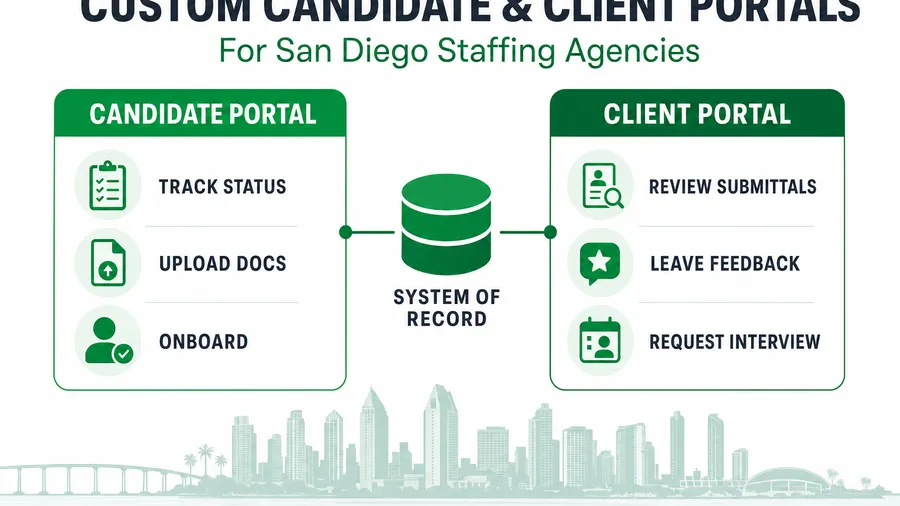
- Custom GHL software GHL doesn’t ship. Candidate portals, client hiring portals, placement and commission dashboards, and custom qualification flows built to your exact spec — the kind of build we cover in custom recruiting software.
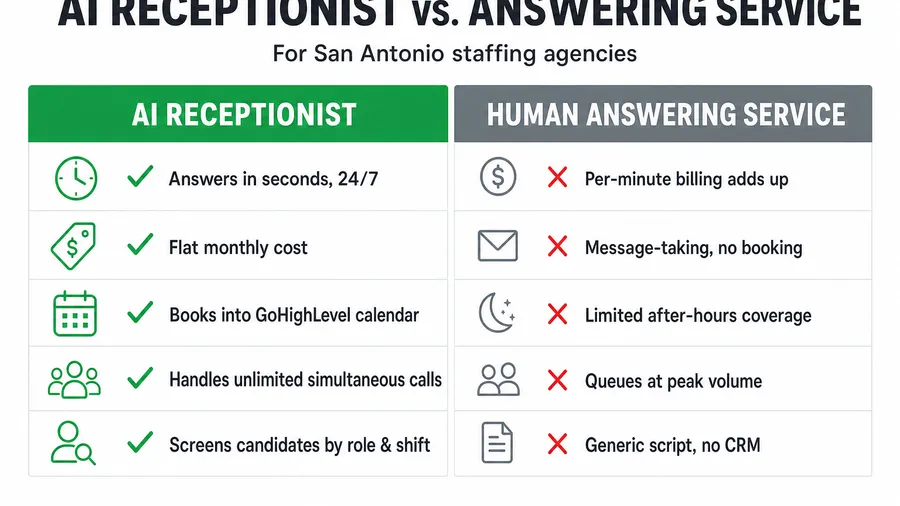
- Custom AI recruiter agents. A voice or chat agent trained on your roles, pay bands, shift patterns, and screening scripts — plugged straight into your GHL calendar and data — instead of a generic bot that can’t qualify anyone.
- Real dashboards. Time-to-fill by source, submittals per recruiter, placement velocity, and redeployment rate, pulled from GHL and your ATS together and delivered as live boards or scheduled reports.
- Clean migration. If your history is trapped in a legacy ATS, a field-mapped, deduplicated migration brings contacts, pipelines, notes, and placement history across intact — validated before go-live.
The point isn’t to bolt more on. It’s to finish the system so it runs the way GoHighLevel is capable of running — and so your recruiters only ever touch it to work the candidates it surfaces.
Why this hits Raleigh staffing desks especially hard
Raleigh is one of the tightest, most competitive talent markets in the Southeast, and that makes an unfinished CRM more expensive here than in a slower metro. The Research Triangle — RTP, the universities, the hospital systems, and a dense life-sciences and tech corridor — runs on high-wage, hard-to-fill roles. Workers in the Raleigh–Cary metro earned an average of $34.01 an hour in May 2025, above the national average of $33.54 (U.S. Bureau of Labor Statistics). When the roles you fill are that valuable and that contested, a 42-hour response time or a candidate lost to double-entry isn’t a rounding error — it’s a placement fee gone.
The prize is large, too. The U.S. staffing industry generated about $124 billion in temporary and contract staffing sales in 2024, employed roughly 11.2 million temporary and contract workers over the year, and runs across roughly 27,000 firms and 54,000 offices nationwide (American Staffing Association). In a Triangle market moving that fast, the Raleigh agency whose GoHighLevel actually responds in minutes and reports in real time — because the build is finished — takes the placements the half-built desks fumble. It’s the same time-to-fill discipline we build every snapshot around, just wired end to end for your stack.
When to invest in custom development
Custom development isn’t the answer to every complaint about GoHighLevel. Run these questions in order:
- Is data being retyped between GHL and another system? If recruiters re-key candidates or statuses by hand, an integration pays for itself fast. Build it.
- Do automations “sometimes” work? Intermittent triggers, lapsed A2P, and untested entry sources are a finished-build problem, not a tuning problem.
- Can leadership see time-to-fill by source right now, in the system? If the answer is a spreadsheet, you need real dashboards.
- Are you trying to force GHL to do something it doesn’t ship? A portal, a commission dashboard, a niche qualification flow — that’s custom software, and duct tape won’t hold it.
- Is the account genuinely finished, just under-run? If the build is solid and the problem is that nobody has time to operate it, you may need a GHL VA, not development.
For most Raleigh desks that feel like GoHighLevel is “almost there but always slightly broken,” the honest diagnosis is an unfinished build — and the highest-ROI move is to finish it once, properly, so speed-to-lead, clean data, and real reporting stop being things you hope for and start being things the system guarantees.
Frequently asked questions
What is GoHighLevel custom development for a staffing agency?
It’s engineering work that finishes and extends your GoHighLevel account beyond what a standard snapshot ships: two-way integrations with your ATS, VMS, job boards, and background-check/payroll vendors; custom software like candidate and client portals; custom AI recruiter agents trained on your roles; real time-to-fill dashboards; and clean migrations from legacy systems. It turns a half-built account into a finished, connected recruiting system.
How is custom development different from hiring a GoHighLevel VA?
A VA operates your GoHighLevel day to day — working the pipeline, keeping cadences running, and handling admin. Custom development builds the system the VA operates: the integrations, automations, portals, and dashboards themselves. Many agencies do both — develop the finished build once, then staff a VA to run it.
Why is a half-built GoHighLevel so costly for a staffing desk?
Because staffing runs on speed and clean data, and a half-built account quietly breaks both. Responding in 5 minutes instead of 30 makes you 21× more likely to qualify a lead (MIT/InsideSales), yet silent trigger failures push real response times toward the 42-hour average (HBR). Meanwhile double data entry drains roughly 17.3 hours a week (Zapier) that should go to placements.
Can you connect GoHighLevel to Bullhorn or our VMS?
Yes. Two-way, real-time integrations between GHL and platforms like Bullhorn, JobAdder, Crelate, Ceipal, Loxo, LinkedIn Recruiter, your VMS, job boards, and background-check and payroll vendors are a core part of what custom development delivers — so candidates and job orders stay in sync and no one re-keys data.
How much does custom GoHighLevel development cost?
It’s scoped and quoted per build, because a single integration and a full custom-portal-plus-migration project are very different sizes of work. The fastest way to a real number is to book a call and walk us through your stack; we’ll scope it against your desk. See the full service on the GHL development page.
Does this only apply to Raleigh staffing agencies?
No — the pain points are universal to any staffing desk on a half-built CRM. We lead with Raleigh because the Triangle’s high-wage, high-competition market (BLS) makes the cost of a slow, disconnected system especially visible. The build we’d scope for a Raleigh desk works the same anywhere in the U.S.
About the author
Adrienne Boyd is the Recruiting Automation Strategist behind the Hiring Snapshot, based in Austin, TX. She spent a decade building applicant-capture funnels and SMS-first nurture cadences for staffing agencies before moving full-time into GoHighLevel automation. She writes the playbooks and field reports, and she is happiest when a “manual, three-person process” collapses into a single trigger.
Related reading
- GoHighLevel ATS: Building a Recruiting Pipeline That Runs Itself
- Connect Indeed & ZipRecruiter to GoHighLevel: The Houston Staffing Playbook
- Migrating a Staffing Agency to GoHighLevel: The New York City Guide
- Custom Recruiting Software for a Seattle Staffing Agency
- High-Volume Recruiting in GoHighLevel: The Automation Stack
Is your GoHighLevel almost there but always slightly broken? Get a custom GHL development quote, book a walkthrough, or see how the Hiring Snapshot works.