· Marcus Delgado · Field Reports · 17 min read
Staffing ATS Pricing in 2026: What Bullhorn, Crelate, Loxo and JobAdder Really Cost
Most recruiting software hides the real number until the demo. Here's a plain teardown of what a staffing ATS actually costs in 2026, the four fees nobody quotes you, and three-year totals for a solo desk, an 8-seat agency, and a 25-recruiter shop.
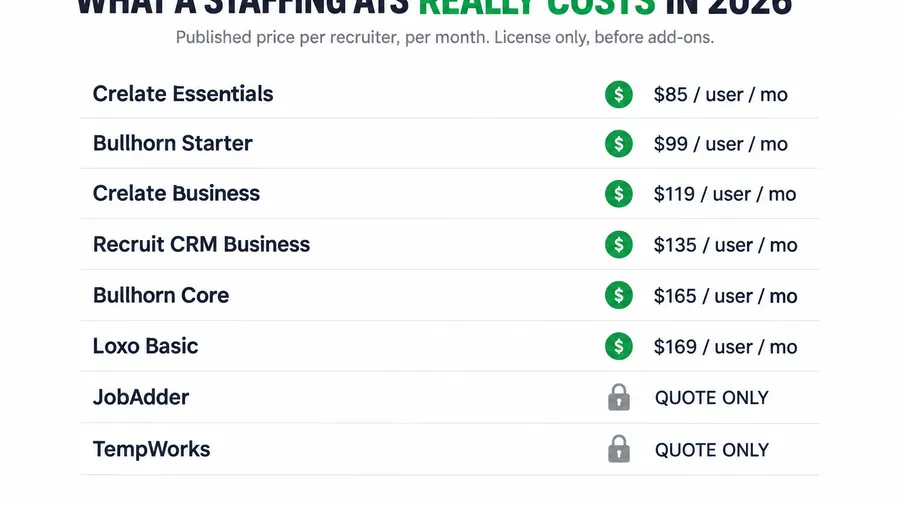
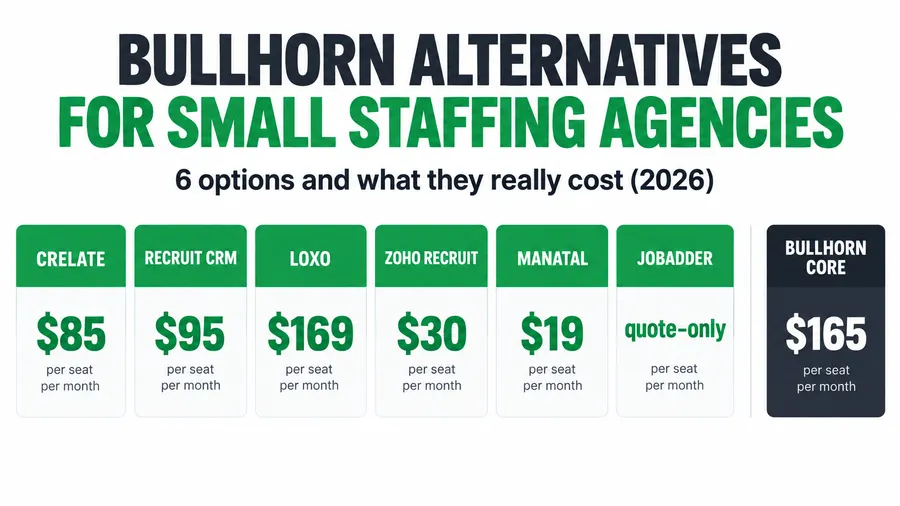
A staffing ATS in 2026 costs most small agencies between $85 and $215 per recruiter per month for the license alone, and the headline price is almost never the number you actually pay. Crelate publishes $85 per user for Essentials and $119 for Business. Bullhorn publishes $99 for Starter and $165 for Core. Loxo publishes $169 for Basic. JobAdder and TempWorks publish nothing at all and route every plan to a “request pricing” form. On top of the per-seat license sit four costs almost no vendor quotes up front: implementation and onboarding fees, per-user creep as you hire, add-on modules for the AI and texting features they market hardest, and annual price escalators baked into the contract. This is the operator’s teardown of what recruiting software really costs, vendor by vendor, with three-year totals for a solo desk, an 8-seat agency, and a 25-recruiter shop, so you can walk into the demo already knowing the number.
Key takeaways
- Published per-seat prices, verified 2026: Crelate Essentials $85/user, Crelate Business $119/user; Bullhorn Starter $99/user, Bullhorn Core $165/user; Loxo Basic $169/user; Recruit CRM roughly $95 to $215/user by tier. JobAdder and TempWorks are quote-only.
- The license is not the cost. Implementation fees, per-seat creep, add-on modules (AI sourcing, texting, analytics), and annual escalators of 5% to 7% are where the real spend hides.
- Per-seat pricing punishes growth. An 8-recruiter desk on Bullhorn Core pays roughly $47,500 over three years in license fees before a single add-on. Every hire raises the bill.
- Quote-only is a negotiating tactic, not a courtesy. When a vendor hides the price (JobAdder, TempWorks), you are meant to anchor on the demo, not the dollar. Bring the questions in the demo-call script below.
- A flat-cost model changes the math. The Hiring Snapshot is a one-time $997 build on GoHighLevel, whose subscription is flat no matter how many recruiters use it, so the cost stops climbing when your headcount does.
Table of contents
- Why staffing software pricing is deliberately confusing
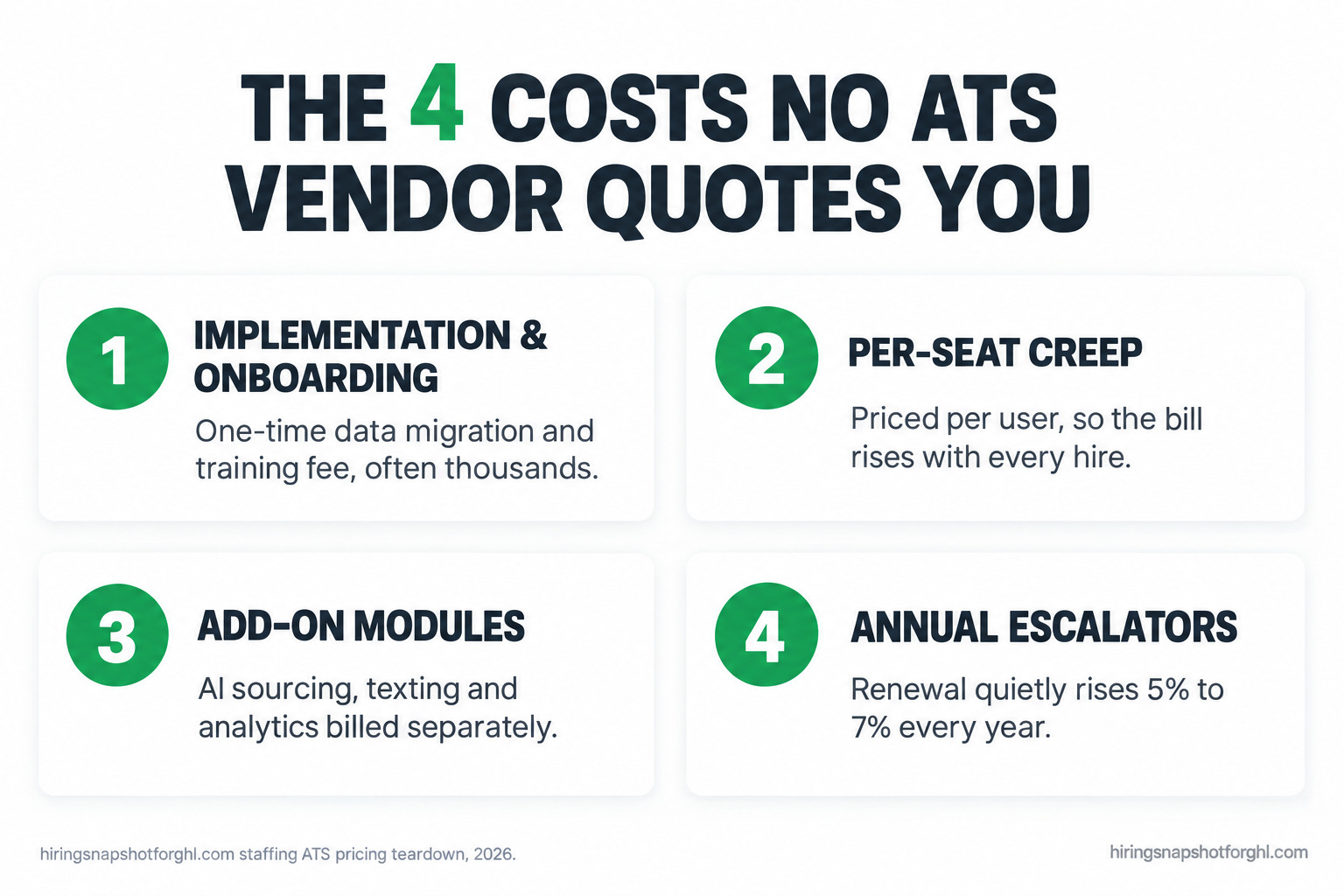
- The four costs no vendor quotes you up front
- The vendor teardown: what each one really charges
- Published per-seat prices, side by side
- Three-year totals for a solo, mid, and large desk
- How to run the pricing call so you don’t overpay
- The compliance cost buyers forget
- Common objections, answered
- FAQ
Why staffing software pricing is deliberately confusing
There are roughly 27,000 staffing and recruiting companies in the United States running about 54,000 offices, and together they put around 2.2 million temporary and contract workers to work in an average week (American Staffing Association). That is a large, fragmented market of mostly small operators, and software vendors have learned exactly how to price against it.
The pattern is consistent. Publish a low entry tier to win the search, gate the features you actually market behind higher tiers, and quote the real number only after a discovery call where a rep has scoped your seat count and your urgency. By the time you see the quote, you have sat through the demo and half-decided. You beat it by treating the license as one line in a four-line budget, and knowing the published anchors before anyone gets you on a call.
The four costs no vendor quotes you up front
The monthly per-seat figure is the part they advertise. These four are the part you feel later.
- Implementation and onboarding. Data migration, configuration, and training are frequently a separate one-time fee, and on the enterprise-grade platforms it runs into the thousands. It rarely appears on the pricing page.
- Per-seat creep. Almost every ATS in this category prices per user per month. That is fine at three recruiters and painful at fifteen, because your software bill is now tied directly to headcount and gets more expensive precisely when you are trying to scale margin.
- Add-on modules. The features vendors market hardest, AI sourcing, candidate texting, email campaigns, analytics, and job-board multiposting, are usually not in the base tier. They are credits or paid add-ons on top. Loxo’s AI sourcing and its 1.2-billion-profile database sit on the sales-led Professional tier, not the published Basic one (Pin); Crelate bills enrichment, texting, and email campaigns separately (AvaHR).
- Annual escalators. The renewal quietly costs more than year one. Loxo applies a reported 5% annual increase; Crelate’s contracts carry a reported 7% or CPI-linked escalator (Pin, AvaHR). Over a three-year term that compounding is real money.
Keep those four in view for every quote below. A $119 headline can easily become a $160 effective seat cost by year three once escalators and one add-on land. Here is how each vendor stacks up.
The vendor teardown: what each one really charges
Prices below are published or third-party-reported figures as of 2026. Where a vendor hides pricing behind a demo, I say so and cite the reported range. Confirm the live number for your seat count before you sign.
Bullhorn: the category standard, priced for scale you may not have
Bullhorn is the purpose-built staffing ATS most agencies benchmark against. Its published small-agency tiers are $99 per user per month for Starter and $165 for Core (reported and verified 2026). Above that, Bullhorn Pro, Max, and the Bullhorn One suite move to custom pricing, and third-party trackers place the fully loaded enterprise band at roughly $200 to $315+ per user per month once automation, analytics, and advanced search-and-match come into scope (Pin).
Who it is right for: mid-size and larger firms that need deep VMS integrations, heavy reporting, and a marketplace of add-ons, with the seat volume to justify it. Who it punishes: the sub-10-seat desk paying Core rates for capability it will not use, plus an implementation lift. If you are weighing it specifically against a GoHighLevel build, I broke that down in GoHighLevel vs Bullhorn for staffing agencies.
Crelate: the transparent anchor
Crelate is the most honest pricing page in the category, which makes it the anchor everyone else should be measured against. Essentials is $85 per user per month billed annually and supports up to two users; Business is $119 per user annually, or $149 billed monthly (AvaHR). Business Plus and Platform move to custom quotes. Watch two things: texting, email campaigns, and contact enrichment are separate charges, and the contract carries a reported 7% or CPI-linked annual escalator.
Who it is right for: small and mid-size agencies that want a real ATS and CRM with published, predictable seat pricing and are comfortable adding the communication modules a la carte.
Loxo: AI-forward, with the AI on the upper tier
Loxo markets itself as an AI-first talent platform. Its Basic plan is a published $169 per user per month, and it offers a free single-user tier (Glozo). The catch is that Basic is the ATS, CRM, job distribution, and resume parsing, but not the AI sourcing. Loxo Source, the 1.2-billion-profile database, the AI agents, and the contact credits all live on the sales-led Professional and Enterprise tiers. A reported 5% annual renewal increase applies.
Who it is right for: search and executive-recruiting firms that will actually use the sourcing engine and can justify Professional pricing. Who should be careful: an agency that signs up for Basic expecting the AI it saw in the marketing, then finds it behind a second, unpublished paywall.
Recruit CRM: mid-market pricing, lightly published
Recruit CRM sits in the mid-market. Third-party trackers report tiers of roughly Pro $95, Business $135, and Enterprise $215 per user per month billed annually, with monthly billing running higher (AvaHR). Its own pricing presentation is thin on dollar figures, so treat the reported numbers as a guide and confirm at quote. Data enrichment, workflow automation, advanced analytics, and multiposting are separate credits or add-ons. It fits recruiting and search firms wanting a clean, modern ATS with GPT-style tools at a mid-market seat price.
JobAdder and TempWorks: the quote-only club
Here is where the teardown gets honest about opacity. JobAdder publishes no per-user price for any of its four plans. Every plan on its pricing page ends in a “request pricing” button, and third-party estimates circulate in the $95 to $160+ per user per month range (ATLAS). Its tiers gate by team size: Recruiter Lite covers 1 to 5 users, Essential 6 to 20, and Pro 21 and up.
TempWorks is the same posture. It publishes nothing public; Capterra lists a starting figure of around $125 per month as the only public anchor (Capterra). It is built for high-volume light-industrial and pay-and-bill staffing, so its quotes bundle back-office payroll and billing a pure ATS does not.
Who they are right for: agencies whose model genuinely needs what these platforms bundle, and who are prepared to negotiate. Just know that a hidden price is a negotiating position, not a favor. You are meant to anchor on the demo instead of the dollar.
Published per-seat prices, side by side
Here are the published or reported entry and mid tiers on one axis. Quote-only vendors are omitted from the chart because there is no honest number to plot.
The spread is real, but the axis is per seat, which matters more than any single bar. The number you see here gets multiplied by your headcount and then again by thirty-six months. That is what the next chart shows.
Three-year totals for a solo, mid, and large desk
License price per seat is an abstraction until you run it for a real desk over a real contract. Here is the same software at three sizes, license fees only, over a standard three-year term. These are directional totals to show the shape of the spend, not a quote, and they exclude implementation fees and escalators, both of which push the real number higher.
The solo contingency recruiter (1 seat). On Crelate Business at $119 a month, three years of license is about $4,300; on Loxo Basic at $169, about $6,100. Manageable, but for a solo desk the real question is whether you use enough of the platform to justify even that, or whether a free tier plus a lighter automation stack does the job while you are still proving the desk.
The 8-recruiter agency (8 seats). This is where per-seat pricing starts to bite. Multiply the seat by eight and by thirty-six months:
At eight seats, the gap between a per-seat ATS and a flat-cost build is not a rounding error, it is the price of a recruiter’s quarterly draw. And that gap widens every time you hire: four of those five bars grow with headcount and one does not.
The 25-recruiter shop (25 seats). Run Bullhorn Core at 25 seats and you are near $49,500 a year in license alone, roughly $148,500 over three years before implementation, add-ons, or the escalator. A larger agency often does need that depth, and the enterprise platforms earn their keep with VMS integrations and reporting a lightweight stack cannot match. The point is not that per-seat software is wrong at scale. It is that you should know you are choosing it, and price the alternative, rather than defaulting into a bill that grows with every hire.
This is the whole reason the Hiring Snapshot exists on GoHighLevel. GoHighLevel’s subscription is flat, typically $97 to $497 a month, and does not charge per recruiter. The snapshot is a one-time $997 build on top. Your software cost stops climbing when your headcount does, which is exactly backwards from how the per-seat category is priced.
How to run the pricing call so you don’t overpay
When a vendor hides the price, the demo is a negotiation and you should treat it like one. Copy these questions and read them straight down the call. They are written to surface every one of the four hidden costs before you get emotionally attached to the tool.
The staffing ATS pricing-call script (steal this)
On the seat price:
- “What is the exact per-user, per-month price on an annual contract for the tier that includes everything you just demoed?”
- “Is that price per named user, or per active recruiter? What happens to the rate if I add or remove a seat mid-term?”
- “What is the price on month-to-month billing, so I can see the annual discount I’m actually being offered?”
On implementation:
- “What is the one-time onboarding, data migration, and training fee, in dollars, and is it required?”
- “Who does the migration from my current system, and what does it cost if my data is messy?”
On the add-ons:
- “Which of the features you just showed me, AI sourcing, texting, email campaigns, analytics, and job multiposting, are in this tier, and which are paid add-ons or credits?”
- “Give me the fully loaded per-seat price with the add-ons I actually need, not the base tier.”
On the contract:
- “What is the annual renewal increase or escalator written into the agreement?”
- “What is the contract length, the auto-renewal window, and the notice period to cancel?”
- “If I leave, do I get a full export of my candidate and client data, in what format, and is there a fee?”
That last question matters more than it looks. Data-export friction is how a per-seat platform keeps you past the point where the price makes sense, so ask it before you sign, not after. If you are moving off an existing system, a clean migration is its own project, which I walked through in migrating a staffing agency to GoHighLevel.
The compliance cost buyers forget
There is a fifth cost that never appears on a pricing page and is climbing fast: compliance with the new rules on automated hiring tools. If your ATS scores, ranks, or screens candidates with AI, some jurisdictions now regulate that directly.
New York City’s Local Law 144 is the one already in force. It requires an employer or employment agency using an automated employment decision tool to commission an independent bias audit within the prior year, publish a summary of the results publicly, and give candidates at least 10 business days’ notice before the tool is used on them. The city’s Department of Consumer and Worker Protection has been enforcing it since July 5, 2023, and penalties run from $500 for a first violation to $1,500 per day for continued non-compliance (NYC DCWP). Colorado’s SB 24-205, the first comprehensive US AI law, reaches high-risk hiring tools too, but its rollout keeps slipping; a 2026 replacement bill pushed the effective date to January 1, 2027 (Colorado General Assembly), so confirm current status before you rely on a date. Federal Fair Credit Reporting Act rules still govern disclosure and adverse-action steps on any third-party background check (FTC).
The takeaway for a buyer: ask any AI-forward vendor whether their tool triggers a bias-audit obligation in the states you recruit in, and who owns the audit and the candidate notice. Building consent, notice, and opt-out into the workflow from the start is cheaper than a penalty, which is the same discipline behind TCPA-compliant recruiting texts.
Common objections, answered
“I already pay for Bullhorn. Is switching even worth it?” If Bullhorn’s depth genuinely fits your desk and the seat count justifies it, stay. The switch is worth pricing when you are paying Core or enterprise rates for capability you do not use, when your bill grows every time you hire, or when the features you run day to day are just candidate capture, texting, scheduling, and follow-up, all of which a flat-cost GoHighLevel build does without a per-seat meter. Run your real three-year total both ways before you decide.
“Do I need to be technical to run something that isn’t Bullhorn?” No. That is the entire reason the Hiring Snapshot ships as a done-for-you build rather than a blank GoHighLevel account. The workflows, cadences, and pipeline come pre-configured and installed within one business day, so you are running recruiting automation, not assembling it. If you would rather hand off the day to day entirely, a trained GHL virtual assistant can run the desk operations for you.
FAQ
How much does a staffing ATS cost per month in 2026?
For small agencies, published per-seat pricing runs roughly $85 to $215 per recruiter per month. Crelate publishes $85 for Essentials and $119 for Business, Bullhorn publishes $99 for Starter and $165 for Core, and Loxo publishes $169 for Basic. Recruit CRM is reported around $95 to $215 by tier, while JobAdder and TempWorks are quote-only. On top of the license, budget for implementation fees, paid add-ons, and annual escalators of 5% to 7%.
How much does Bullhorn cost?
Bullhorn’s published small-agency tiers are $99 per user per month for Starter and $165 for Core, verified in 2026. Pro, Max, and the Bullhorn One suite use custom pricing, and third-party trackers place the fully loaded enterprise band at roughly $200 to $315 or more per seat once automation, analytics, and advanced search are included. Monthly billing costs more than annual.
Why won’t JobAdder and TempWorks show their prices?
Both are quote-only. Every JobAdder plan routes to a “request pricing” form, and TempWorks publishes no public per-user rate beyond a Capterra starting figure of about $125 per month. Hiding the price lets a rep scope your seat count and urgency before naming a number. Third-party estimates put JobAdder around $95 to $160 or more per user per month, but you will not get a firm figure without a call.
Is per-seat pricing bad for a growing agency?
It ties your software cost directly to your headcount, so the bill rises every time you hire. At three recruiters a per-seat ATS is cheap; at fifteen it is a significant line item. A flat-cost model, like a GoHighLevel build that does not charge per user, keeps the software cost stable as you grow.
What hidden fees should I ask about before signing an ATS contract?
Four: the one-time implementation and data-migration fee, which add-on modules (AI sourcing, texting, analytics, multiposting) sit outside your tier, the annual renewal escalator in the contract, and the data-export terms if you ever leave. Ask all four on the pricing call, because each is a cost the headline seat price does not include.
How does the Hiring Snapshot compare on price?
The Hiring Snapshot is a one-time $997 build on GoHighLevel rather than a per-seat subscription. GoHighLevel’s own plan, typically $97 to $497 a month, is flat no matter how many recruiters use it. Over three years at eight seats, a per-seat ATS license commonly totals $34,000 to $49,000 before add-ons, while a flat build plus GoHighLevel lands near $12,000.
About the author
Marcus Delgado is the Staffing Agency Growth Lead behind the Hiring Snapshot. He ran a light-industrial staffing desk before joining the team to focus on agency growth, and he thinks in placement economics: fill rates, redeploys, and gross margin per requisition. His posts lean on real desk math, not vanity metrics.
Related reading
- GoHighLevel vs Bullhorn for Staffing Agencies: An Honest Comparison
- Staffing Agency Bill Rate & Markup: The Margin Math That Keeps a Desk Profitable
- Staffing Industry Benchmarks 2026: The Recruiting Metrics That Actually Matter
- Migrating a Staffing Agency to GoHighLevel: The Clean Cutover Playbook
- Hiring Snapshot vs DIY GHL Build: When to Buy and When to Build
Want the recruiting pipeline without the per-seat meter? See how the Hiring Snapshot works, then get the full snapshot for a one-time $997, installed within one business day.