· Neha Chandra · Playbooks · 20 min read
Pay Transparency Laws for Staffing Agencies in 2026: Which States Make You Post a Salary Range
You post job ads for a living, across state lines, at volume. That is exactly what pay transparency laws now regulate, and in some states the staffing agency, not the client, is the one on the hook. Here is which states require a salary range in the posting, what it costs to get it wrong, and the job-ad copy you can use today.
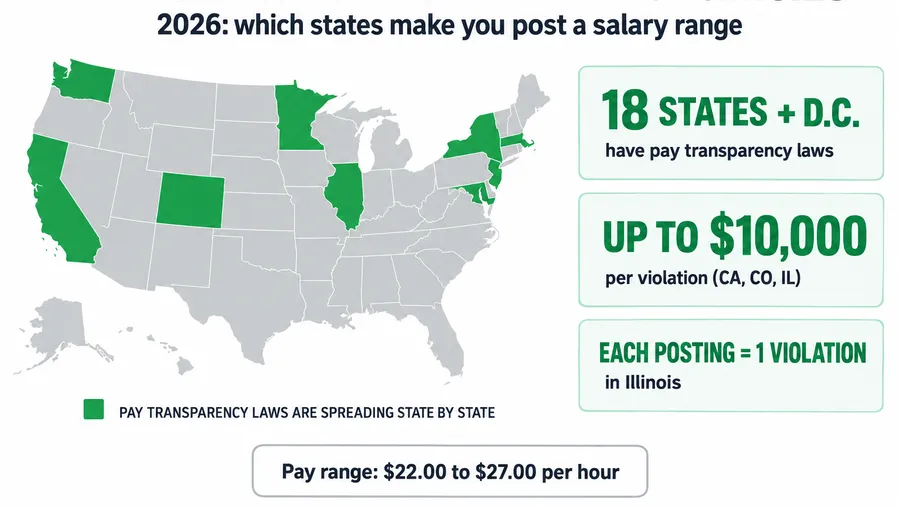
If you post job ads for clients in more than one state, at least one of your postings today probably breaks a pay transparency law, and in a growing number of states the fine lands on your staffing agency, not the client who forgot to give you the range. Eighteen states and Washington, D.C. now regulate what a job ad can leave out, and the fastest-moving requirement is the one that hits you hardest: the salary or hourly range has to be in the posting itself. You post at volume, across state lines, from job boards you do not fully control. That is the exact behavior these laws were written to catch. This is the plain guide to which states require a range in the ad, why the third party who posts it can be the one who pays, what a violation costs, and the job-ad language you can copy today.
Key takeaways
- A range in the posting is now the rule in the big markets. California, Colorado, Washington, New York, Illinois and a growing list of states require a good-faith pay range in the job ad itself, not “on request” (SHRM).
- Illinois makes the staffing agency directly liable. Under HB 3129, the third party that posts a noncompliant listing is liable unless it can show the employer never supplied the range. Recruiters and job-posting services are named.
- California puts the duty on both sides. An employer that uses a third party to post must give that third party the pay scale, and the third party must include it (UC Merced HR, SB 1162).
- The numbers add up per posting. Illinois runs up to $500 / $2,500 / $10,000 by violation count, California $100 to $10,000 per violation, and Washington now sits at $100 to $5,000 per violation plus fees after a 2025 amendment, following a wave of class actions.
- Fix it in your intake, not your legal budget. Capture the range on the req, template the ad, and the whole problem collapses into one field you already ask for.
Table of contents
- Why this landed on a staffing desk in 2026
- What a missing range actually costs
- The wrinkle that catches agencies: you are the third party
- Which states make you put the range in the ad
- The big five, and the 2026 newcomers
- Steal these: compliant job-ad and contract language
- How this plays out for a solo, mid, and high-volume desk
- How agencies actually get caught
- Common objections, answered
- FAQ
Why this landed on a staffing desk in 2026
For most of the last decade, pay ranges were a negotiating tool you kept in your pocket. That era is closing. Colorado started it in 2021, the big states followed in 2023, and 2025 and 2026 turned a trickle into a map you cannot ignore. The American Staffing Association counts roughly 27,000 US staffing and recruiting companies operating about 54,000 offices, placing around 2.2 million temporary and contract workers in an average week (ASA). Every one of those placements starts with a job ad, and the whole business model is posting other people’s roles. So a law about what a job ad must contain is not a side issue for you, the way it is for a single employer hiring twice a year. It is a rule about your core daily activity, repeated hundreds of times a month, across whatever states your clients sit in.
The reason it feels sudden is that nobody sends you a memo. A client hands you a req with a title and a bill rate, you spin it onto Indeed, ZipRecruiter and LinkedIn, and you move on. Nothing in that flow tells you that Illinois wants a benefits line, that Washington wants a fixed range and not an open-ended one, or that the posting you just cloned to a third board counts as a separate violation. The laws did not ask your permission, and the job boards will happily publish a noncompliant ad. The gap between “this is legal” and “this posts fine” is where agencies get caught.
What a missing range actually costs
Start with the per-violation math, because the “per” is where staffing gets hurt. Several of these laws, Illinois among them, treat each noncompliant posting as its own violation. Post the same warehouse role to five boards without a range in a state that counts this way, and you are not looking at one problem, you are looking at five counts.
The fine is only the visible cost. In Washington, the Equal Pay and Opportunities Act gives job applicants a private right of action, and from 2024 into 2025 that meant a wave of class-action suits where a single missing range on a widely seen posting became a claim with a statutory penalty per plaintiff plus attorney fees. A 2025 amendment cooled it slightly, moving the flat number to a $100 to $5,000 range per violation, adding a five-business-day cure period, and shielding postings that a job board scraped and republished without the employer’s consent. The private right of action itself did not go away. That is a different animal from a state agency warning letter, because the exposure scales with how many people saw the ad, which for a staffing agency running high-traffic warehouse or CNA postings can be a large number fast. Add the reputational hit: a public filing that names your agency for a transparency failure is exactly the kind of thing a client’s HR department reads before it renews your contract.
The wrinkle that catches agencies: you are the third party
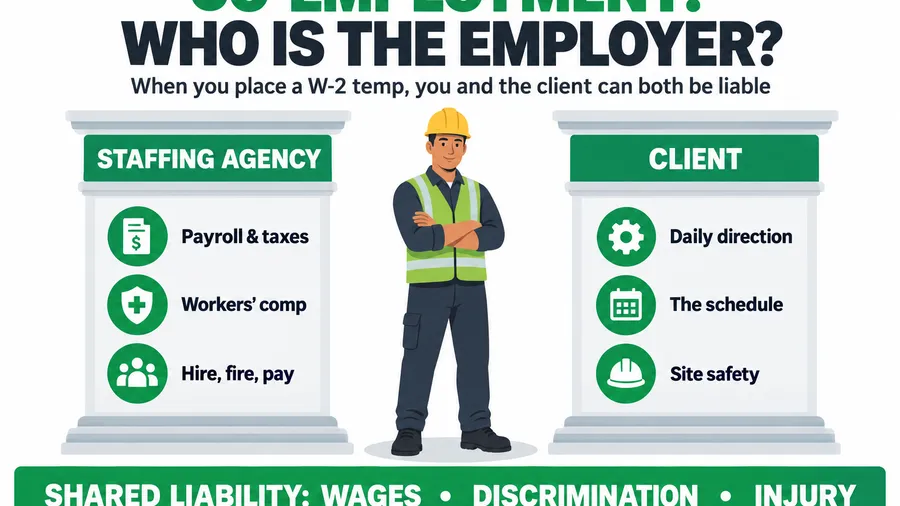
Here is the part almost no general guide spells out, because most guides are written for a single employer, not for a business whose entire job is posting other companies’ roles. Several of these laws speak directly to third parties, and a staffing agency is the textbook third party.
Take Illinois. Under HB 3129, in effect since January 1, 2025, a third party that posts a job on an employer’s behalf is itself liable for a noncompliant listing, unless it can show the employer failed to provide the pay scale and benefits information (Ogletree). Read that twice. The recruiter or job-posting service is named in the liability, not just the hiring company. Your defense exists, but it is a documentation defense: you have to be able to prove the client never gave you a range. If the range is sitting in an email in your inbox and you just did not paste it into the ad, that defense is gone and the count is yours. Illinois also gives a seven-day window to fix a flagged posting, which is generous, but only if someone is watching for the flag.
California comes at it from a different angle. Under SB 1162, an employer that engages a third party to announce or post a job must provide the pay scale to that third party, and the third party must include the pay scale in the posting (UC Merced HR). California does not spell out independent third-party liability the way Illinois does, so the hiring employer stays the primary target, but you still carry an explicit duty to publish the scale you are handed, and your posting is the one the Labor Commissioner sees. The practical lesson is identical in both states: the pay range has to travel with the requisition, in writing, or you are carrying a risk that was never really yours to carry.
This is why the fix is an intake fix, not a legal one. If your req form does not capture a good-faith range as a required field, you are one busy Tuesday away from a noncompliant ad with no paper trail. A GoHighLevel recruiting pipeline where the req cannot advance without a range turns a compliance question into a form-validation question, which is a much easier thing to win.
Which states make you put the range in the ad
There are two very different kinds of pay transparency law, and only one of them changes how you write an ad. The “on request” states (Connecticut today, Nevada, Rhode Island) require you to disclose a range when an applicant asks or before an offer. The “in the posting” states require the range to be in the ad from the moment it goes live. That second group is the one that governs your daily posting, and it is the group that is growing.
| Jurisdiction | Range in the posting? | Employer size | Effective | Notes for agencies |
|---|---|---|---|---|
| Colorado | Yes | All employers | 2021 | First in the nation; wants pay and general benefits |
| Washington | Yes | 15+ | Jan 2023 | Private right of action; active class actions |
| California | Yes | 15+ | Jan 2023 | Third party must include the scale it is given |
| New York State | Yes | 4+ | Sept 2023 | Applies to roles performed in NY, including remote |
| Illinois | Yes | 15+ | Jan 2025 | Third party directly liable; 7-day cure |
| Minnesota | Yes | 30+ | Jan 2025 | Range plus a general benefits description |
| New Jersey | Yes | 10+ | June 2025 | Covers postings and internal promotions |
| Vermont | Yes | 5+ | July 2025 | Range in most job advertisements |
| Massachusetts | Yes | 25+ | 2025 | Range in postings; pay-data reporting layer |
| Maine | Yes | 10+ | 2026 | Newest wave |
| Virginia | Yes | Private employers | 2026 | Statewide posting requirement |
| Connecticut | Moving to posting | 1+ | Oct 2026 | Shifts from on-request to proactive |
Sources for the table: SHRM state pay transparency tracker, Paycor 2026 state guide, and Worklaw’s 2025 additions summary. Confirm the current text of any state you place in with counsel, because thresholds and effective dates keep moving.
The pattern that matters for a multi-state desk: write to the strictest applicable rule and apply it everywhere. If a role could be performed remotely from New York or Washington, those states generally expect the range even when your client sits elsewhere. Running a different ad per state is how errors creep in. One compliant template, used everywhere, is easier and safer.
The big five, and the 2026 newcomers
Colorado. The original. Colorado’s Equal Pay for Equal Work Act has required a pay range and a general description of benefits in job postings since 2021, for employers of any size with work performed in the state. Because it is the oldest, it is the most tested, so treat Colorado’s “good-faith range plus benefits” format as your baseline template.
Washington. Effective January 2023 for employers with 15 or more employees, Washington requires a fixed wage scale or salary range plus a general description of benefits in each posting. The teeth are the private right of action, and since 2024 applicants have filed hundreds of class actions over missing ranges. An open-ended range or a “competitive salary” line is not a range, and it will not save you.
California. Effective January 2023 for employers with 15 or more employees, California requires the pay scale in the posting and, as covered above, pushes a duty onto third parties. The Labor Commissioner can assess civil penalties from $100 to $10,000 per violation, though a first violation may be curable if you fix the posting.
New York. New York State’s law took effect in September 2023 for employers with four or more employees, for roles performed in New York, including remote roles that report to a New York office, with civil penalties climbing to $3,000 for repeat violations. New York City’s earlier ordinance adds a wrinkle built for our industry: employment agencies and recruiters are covered regardless of size, but a temp staffing firm advertising its own temporary roles is carved out, because those workers are already covered under the state’s Wage Theft Prevention Act. The client company that hires through you stays covered either way. For a staffing agency, the four-employee state threshold is effectively “everyone,” so if you place into New York, you post ranges.
Illinois, and why it is the agency’s law. Illinois is the one that names you. HB 3129 has required the pay scale and benefits in the posting since January 1, 2025, treats each noncompliant posting as a separate violation, runs penalties of up to $500, then $2,500, then $10,000 by count, and puts the third party on the hook (Perkins Coie). If you place in Illinois, this is the single most important paragraph in this article.
The 2026 newcomers. Maine and Virginia joined the posting-requirement group in 2026, and Connecticut is moving from an on-request model to a proactive posting model in October 2026 (Paycor). No state has repealed its law, and the newcomers copy the established template rather than inventing a new one, so the habits you build for Colorado and Illinois carry you into whatever state adds a law next.
Steal these: compliant job-ad and contract language
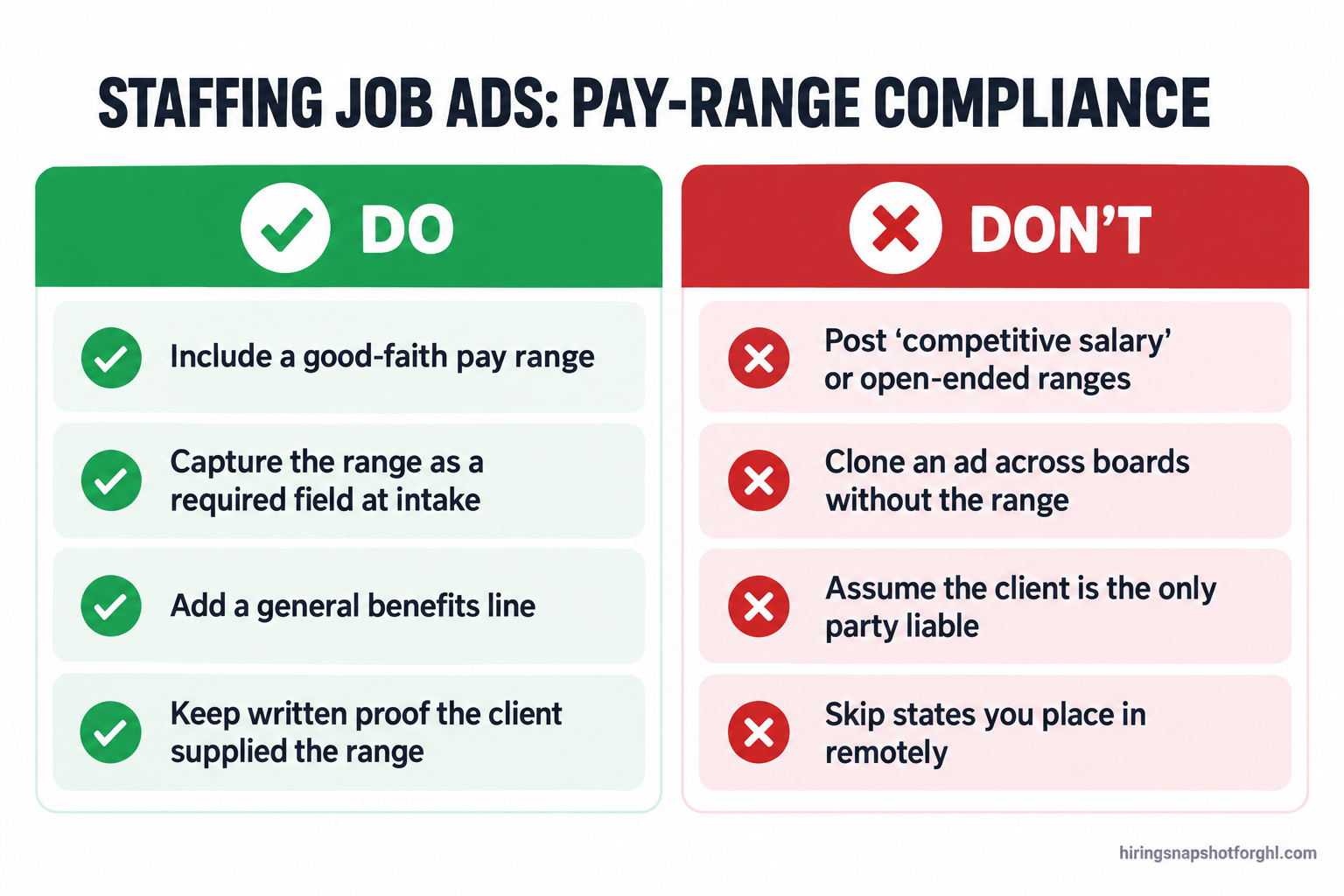
This is the part you can use this afternoon. The point of every one of these lines is to satisfy the “good faith range plus benefits” pattern that the strict states share, so one template works across most of them.
1. The core range line for a posting
“Pay range for this role: $22.00 to $27.00 per hour, depending on experience and shift. This is a good-faith estimate of the base pay we expect to offer at the time of this posting.”
2. The benefits line several states also require
“Compensation also includes: weekly pay, overtime at time-and-a-half, access to our health plan after 60 days, paid holidays, and a safety bonus. Exact benefits depend on assignment length and client.”
3. The salaried-role range line
“Salary range: $58,000 to $72,000 per year. Placement within the range depends on experience, certifications, and the specific client assignment.”
4. The clause to add to every client service agreement
“Client will provide Agency, in writing, a good-faith pay range and a general description of benefits for each requisition before Agency advertises the role. Agency will include this information in job postings where required by law. Client is responsible for the accuracy of the range it supplies.”
That fourth one is not really ad copy, it is your defense. When a posting is wrong, the question in Illinois and California is “who was supposed to supply the range,” and a signed clause saying the client supplies it in writing before you advertise is the paper trail that makes your third-party defense real instead of theoretical. Pair it with an intake form that will not let a req advance without the range filled in, and you close the loop on both sides. Wiring that capture into an automated candidate onboarding and intake flow means the timestamp and source of every range live on the record without anyone remembering to log it.
How this plays out for a solo, mid, and high-volume desk
The same laws land differently depending on where and how much you post. Run the framework three ways.
The solo contingency recruiter in one metro. You place perm roles in a single state and post a handful of reqs a week. Learn your one state cold and write to it: if it requires a range in the posting, build one template with the range line and the benefits line, and never post without it. Your biggest risk is not volume, it is the client who refuses to give a range because they “want flexibility.” Put the contract clause in front of them and explain that in a posting state, “flexible” is not an option the law allows. If they still refuse, they are handing you their liability, so price or decline accordingly.
The mid-size agency across three or four states. Now the trap is the patchwork: one state wants benefits described, another has a private right of action, a third has a four-employee trigger that catches you. Do not run four different ad formats. Write to the strictest rule across your footprint and apply it everywhere, because one compliant template used consistently beats four used carelessly. Your operational risk is the clone: a recruiter copies a compliant Illinois posting to a fourth board and drops the range in the paste. Standardize posting through one system so the range is part of the record, not the recruiter’s memory.
The high-volume light-industrial desk. You post the same warehouse, forklift, and CNA roles hundreds of times a month, often to multiple boards each. This is where per-posting penalties and Washington-style class actions get expensive, because exposure multiplies by every board and every repost. Your whole compliance program is standardization: one intake field for the range, one template that carries it, one posting workflow that will not publish without it, and a weekly scan of live postings for any missing a range. At your volume a manual process fails eventually, so the durable answer is a system that makes the noncompliant posting impossible to create.
How agencies actually get caught
Nobody sets out to break these rules. They break in predictable, boring ways, and knowing the failure modes is most of the fix.
The clone-and-drop. A recruiter takes a compliant posting and reposts it to another board, and the range gets lost in the copy or stripped by the board’s own form. Each repost is a separate violation. Fix: post from one source of truth, not by copy-paste.
The “competitive salary” habit. Old muscle memory writes “competitive pay” or “DOE” where a number belongs. In a posting state, that is a missing range, full stop. Fix: make the range a required field so the ad literally cannot be built without it.
The client-never-sent-it gap. The req comes in without a range, you post anyway to hit a deadline, and now there is no range and no proof the client withheld it. In Illinois that erases your defense. Fix: the contract clause plus an intake form that blocks a range-less req.
The remote-role blind spot. You post a remote role from a state with no law and assume you are clear, but the role can be performed in New York or Washington, so their rules attach. Fix: treat any remote or multi-state role as covered by the strictest state in play.
The stale range. A range that was good faith a year ago sits on an evergreen posting after the market moved. “Good faith” is judged at the time of posting, so a range you never refresh can drift out of compliance. Fix: date your ranges and re-check evergreen postings on a schedule.
Every one of these is a workflow problem wearing a legal costume. Solve the workflow and the legal exposure mostly evaporates.
Common objections, answered
“My clients set the pay, so this is their problem, not mine.” In several states it is explicitly both of your problem. Illinois names the third party who posts, and California puts a duty on the agency to include the scale it is given. Even where only the employer is technically liable, yours is the name on the posting a regulator or plaintiff sees first. The contract clause shifts the duty to supply the number back to the client, but it does not let you post a range-less ad and walk away.
“Won’t posting a range weaken my hand with candidates?” Candidates already expect it, and the laws exist because workers pushed for it. A tight, honest range attracts the people who fit it and filters out the ones who would never take the rate, which on a light-industrial desk saves screening time. A missing range does not protect your negotiating room, it creates liability.
“I post through Indeed and LinkedIn. Isn’t compliance on them?” No. The board publishes what you give it, and some strip formatting that can hide your range. The obligation runs to the employer and, in third-party states, to you as the poster. A board is a printing press, not a compliance department.
“There are too many states with too many rules to keep straight.” You do not track fifty rulebooks, you build to the strictest common denominator: a good-faith numeric range plus a general benefits line, on every posting, everywhere. That single format satisfies the substance of nearly every posting state. The details differ, the core habit does not.
FAQ
Do pay transparency laws apply to staffing agencies and recruiters?
Yes, and in some states they apply to you specifically as the third party that posts the job. Illinois’ HB 3129 makes a third party liable for a noncompliant posting unless it can prove the employer never supplied the pay information, and California’s SB 1162 requires the third party to include a pay scale the employer provides. Even in states that name only the employer, your agency is the entity whose posting is visible, so the practical and reputational exposure runs through you.
Does the salary range have to be in the job posting, or only given on request?
It depends on the state. Colorado, California, Washington, New York, Illinois and most of the recent additions require the range in the posting itself from the moment it goes live. A smaller group, including Connecticut today, requires disclosure only on request or before an offer, though Connecticut is moving to a posting model in October 2026. For a multi-state desk, the safe default is to always put the range in the posting.
What counts as a compliant pay range?
A good-faith estimate of what you actually expect to pay for the role at the time of posting, expressed as a real numeric range such as “$22 to $27 per hour.” Open-ended ranges, “competitive,” and “DOE” do not satisfy a posting law. Several states also want a general description of benefits and other compensation alongside the pay range, so include a short benefits line as standard.
What happens if a client refuses to give me a pay range?
In a posting state, you cannot lawfully advertise the role without one, so a refusal is not a workaround, it is a risk transfer onto you. Put a clause in your service agreement requiring the client to supply a written good-faith range and benefits description before you advertise, and make it the client’s responsibility to keep the number accurate. If a client still refuses, treat it as a red flag and price or decline the work accordingly.
Do these laws apply to remote roles I post from another state?
Often, yes. Laws like New York’s and Washington’s generally reach roles that can be performed in the state, including remote roles, regardless of where your agency or the client sits. If a remote posting could be filled by someone working in a covered state, the safe approach is to include the range and treat the role as covered by the strictest applicable law. As of 2026, eighteen states plus Washington, D.C. have these laws on the books, and the list has only grown, so building the habit now is a safe bet wherever you expand next.
About the author
Neha Chandra is the Staffing Compliance and Operations Expert behind the Hiring Snapshot. With a background in HR operations and contingent-workforce compliance, she audits every cadence against TCPA, EEOC, and FCRA realities so automation never outruns the rules. This article is general information for staffing operators, not legal advice; confirm the current rules for the states you place in with your own counsel.
Related reading
- AI Hiring Laws for Staffing Agencies in 2026: What NYC, Illinois and Colorado Now Require
- TCPA Compliance for Recruiting Texts: The 2026 Rules Every Staffing Agency Must Follow
- How to Use GoHighLevel as an ATS: Build a Recruiting Pipeline That Fills Reqs Faster
- Candidate Onboarding Automation for Staffing Agencies
- Staffing ATS Pricing in 2026: What Bullhorn, Crelate, Loxo and JobAdder Really Cost
Want recruiting automation that keeps you fast without outrunning the rules? See how the Hiring Snapshot works, then get the full snapshot for a one-time $997.