· Neha Chandra · Playbooks · 28 min read
Backdoor Hires: When a Client Hires Your Temp Direct and Skips the Fee (and How to Stop It)
You placed a worker, the client loved them, and three months later you find out they went on the payroll direct and nobody paid your conversion fee. Here is why backdoor hires happen, what each one really costs you, and the six-stage system that protects the fee without torching the account.
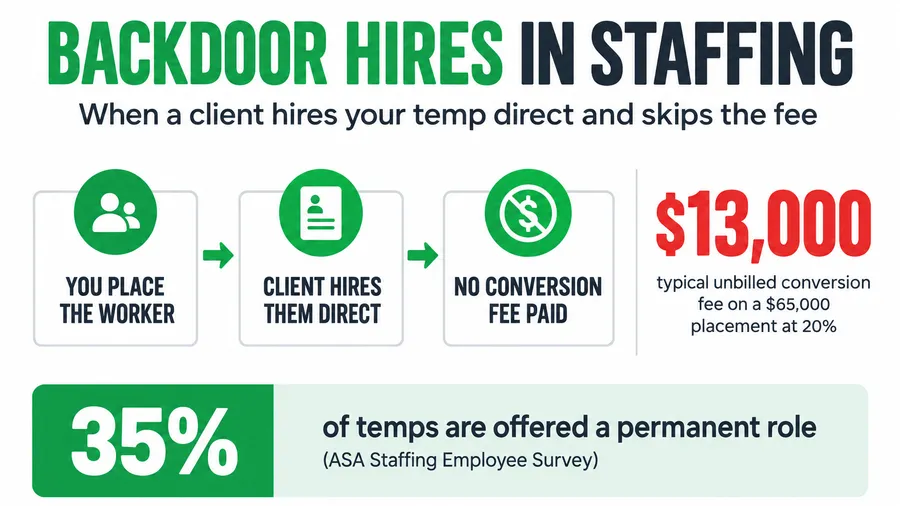
It is a Tuesday and you are catching up on a client account you have not touched in a while. You pull up the worker you placed there in the spring, a good one, the kind of candidate you were proud to send. You go to check whether they are still on assignment and the timesheet says they rolled off six weeks ago. You call the worker to see what happened, and they are cheerful about it. The client hired them full-time. They love the job. Nobody told you, nobody paid your conversion fee, and the placement you sourced, screened, and sent is now a direct employee of your client at zero cost to them. That is a backdoor hire, and it is one of the quietest ways a staffing desk loses money it already earned.
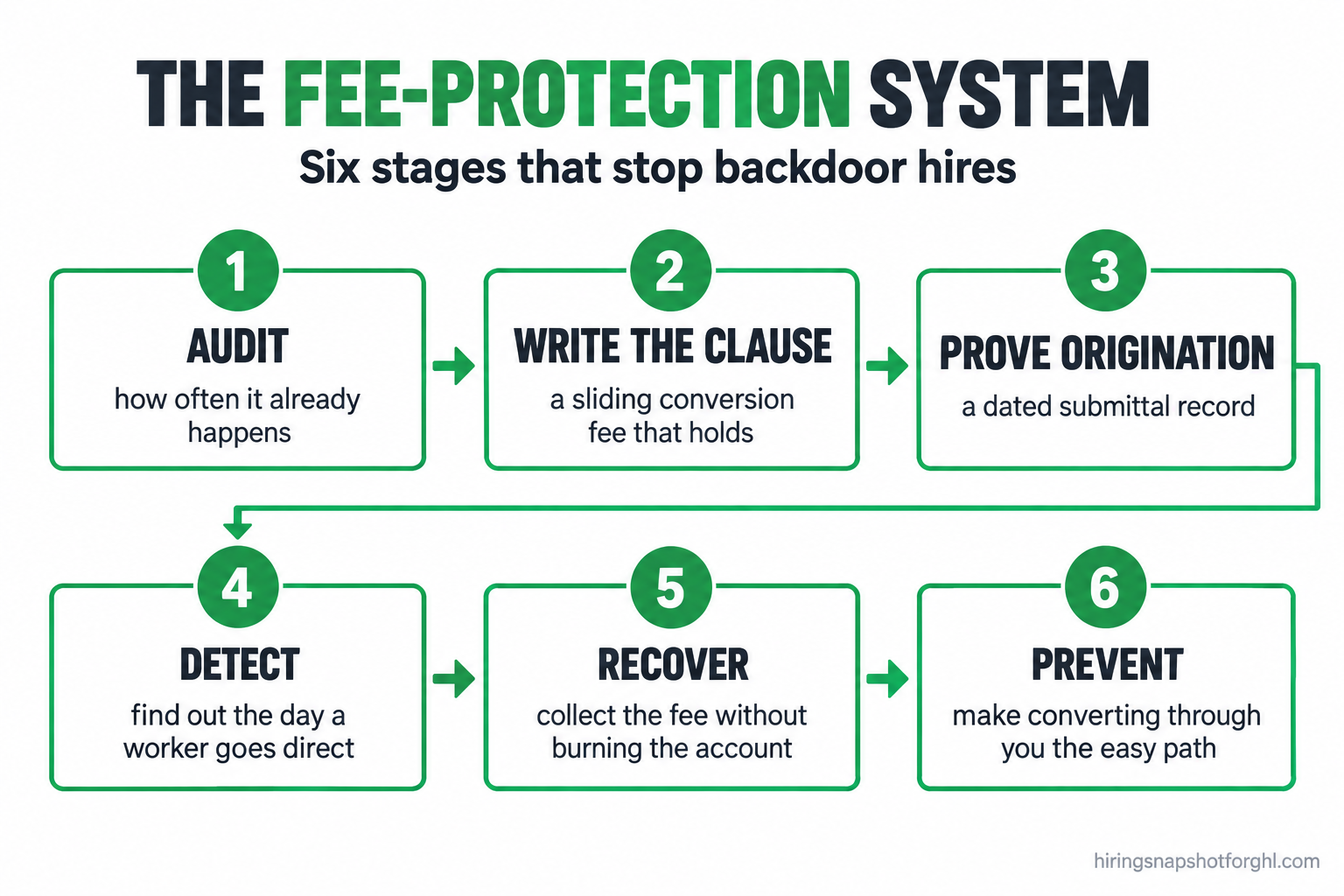
The short answer: backdoor hires happen because the conversion fee lives in a contract nobody enforces, the agency finds out too late, and it never has the paper to prove the candidate came from them. You stop it by treating the fee as something you actively protect, not something you hope the client honors. Audit how often it is already happening, write a conversion clause that actually holds, keep a clean record that proves you introduced the candidate, build a way to find out the day a worker goes direct, run a recovery conversation that collects without burning the relationship, and price and automate the whole thing so converting through you is the easy path. This is the full fee-protection system, with the exact clause and message copy you can steal, the desk math on what one backdoor hire really costs, and the places it quietly breaks.
Key takeaways
- Conversions are common, so the exposure is real. The ASA Staffing Employee Survey found 35% of temporary and contract employees were offered a permanent job by a client where they worked, and two-thirds of them accepted. Most of those conversions are legitimate. The ones that skip your fee are the leak.
- A conversion fee is not a non-compete. It is a business-to-business term between you and the client, not a restriction on the worker, which is why the FTC Noncompete Rule being struck down and shelved does not touch it. Do not let a client confuse the two.
- The fee drops over time, so timing matters. Conversion fees are commonly 10% to 25% of first-year pay on a sliding scale that falls to zero after six to twelve months on assignment. A backdoor hire at month two costs you far more than one at month seven.
- You cannot bill what you cannot prove. The agency that keeps a dated origination record collects. The one that works on a handshake argues.
- Prevention beats collection. The cheapest backdoor hire is the one that never happens because converting through you was simpler than going around you.
Table of contents
- What a backdoor hire actually is
- What one backdoor hire really costs you
- The fee-protection system, six stages
- Stage 1: Audit how often it is already happening
- Stage 2: Write the conversion clause that actually holds
- Stage 3: Prove you introduced the candidate
- Stage 4: Find out the day a worker goes direct
- Stage 5: Run the recovery conversation
- Stage 6: Make converting through you the easy path
- Three real scenarios: solo, 8-seat, and 25-seat
- The legal and compliance side, in plain terms
- Common objections, answered
- FAQ
What a backdoor hire actually is
A backdoor hire is when a company you did business with puts one of your candidates on their payroll without paying what your agreement says they owe. It shows up in two shapes. On a temp or temp-to-hire desk, it is a worker who rolls off assignment and reappears as a direct employee of the same client, skipping the conversion fee. On a direct-hire or contingency desk, it is a candidate you submitted who gets hired weeks later through a side door, sometimes after the client told you they passed, so no placement fee ever changes hands.
Most conversions are not theft. A client hiring your temp full-time is usually a sign you did your job well, and the ASA Staffing Employee Survey found 35% of temporary and contract workers were offered a permanent role by a client and two-thirds accepted. That is the whole promise of temp-to-hire. The problem is the small slice of those conversions where the client quietly skips the fee, because across the roughly 27,000 staffing and recruiting companies running close to 54,000 offices in the US (American Staffing Association), the ones that do not protect the fee lose real money every year to hires they never got paid for.
Here is the distinction that matters most, because clients lean on it to wriggle out. A conversion fee is not a non-compete. A non-compete restricts the worker from taking a job. A conversion fee is a term in a business agreement between your agency and the client that says if you hire the person we introduced, you pay us for the introduction. The worker is free to take any job they want. That is why the FTC Noncompete Rule, which a district court set aside on August 20, 2024 and the FTC moved to abandon in September 2025, has nothing to do with your conversion fee. When a client says “non-competes are dead, we do not owe you,” they are either confused or hoping you are. Your fee is a contract between two businesses, and it stands on its own.
What one backdoor hire really costs you
Put a number on a single backdoor hire and you stop treating it as the cost of doing business. Say you placed a warehouse supervisor at a $65,000 annual salary on a temp-to-hire basis, and your agreement sets the conversion fee at 20% of first-year pay. That is a $13,000 fee. If the client hires them direct at month two and you never find out or never bill it, that $13,000 is gone, on top of the recruiting, screening, and payrolling you already fronted to get them on the floor.
Now stack it. The fee you lose is the obvious cost. Underneath it is the margin you were earning on that worker’s hours, which also stops the day they go direct, often earlier than your markup had paid back the cost of finding them. And the quiet third cost is the precedent. A client who learns that skipping the fee works once will do it again, and will mention to a peer that your agency does not chase it. One unbilled conversion is a bad month. A reputation for not enforcing your own agreement is a structural leak in your margin that shows up on every account.
The fee-protection system, six stages
Losing conversions feels like bad luck when you run on a handshake and like a solved problem when you run it as stages. The desks that get paid are not luckier or more aggressive. They have closed the gap at every step: they know how often it happens, their contract language holds, they can prove where the candidate came from, they hear about a conversion fast, they have a calm script for collecting, and they have made converting through them the obvious choice. Six stages, in order. Skip one and the next has to cover for it.
Stage 1: Audit how often it is already happening
You cannot fix a leak you have not measured. Most desks “know” they lose the occasional conversion the way they know the coffee is bad, by feel, which means they have no idea whether it is one a year or one a month. So count it. Pull every temp and temp-to-hire worker who rolled off assignment in the last twelve months and was not redeployed, and check where they went. Cross-reference against the client. A worker who ended an assignment and now shows up as a direct hire at the same company, with no conversion fee invoiced, is a backdoor hire whether anyone called it that or not.
For direct-hire desks, run the same check on submitted-not-placed candidates. Take the candidates you sent in the last year who the client said they passed on, and spot-check whether any of them ended up employed there anyway. You will not catch all of them, but even a sample tells you the size of the problem.
How it breaks. The usual failure is doing this once, feeling bad, and changing nothing. The audit is not the fix, it is the number that tells you the fix is worth building. The second failure is not writing down the reason each one slipped: no clause, a clause with a hole, no proof of origination, or you simply never found out. Those are four different problems with four different fixes, and the audit is where you learn which ones are costing you. A desk that finds most of its leaks are “never found out” needs Stage 4. One that finds “clause had a hole” needs Stage 2.
Stage 2: Write the conversion clause that actually holds
Almost every backdoor-hire loss traces back to a contract that was too vague to enforce or too weak to bother with. A strong conversion clause does four things. It defines what counts as a hire broadly enough that the client cannot route around it, it sets the fee on a clear schedule, it names a look-back window after the assignment ends, and it says plainly that the client will tell you before converting.
Define “hire” to include direct employment, employment through a third party like another agency or a payroll company, and engaging the worker as an independent contractor. Clients who want to dodge the fee get creative, and “we did not hire them, our other vendor did” is a line you close in the contract, not in an argument later. Set the fee on a declining schedule tied to hours worked or months on assignment, because a flat fee that never drops feels unfair to clients and a sliding one that reaches zero is the industry norm: conversion fees commonly run 10% to 25% of first-year pay and taper to zero after six to twelve months. Many agencies waive the fee entirely once a worker has billed enough hours, the way KORE1 converts at no charge after 1,040 hours, roughly six months of full-time work. Add a look-back window, so a client cannot end the assignment on Friday and hire the worker direct on Monday to pretend the conversion was unrelated. Spell the exact terms out the same way you handle every other protection in your staffing agency fee agreement.
Steal this: the conversion-fee clause (have your attorney adapt it)
“Conversion. If, during any assignment or within [six] months after the last day a Worker provided services, Client or any affiliate hires, engages, or employs a Worker introduced by Agency, whether directly, through another staffing supplier, through a payroll provider, or as an independent contractor, Client will pay Agency a conversion fee. The fee is [20%] of the Worker’s first-year total cash compensation, reduced by [X]% for each full [160 hours] the Worker has billed through Agency, reaching zero after [1,040] billed hours. Client agrees to notify Agency in writing before converting any Worker. This provision is a commercial term between Agency and Client and is not a restriction on the Worker’s employment.”
How it breaks. The clause fails when it is signed and then forgotten, or when it only exists on your paperwork and not on the client’s purchase order, which is the document their accounts-payable team actually reads. It also fails when it is so punitive that a client would rather fight it than pay it. A fee that never drops, or a look-back that runs for years, reads as a trap, and clients fight traps. A clean sliding schedule with a clear zero point is both more enforceable and easier to collect, because it feels like a fair deal rather than a penalty.
Stage 3: Prove you introduced the candidate
A contract is only worth what you can prove under it. The single most common way a conversion fee dies is the client saying “that candidate applied to us directly, you did not introduce them,” and the agency having nothing dated to show otherwise. The fix is boring and it is the whole ballgame: keep a timestamped record of every candidate you submit to every client, and make that record something you can produce in one click.
For each submission, log the candidate, the client, the role, and the date and time you sent them, and keep the actual submittal, the email or the portal entry, attached to it. When you place a worker, record the assignment start and the agreement they are covered by. When you later claim a conversion fee, you are not arguing about memory, you are forwarding a dated submittal that predates the client’s “direct application” by weeks. A good CRM does this automatically, which is a large part of why desks that run everything through GoHighLevel-based recruiting workflows rather than a shared inbox win these arguments: the record exists whether or not anyone remembered to make it.
Steal this: the origination-confirmation email (send on every submittal)
Subject: Candidate submitted: [Name] for [Role]
“Hi [Client], confirming I am submitting [Candidate Name] for your [Role] as of [date, time]. Per our agreement, [Candidate] is an introduced candidate of [Agency], and any hire or engagement of them by [Client] or an affiliate within the conversion window is covered by our conversion terms. Resume and notes attached. Happy to set up interviews whenever you are ready.”
How it breaks. It breaks when the record lives in one recruiter’s sent folder and that recruiter leaves, or when submittals go out by phone and text with nothing written down. It also breaks when you submit the same candidate to a client who had already seen them from another source, so always confirm the submittal in writing at the moment you send it, the way the email above does, and you convert a he-said-she-said into a dated fact. The email is not a formality. It is the evidence you will wish you had.
Stage 4: Find out the day a worker goes direct
Most backdoor hires are not disputed, they are simply never discovered. The worker rolls off, the assignment closes, and the agency moves on to the next fire. Six months later you notice, if you notice at all, and by then the trail is cold and the fee may have already slid toward zero. The desks that get paid are the ones that find out fast, and finding out fast is a system, not a hunch.
Three signals tell you a conversion happened. The first is the worker: a placed worker who ends an assignment and goes quiet to your redeployment outreach, while clearly still employed, is a flag worth a direct, friendly check-in. The second is the client: an account that stops ordering for a role they used to fill through you may have solved it by hiring your person. The third is the worker’s own update, on a professional profile or in casual conversation, that they now work “for” the client rather than “through” you. None of these is proof on its own, but any of them is a reason to ask a simple question before the window closes.
Steal this: the placed-worker check-in (friendly, not an interrogation)
“Hey [Name], it has been a bit since your assignment at [Client] wrapped and I wanted to check in. Are you back on the market, or did something land for you? If you are still over at [Client], that is great to hear, just let me know so I keep your file current. And if you are open to something new, I have [role] coming up that fits you well.”
How it breaks. It breaks when nobody owns the roll-off list, so workers end assignments and fall off the radar with no one checking where they went. It breaks when the check-in reads like a collections call, which makes the worker go quiet instead of telling you the truth. Keep it warm and about them, and most workers will happily tell you they got hired, because to them it is good news, not a confession. One more failure mode worth naming: do not let the detection step bleed into pestering a worker who has clearly moved on. A single friendly check-in is good service and good intelligence. A string of them is harassment, and if you are texting, it needs to stay inside TCPA consent rules like every other message you send.
Stage 5: Run the recovery conversation
Once you know a conversion happened and you have the clause and the origination record, you have a fee to collect. This is where most desks flinch, because they are afraid chasing the money will cost them the account. Run it right and it does the opposite: a calm, professional invoice backed by paper signals that you are a real business that honors and expects its agreements, and good clients respect that. The goal is to get paid and keep the relationship, and those are not in tension when you lead with the facts instead of the emotion.
Start with the assumption that it was an oversight, because often it was. The hiring manager who onboarded your worker may have no idea a conversion fee exists; that is a procurement detail two desks over. So the first contact is informational, not accusatory. You note the hire, reference the agreement and the submittal date, state the fee per the schedule, and attach both. You give them an easy path to pay. Only if they resist do you escalate, and even then you stay factual: the agreement is signed, the origination is dated, and the fee is what both parties agreed to.
Steal this: the recovery email (assume good faith first)
Subject: Conversion of [Worker Name] at [Client]
“Hi [Name], I understand [Worker] has joined [Client] full-time. That is genuinely great, they were a strong placement and I am glad it worked out. Per our staffing agreement dated [date], a direct hire of a worker we introduced triggers a conversion fee. Based on [Worker]‘s billed hours through us, the fee is [$amount] on the schedule in Section [X]. I have attached the agreement and the original submittal from [submittal date] for your records, and I will send the invoice today with [net-15] terms. If a different person handles this on your side, point me to them and I will coordinate. Thanks, and I would love to keep helping you fill roles.”
How it breaks. The conversation breaks when you lead with anger, because now it is a fight and the client digs in. It breaks when you have no paper, because then it is your word against theirs and you lose. And it breaks when you do not have a plan for a no: decide in advance, based on the size of the fee and the value of the account, whether this one is worth a demand letter and a small-claims filing or whether you log it, tighten the clause, and move on. Not every fee is worth a lawyer, but a client who learns you will never escalate has learned they never have to pay. Knowing your line before the call keeps you calm during it.
Stage 6: Make converting through you the easy path
The cheapest backdoor hire is the one that never happens, and you prevent it by making the honest path easier than the sneaky one. Clients do not usually set out to cheat you. They go around the fee when the fee feels unfair, when converting through you is a hassle, or when they forget the term exists. Fix all three and most conversions come to you willingly.
Make the fee feel fair by using the sliding schedule from Stage 2, so a client who has had your worker for five months pays little or nothing and feels no reason to hide it. Make converting easy by having a simple, pre-agreed process: a client who wants to hire your temp should know exactly who to call and what it costs, with no negotiation drama. And keep the term top of mind by mentioning it like a normal part of doing business, at the start of an assignment and again as a worker approaches a conversion-likely tenure, framed as a benefit: “when you are ready to bring [Worker] on full-time, here is how simple it is.” A client who feels the path to converting is open and fair rarely bothers with the back door. The same logic is why a strong contractor redeployment pipeline protects your margin from the other side, by keeping good workers earning through you instead of going direct out of boredom between assignments. If you do not have the hours to run this follow-through yourself, a trained virtual assistant can own the roll-off check-ins and the conversion reminders so nothing slips.
How it breaks. Prevention fails when the message only ever sounds like a threat, so the client hides the conversion to avoid the confrontation. It also fails when the process is murky: a client who does not know what converting costs or who to ask will often just do it quietly rather than open a negotiation. Make it fair, make it simple, and say it out loud early, and the back door stops being worth using.
Three real scenarios: solo, 8-seat, and 25-seat
The system is the same at every size. What changes is who runs it and how much automation does the work.
The solo contingency recruiter. You are the sales team, the sourcer, and the accounts department, so the risk is that fee protection lives entirely in your head. Your win is to get the clause into every agreement and the submittal confirmation out on every candidate, both of which take minutes and save five figures. You will not run a formal roll-off report, so lean on the two cheapest signals: a worker going quiet, and a client that stops ordering. For you, the recovery conversation is personal and that is an advantage, because the relationship is direct and a fair, friendly ask usually gets paid. Your biggest leak is the candidate you submitted, the client passed on, and then hired anyway, so the dated submittal email is your most important habit.
The 8-seat light-industrial desk. Now you have volume and no longer know every worker personally, so detection has to become a process instead of a memory. Someone owns the weekly roll-off list, the conversion clause is standard on every client PO, and the CRM holds every submittal with a timestamp. This is the size where a backdoor hire is most likely to go unnoticed, because workers roll on and off constantly and a single quiet conversion hides in the churn. Automating the alert, a worker ends an assignment and is not redeployed within X days, triggers a check-in task, is the change that pays for itself. The recovery conversation here is a billing routine, not a confrontation, run the same way every time.
The 25-seat healthcare or high-volume shop. At this scale conversions are a managed revenue line, not a surprise. The clause is negotiated into master service agreements, origination is logged automatically on submission, and a report flags every roll-off that looks like a possible conversion. Account managers raise the conversion option with clients proactively, so most conversions are billed cleanly and the fee becomes a predictable part of the account’s value. The failure mode at this size is a big client using its size to strike the clause out of the MSA, so the fee protection has to be defended in the contract negotiation, not after a worker has already gone direct. The agency that holds the clause here is protecting a real slice of annual revenue.
The legal and compliance side, in plain terms
None of this is legal advice, and the one firm rule is to have an employment attorney in your state write and review your actual contract language. A few principles hold broadly, though, and they are worth understanding before you write anything.
A conversion fee is generally treated as a liquidated-damages term in a business contract: a pre-agreed, reasonable estimate of what the introduction was worth, not a penalty. That distinction matters, because courts tend to enforce reasonable liquidated damages and tend to strike down clauses that look like punishment. A sliding fee that reflects the real value of the placement and drops as the client gets more value from the assignment reads as reasonable. A flat, never-ending fee reads as a penalty and is easier to challenge. This is the practical reason the fair schedule is also the enforceable one.
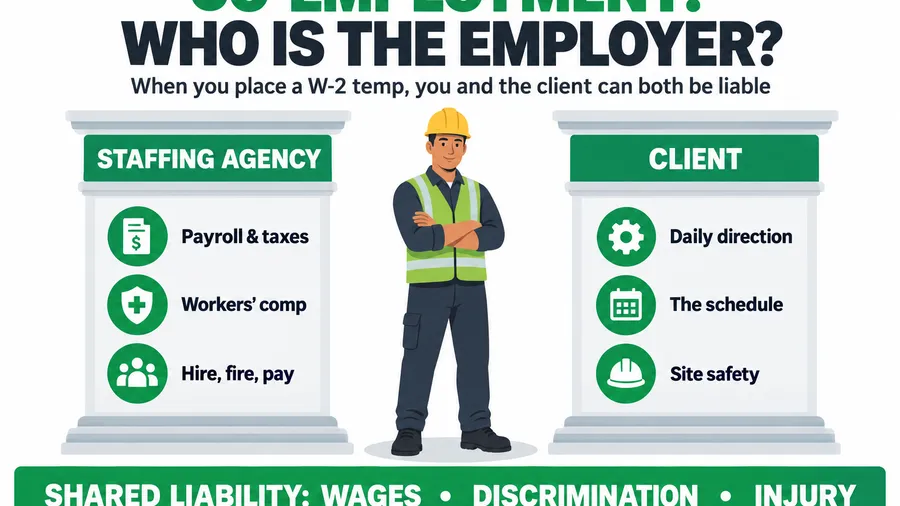
Keep the worker out of it. Your fee is a term between your agency and the client, and it should never restrict the worker’s ability to take a job. A clause that tries to stop a worker from being hired, rather than charging the client for hiring them, drifts toward a non-compete, and that is exactly the territory the shelved FTC Noncompete Rule and a patchwork of state laws make treacherous. Enforceability of contract terms genuinely varies by state, which is another reason the attorney review is not optional. Finally, remember that the whole relationship sits inside the usual staffing compliance frame, from co-employment exposure to FCRA and wage rules, so the conversion clause should fit your broader agreement rather than contradict it.
Common objections, answered
“Chasing the fee will cost me the account.” It is the opposite when you do it right. A calm, well-documented invoice tells a client you are a real business that honors its agreements and expects the same, and serious clients respect that. The accounts you lose by enforcing a fair fee are usually the ones that were going to squeeze you on everything else anyway. The ones worth keeping pay the fee and keep sending you reqs, because they value the service more than the few thousand dollars they tried to save.
“My contract does not even have a conversion clause.” Then that is the single highest-value hour of work on your desk this week. Get the clause written by an attorney, add it to your standard agreement, and get it onto new client paperwork and renewals. You cannot recover the conversions you already lost, but every placement you make after the clause is in place is protected. Start with new agreements today and work the clause into existing accounts at renewal.
“The client says the candidate applied to them directly.” This is why Stage 3 exists. If you have a dated submittal that predates their hire, the “direct application” story falls apart, and you forward the timestamp instead of arguing. If you do not have that record, you will probably lose this one, which is the lesson that makes you start logging every submittal in writing from now on. The dated origination record is the difference between billing a fact and debating a feeling.
“Is a conversion fee even enforceable, now that non-competes are going away?” Yes, and the two are not the same thing. The FTC Noncompete Rule is not in effect, but that rule was about restricting workers, and it never touched business-to-business conversion fees. Your fee is a commercial term between your agency and the client for an introduction you made. Enforceability depends on your contract and your state, which is why you have an attorney draft it, but the demise of the non-compete rule does not weaken it.
“Do I really need software for this?” You need a reliable record and a reliable alert, and those are exactly the things a human does well for a month and then drops under pressure. The submittal timestamp, the roll-off flag, the conversion-likely reminder, and the check-in task are boring, repeatable, and easy to automate, which is why the Hiring Snapshot ships them pre-built on GoHighLevel. You can run the whole system on a spreadsheet and a good memory, right up until the busy week when both fail and a five-figure conversion slips out the back door.
FAQ
What is a backdoor hire in staffing?
A backdoor hire is when a client puts one of your candidates on their payroll without paying the fee your agreement requires. On a temp or temp-to-hire desk it is a worker who ends an assignment and is hired direct by the same client, skipping the conversion fee. On a direct-hire desk it is a candidate you submitted who gets hired through a side door, often after the client said they passed, so no placement fee is ever paid. Either way, you sourced and introduced the person and did not get paid for the hire you made possible.
How much is a temp-to-perm conversion fee?
There is no single industry rate, but conversion fees commonly run 10% to 25% of the worker’s first-year pay, set on a sliding scale that shrinks the longer the worker has billed through you and typically reaches zero after six to twelve months on assignment. A common US pattern waives the fee after around 1,040 billed hours, roughly six months of full-time work. The exact percentage and schedule should be written into your staffing agreement before the assignment starts, so a conversion is never a negotiation after the fact.
Is a conversion fee the same as a non-compete?
No. A non-compete restricts a worker from taking a job and is governed by state law and, until recently, a now-shelved FTC rule. A conversion fee is a business-to-business term between your agency and the client that charges the client for hiring someone you introduced. The worker remains free to take any job they want. Because the fee does not restrict the worker, the collapse of the FTC Noncompete Rule has no bearing on it, though you should still have an attorney draft your language because contract enforceability varies by state.
How do I prove a client hired my candidate?
Keep a timestamped record of every candidate you submit to every client, including the date, the role, and the actual submittal email or portal entry. When a client later hires that candidate, a dated submittal that predates their hire is strong evidence you made the introduction, which defeats the common “they applied to us directly” defense. Confirm each submittal in writing at the moment you send it, and store it in a CRM rather than a personal inbox so the record survives even if a recruiter leaves.
How do I collect a conversion fee without losing the client?
Assume good faith and lead with the facts. Many hiring managers do not know a conversion fee exists, so the first contact notes the hire warmly, references the signed agreement and the dated submittal, states the fee per the schedule, and attaches the paperwork with an easy way to pay. Most clients pay a clear, fair, well-documented invoice without friction. Only escalate if they refuse, and decide in advance, based on the fee size and the account’s value, whether a given fee is worth a demand letter or small-claims filing.
How can I stop backdoor hires before they happen?
Make converting through you easier and fairer than going around you. Use a sliding fee that drops over time so clients feel no need to hide a late conversion, agree a simple conversion process so hiring your worker is painless, and mention the term early and positively as a normal part of the relationship. Pair that with a clean origination record and a roll-off alert so you find out quickly if a conversion happens anyway. Prevention plus fast detection catches far more fees than aggressive collection ever will.
About the author
Neha Chandra keeps the Hiring Snapshot honest. With a background in HR operations and contingent-workforce compliance, she audits every cadence and contract against TCPA, EEOC, and FCRA realities so automation never outruns the rules. She writes the compliance notes and operations deep-dives that keep staffing agencies fast and defensible at the same time.
Related reading
- Staffing Agency Fee Agreement: The 7 Clauses That Protect Your Placement Fee
- Contractor Redeployment: The Automation That Turns One Placement Into Three
- Co-Employment Risk for Staffing Agencies: What You’re Actually Liable For
- Margin Compression in Staffing: How to Defend Your Markup When Clients Push for a Lower Rate
- TCPA Compliance for Recruiting Texts: The 2026 Rules Every Staffing Agency Must Follow