· Marcus Delgado · Growth · 28 min read
Margin Compression in Staffing: How to Defend Your Markup When Clients Push for a Lower Rate (2026)
A client just asked you to drop your markup or they walk. Here is what a few points of margin actually cost you in real dollars, the six-stage system to hold the line without losing the account, and the exact scripts to say no and keep the business.
It is a Thursday afternoon and the email from your biggest client lands with the subject line “quick call about rates.” You already know what it is. They have been “benchmarking,” another agency quoted them two points lower, and they want you to match it or they will “have to make a change.” You do the math in your head while you read it, and the math is ugly: this one account is a third of your weekly billings, and the two points they are asking for is most of what you actually keep.
The short answer: margin compression is not a pricing problem, it is a system problem, and you defend against it the same way you defend a desk, with numbers, a plan, and a script you have rehearsed before the client ever calls. You have to know your true floor to the penny, price with room above it, answer the pushback with value instead of a flinch, and recover margin on the back end through redeployment and faster fills so you are not living and dying on one rate conversation. This is the whole system, with the real margin math, the copy you can steal when the client pushes, and the traps that quietly bleed a desk dry one “small” concession at a time.
Key takeaways
- A few points is most of your profit. The average aggregate gross margin for temporary staffing firms is about 25%, so a client asking you to shave five points off a markup is often asking for a fifth to a quarter of everything you keep.
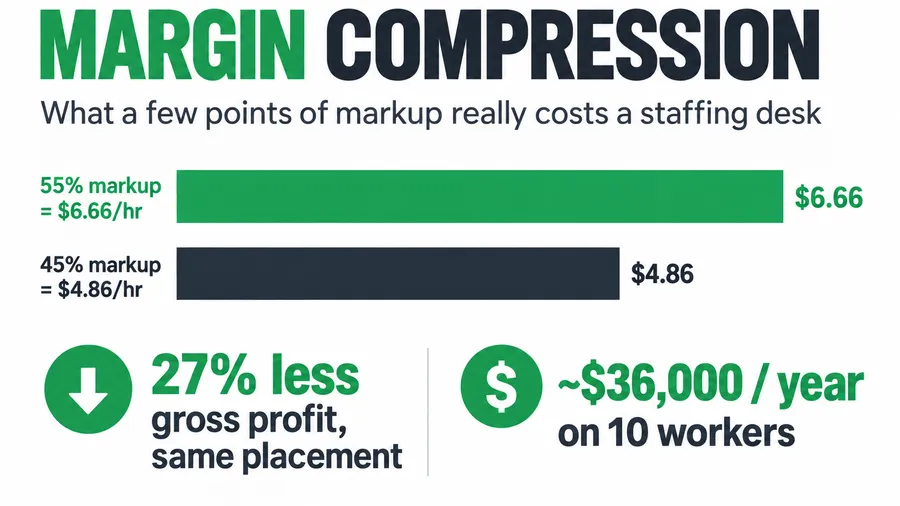
- The dollars are bigger than they feel. On a $18/hr light-industrial worker, cutting your markup from 55% to 45% drops your gross profit per hour from $6.66 to $4.86. On ten full-time workers that is roughly $36,000 a year, off the exact same placements.
- Your true cost is higher than pay rate. Benefits and statutory burden run employers about 29.9% of total compensation on average, and for staffing the workers’ comp and unemployment load on top of wages is why your floor is never just the hourly pay.
- Price with room, hold at the floor. If you lead at your floor you have nothing to trade, and the first pushback takes you underwater. The desks that keep margin quote above their floor and defend the gap on purpose.
- Recover on the back end. Redeployment, faster time-to-fill, and automatic pass-through of wage and burden increases make you far less dependent on winning any single rate negotiation.
Table of contents
- What margin compression actually costs you
- Why clients push now, and why it works
- The margin-defense system, six stages
- Stage 1: Know your true floor to the penny
- Stage 2: Price with room above the floor
- Stage 3: Answer the pushback with value, not a flinch
- Stage 4: Recover margin on the back end
- Stage 5: Automate rate reviews and pass-throughs
- Stage 6: Reprice or fire the accounts that won’t clear the floor
- Three scenarios: solo, 8-seat, and 25-seat
- The compliance side: co-employment and pay transparency
- Common objections, answered
- FAQ
What margin compression actually costs you
There are roughly 27,000 staffing and recruiting companies in the United States running about 54,000 offices, and together they put around 2.2 million temporary and contract workers to work in an average week (American Staffing Association). Every one of them lives on the spread between what the client pays and what the worker and the burden cost, and that spread is thinner than most people outside the business assume. The average aggregate gross margin for temporary staffing firms is about 25%, and for a light-industrial desk running high volume at lower skill it is often well below that. When a client asks for “just a couple of points,” they are asking for a slice of a number that was never fat to begin with.
Here is why it hits so hard. Start with a light-industrial worker at $18 an hour. Your real cost is not $18. You carry the employer side of payroll taxes, unemployment insurance, and workers’ comp, which for staffing is heavier than most industries because of the roles. Benefits and statutory burden run employers about 29.9% of total compensation on average across private industry, and even a lean light-industrial burden of 18% puts your fully loaded cost at $21.24. That is your real floor before you have kept a dime.
Now watch what a markup cut does to the only number that pays your rent, gross profit per billed hour.
Drop from a 55% markup to 45% and your gross profit per hour falls from $6.66 to $4.86. That is 27% less gross profit on the identical worker doing the identical job. Put ten of those workers on full-time assignment for a year, about 20,000 billed hours, and the “couple of points” the client wanted is roughly $36,000 of gross profit a year. That is a recruiter’s base, or the difference between a desk that funds payroll comfortably and one that is calling a factoring company every Friday. The full mechanics of how markup turns into margin, with burden and spread broken out, are walked through in the bill rate and markup guide; this piece is about what to do when someone comes to take it.
Why clients push now, and why it works
Rate pushback is not new, but it is sharper right now, and understanding why tells you how to answer it. The first reason is simple: bill rates climbed over the last couple of years as wages rose, so clients are staring at higher invoices and looking for somewhere to claw it back. Your markup is the visible, negotiable-looking line, so that is where they aim, even though the wage, not your margin, is what actually moved.
The second reason is information and buying power. Procurement has gotten more sophisticated at small and mid-size clients, and they now shop you against two or three other agencies as a matter of routine. They will quote you a competitor’s number whether or not it is real, because it costs them nothing and it works more often than it should. And pay-transparency rules, now live in fourteen states plus DC for job postings, mean the wage is increasingly out in the open, so a client who sees the posted pay range can back into a rough guess at your markup and decide it looks too high.
It works because most agency owners negotiate scared. The account feels too big to lose, the pushback lands on a busy afternoon, and “let me knock a couple points off to keep them happy” feels like the safe, relationship-preserving move. It is the opposite. A concession made in a flinch trains the client to push again next quarter, and the quarter after that, until you are running their desk at a margin that does not cover the risk you are carrying. The fix is not to be tougher. It is to have a system so the answer is already decided before the call.
The margin-defense system, six stages
Holding margin feels like a personality trait of owners with nerve, and it is really a set of systems that take the nerve out of it. The desks that keep their spread are not the ones with the most backbone in the moment. They are the ones that walk into every rate conversation already knowing their floor, already priced with room above it, and already set up to recover margin elsewhere so no single account can hold them hostage. Six stages, and they build on each other: knowing your floor lets you price with room, pricing with room gives you something to trade, and back-end recovery means you can afford to let a bad account walk.
Stage 1: Know your true floor to the penny
You cannot defend a number you have not calculated. The single most common reason owners cave on rate is that they do not actually know where their floor is, so every pushback feels like it might be survivable, and they find out it was not when the P&L comes in soft. Your floor is not the pay rate and it is not a gut feel. It is the fully loaded cost of the placement plus the minimum gross margin that covers your overhead and the risk you are carrying.
Build it per role, not per agency. Take the pay rate, add the employer payroll taxes, add unemployment insurance at your state’s rate, and add the workers’ comp premium for that specific job code, which for a forklift operator is a completely different number than for a clerical temp. That sum is your fully loaded cost. On our $18 light-industrial worker with an 18% burden, that is $21.24. Then set the minimum margin you will accept, the number below which the placement is not worth the risk, the payroll float, and the collection exposure. When a client pushes, you are not guessing whether you can go lower. You know to the penny, and you know the exact bill rate where you walk.
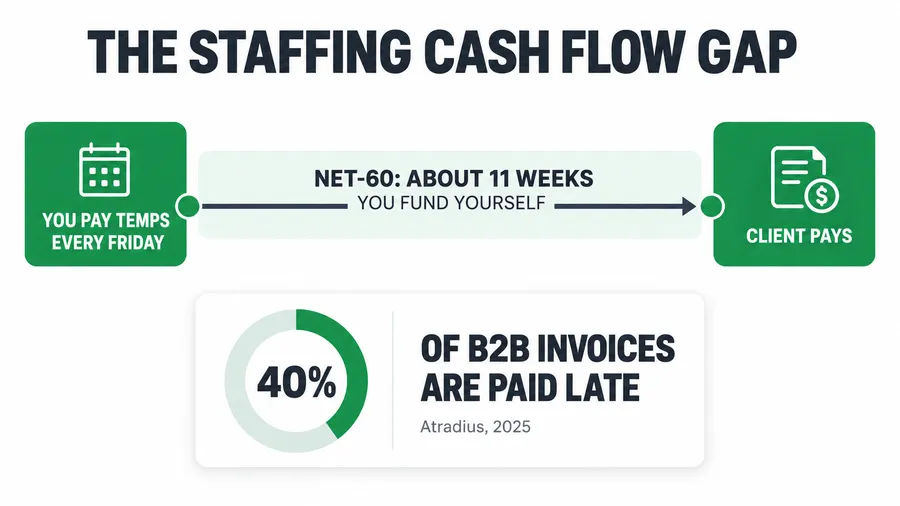
How it breaks. The usual failure is using one blended burden number across every role, so you think you are making margin on the high-comp job codes while you are quietly losing it on the risky ones. The other is forgetting that net-60 payment terms are a cost: if a client pays slow and you factor the invoices, that financing eats into the same margin, so a rate that clears your floor on paper can still lose money once the cost of covering payroll on net-60 terms is counted. Your floor has to include the cost of getting paid, not just the cost of the worker.
Stage 2: Price with room above the floor
If you quote at your floor, the very first pushback puts you underwater, because there is nowhere left to go but into your own margin. The desks that hold their spread do the opposite: they price with deliberate room above the floor, so when a client pushes they can give a little and still land profitably, and the client leaves feeling like they won. That gap is not greed. It is the negotiating room that lets you keep a good account without bleeding.
Set your opening markup high enough that a reasonable concession still clears your minimum margin with a cushion. If your floor on the $18 worker is a 40% markup and you open at 55%, you have fifteen points to work with and can settle at 48% or 50% all day while staying healthy. Lead at 42% and you are one conversation from a loss. This also changes the psychology of the call: a client who gets you down from 55% to 50% feels like a winner and stops pushing, while a client who smells that you quoted thin keeps digging because they sense there is no floor. Give yourself room so the concession is real for them and painless for you.
How it breaks. The flinch quote, where you lowball the opening rate to win the business and then have nothing to trade when procurement comes back for more. And the opposite error, pricing so far above market that you lose the deal outright or get benchmarked out before you ever get to defend the number. Room above the floor is not the same as padding. It is a disciplined gap sized to your market and your risk, not a random high number.
Stage 3: Answer the pushback with value, not a flinch
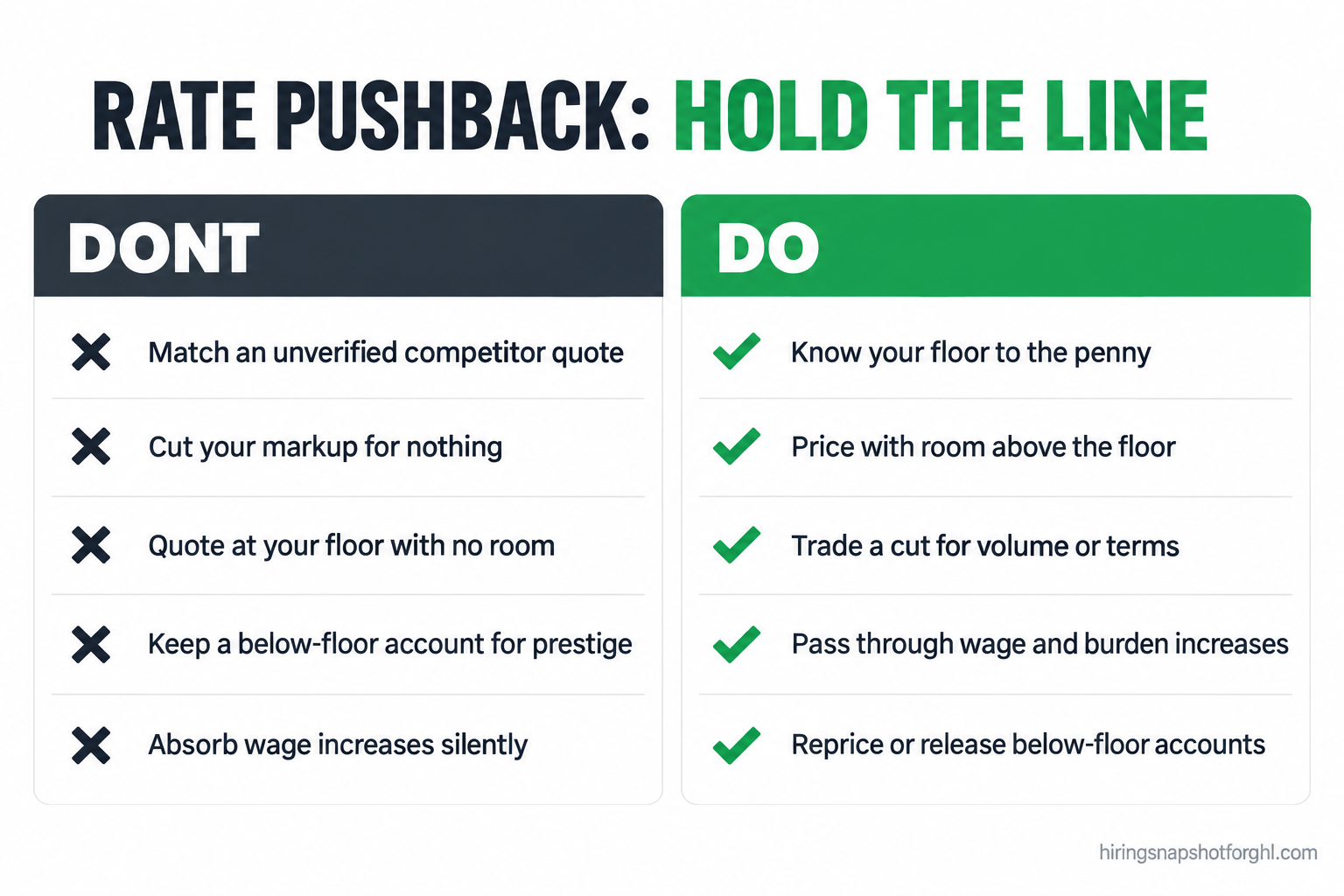
This is the stage that actually happens on the phone, and it is where most margin dies. The client says a competitor is two points cheaper and asks you to match. The losing move is to answer the rate with a rate, because the moment you negotiate on price alone you have conceded that price is all you sell, and the cheapest agency always wins that game. The winning move is to move the conversation off the rate and onto what the rate buys: your fill speed, your fill quality, your redeploy bench, the no-shows you prevent, the compliance you carry so they do not get sued.
Reframe, then trade. Reframe by making the cost of a cheap, slow agency concrete: an unfilled shift, a bad hire who walks in week two, a co-employment problem that lands on them. Then, if you give anything, trade for it rather than donating it. A lower markup in exchange for volume, a longer commitment, faster pay terms, or exclusivity on the req is a deal. A lower markup for nothing is a training exercise that teaches the client to push again. And know your walk-away before the call, because a floor you will not actually enforce is not a floor, it is a wish.
How it breaks. Negotiating against a competitor quote you have not verified, which is often a number for a worse service or a bait figure that evaporates when the client actually tries to book it. Caving in the silence, where the client goes quiet and you fill the gap by volunteering a discount nobody asked for. And making a concession permanent when it should have been a one-time, specific trade. If you must move, move once, name what you got for it, and put an expiration on it.
Steal this: the rate-pushback response email
“Thanks for the heads-up, and I appreciate you giving me the chance to talk it through rather than just making a switch. A couple of things before you decide on price alone. On the last [N] orders we filled for you, our average time-to-fill was [X days] and our first-week retention was [Y%], which is the number that actually protects your production line, because an unfilled shift or a hire who walks in week two costs you far more than a point or two of markup. If budget is the real constraint, I would rather find the savings somewhere that does not cost you fill quality: if you can commit to [volume / a longer term / net-15 terms], I can move to [specific rate] on that basis. What I can’t do is match a number that only works if the service is worse, because when it goes wrong it lands on your floor, not mine. Can we get 15 minutes to look at the actual numbers together?”
Stage 4: Recover margin on the back end
The agencies that panic over every rate conversation are usually the ones with only one lever: the markup. The ones that stay calm have three or four other places to make money, so losing a point on bill rate is an annoyance, not a crisis. Back-end recovery is how you stop being a hostage to the front-end negotiation.
Redeployment is the biggest lever. A worker you place, roll off, and re-place costs you almost nothing to source the second and third time, so the margin on a redeploy is far richer than on a cold placement where you paid full freight to find the person. A desk that reliably redeploys its bench is earning more gross margin per candidate than a desk that lets every assignment end in a cold goodbye, which is why contractor redeployment is as much a margin tool as a service one. The second lever is speed: every day you cut off time-to-fill is billed hours you capture instead of lose, and faster fills let you say yes to more orders without adding headcount. The third is mix: steering your desk toward the roles and clients where your margin is healthy, rather than chasing volume on accounts that were always thin. When the back end is working, the front-end rate is one input among several, and you negotiate from strength because you are not betting the quarter on it.
How it breaks. Treating redeployment as something that happens by luck when a recruiter remembers to call a good worker, instead of an automated nudge that fires the day someone rolls off. And chasing top-line revenue on low-margin accounts because growth feels like progress, when you are actually buying billings at a loss and papering over it with volume. Back-end recovery only works when it is systematic, which is a process and automation problem, not a hustle problem.
Stage 5: Automate rate reviews and pass-throughs
Most margin does not die in a dramatic negotiation. It erodes quietly, a half-point at a time, because nobody is watching. A worker gets a raise and the bill rate does not move, so you absorb it. Minimum wage goes up on January 1, New Jersey’s to $15.92 an hour for 2026, and the client’s rate card stays the same, so your margin on every worker at the floor just compressed and you did not even negotiate it away. The fix is to make rate review a scheduled, automatic event instead of a thing you get to when you remember.
Two mechanisms do most of the work. First, a pass-through clause in every client agreement that says any increase in pay rate, statutory burden, or minimum wage is passed through to the bill rate automatically, so a wage increase is the client’s cost, not a silent cut to your spread. Second, a standing rate-review cadence: every active assignment gets its margin checked on a schedule, and anything that has drifted below your floor triggers a conversation before it has bled for six months. This is exactly the kind of thing a CRM should be doing for you. Running GoHighLevel as your recruiting pipeline lets you tag each placement with its margin and fire an alert the moment a wage change or a calendar date pushes it under the floor, so erosion surfaces as a task, not as a bad quarter.
How it breaks. The pass-through clause that exists in the contract but nobody enforces, so the legal right to raise the rate sits unused while the margin leaks. And the rate review that depends on a human noticing, which means it happens on your best accounts and never on the ones quietly going underwater. If the review is not automated and dated, it is not happening.
Steal this: the annual bill-rate adjustment notice
“As part of our standing rate review, I am writing to update the bill rate on your current assignments effective [date]. This reflects the [state] minimum wage increase and the corresponding rise in statutory burden (payroll taxes, unemployment, and workers’ comp) that apply to these roles. Per our agreement, these increases pass through to the bill rate, and the adjustment is limited to the actual cost change, with no increase to our margin. Updated rates are attached by role. Happy to walk through the breakdown line by line if useful.”
Stage 6: Reprice or fire the accounts that won’t clear the floor
Not every account is worth keeping, and the willingness to walk is what makes every other stage credible. If the client knows, or senses, that you will never actually let them go, your floor is theoretical and they will test it forever. The final stage is the discipline to reprice or release the accounts that will not clear your floor, because a client you serve below cost is not a client, it is a subsidy you are paying for the privilege of being busy.
Run the numbers per account at least twice a year. Any account sitting below your minimum margin gets one of two conversations: a reprice, where you lay out the real cost and give them the honest rate it takes to serve them properly, or a managed exit, where you give them time to find another agency and part cleanly. Losing a below-floor account almost always makes you more money, because it frees recruiter time and payroll capacity for work that actually pays, and it removes the anchor that was dragging your whole desk’s margin down. The hardest part is emotional, not financial: a big, unprofitable account feels like security, and letting it go feels like losing. The P&L says otherwise almost every time.
How it breaks. Keeping a marquee logo at a loss for the “prestige,” which pays no bills and trains your other clients to expect the same rate when they hear about it. And repricing with a threat instead of a straight business case, which turns a rational conversation into a fight. Reprice with numbers and a calm tone, give a real alternative, and mean it when you say the floor is the floor.
Three scenarios: solo, 8-seat, and 25-seat
The system is the same at every size. Where the pressure lands is not.
The solo contingency recruiter, perm placements, 20 to 25% fees. Your margin fight is not over a markup, it is over your fee percentage, and the pushback sounds like “can you do 15%?” The math is just as brutal: on a $70,000 placement, dropping from 22% to 18% is $2,800 out of a single fee, and on a perm desk you do not have volume to make it up. Your version of Stage 2 is pricing with room and refusing to anchor on the discount, and your version of Stage 3 is trading a lower fee only for something real, exclusivity on the search or a longer fallback guarantee, never for nothing. Standard contingency fees run 15 to 25%, with 20% the most common and senior roles higher, so know where you sit in that band and defend it with your fill record, not your willingness to discount. Stage 4 for you is reactivating your own database so you fill faster and depend less on winning any one fee negotiation.
The 8-recruiter light-industrial agency, temp and temp-to-hire, 40 to 80% markup. This is where margin compression does the most damage, because one anchor account pushing you down two points can erase a recruiter’s worth of profit, and you probably have two or three accounts doing it at once. All six stages are live, and Stage 5 is the one that pays back fastest: at your volume, silent erosion from un-passed-through wage increases is bleeding you more than any single negotiation, and automating the pass-through and the margin alerts stops it. Watch your blended gross margin by account, not just agency-wide, because the average hides the accounts that are quietly underwater. The metrics worth tracking are in the 2026 staffing benchmarks.
The 25-recruiter healthcare or high-volume shop. Here the pushback is institutional, not personal: you are dealing with procurement, rate cards, and sometimes a vendor management system that caps your markup before you ever talk to a human. Your defense moves upstream, into how you qualify a client and a req before you accept it, so you are not stuck defending a rate on business you should have priced or declined at intake. Qualifying hard at the front, the way the job-order qualification playbook lays out, is your margin defense at this scale, because by the time a low-margin order is in your system the compression already happened. Stage 6 is non-negotiable here: with this many accounts you will always have some below the floor, and the discipline to reprice or exit them is what keeps the blended margin healthy.
The compliance side: co-employment and pay transparency
Two compliance realities shape how you can talk about rate, and getting them wrong costs more than any markup concession. The first is co-employment. In a staffing arrangement, you and the client share certain legal responsibilities for the worker, wage compliance, safety, and the rest, which means the risk you carry is real and is part of what your margin pays for. When you defend your rate, that shared liability is a legitimate part of the value, but do not market it away by promising to take on obligations that are legally the client’s, because a marketing claim that blurs who employs the worker can deepen your co-employment exposure, not reduce it.
The second is pay transparency. With salary-range posting now required in fourteen states plus DC, and states like New Jersey barring vague ranges and capping how wide a posted range can be, the pay rate is increasingly visible, which is part of why clients feel confident guessing at your markup. Two practical notes. First, when the agency places the posting, the agency can carry liability for whether it meets the state’s transparency rules, so this is your compliance problem, not only the client’s. Second, visible pay does not mean your margin is indefensible: the markup pays for burden, risk, speed, and compliance, none of which show up in a posted wage, and that is exactly the conversation Stage 3 is built to have. This is general information, not legal advice, so confirm the current rules in your state with counsel.
Common objections, answered
“If I don’t drop the rate, I’ll lose the account.” Sometimes. But run the real number before you assume it: an account served below your floor is costing you money to keep, so losing it can improve your P&L even as it hurts your pride. More often the threat is a negotiating move, not a decision, and holding your floor calmly, with your fill record in hand, keeps far more accounts than owners expect. The ones you lose by refusing to serve at a loss are the ones you were better off without.
“My competitor genuinely bills below my floor. How do I compete with that?” You do not, on price, and you should not try. An agency billing below what the burden and risk actually cost is either cutting corners you will get blamed for or heading for trouble, and matching them just means you go down with them. Compete on the things a cheap agency cannot do: fill speed, retention, redeploy bench, and the compliance you carry. If a client only wants the cheapest number and nothing else, that is a client you let the cheap agency have, because they will cost you more than they pay.
“The client says my markup is too high because the worker is low-skill and cheap.” The markup is not a function of the worker’s skill, it is a function of your cost and risk, and a low-wage light-industrial role often carries higher workers’ comp and higher turnover, which makes it more expensive to run, not less. Walk them through the fully loaded cost: the burden, the recruiting churn on high-volume roles, the compliance. The point lands better with the bill-rate math in front of them than as an assertion.
“Isn’t automating rate reviews overkill for a small desk?” The opposite. A small desk feels every point more acutely because there is no scale to absorb it, and a small desk is exactly where silent erosion goes unnoticed because nobody has time to audit margins by hand. Automating the pass-through and the margin alert is cheaper and more reliable than hoping you catch the drift, and it is the single highest-impact thing a small shop can do to protect its spread.
FAQ
What is margin compression in staffing?
Margin compression is the gradual or sudden shrinking of the gross margin a staffing agency keeps on a placement, the spread between the bill rate and the fully loaded cost of the worker. It happens through direct rate pushback, when a client negotiates your markup down, and through silent erosion, when wages, minimum-wage increases, or statutory burden rise but the bill rate does not move to match. Because temp staffing gross margins average around 25%, even a few points of compression removes a large share of what the agency actually keeps.
How much does cutting my markup actually cost me?
More than it feels like, because a few points of markup is a large share of a thin margin. On an $18/hr light-industrial worker with an 18% burden, cutting the markup from 55% to 45% drops gross profit per billed hour from $6.66 to $4.86, which is 27% less profit on the same placement. Across ten full-time workers for a year, roughly 20,000 billed hours, that is about $36,000 of gross profit, enough to fund a recruiter. Always convert a markup concession into annual dollars before you agree to it.
How do I respond when a client asks me to match a competitor’s lower rate?
Move the conversation off the rate and onto what the rate buys, then trade rather than donate. Make the cost of a slow or low-quality agency concrete, an unfilled shift or a hire who walks in week two, and point to your own fill speed and retention. If you give anything on rate, trade it for volume, a longer term, faster payment, or exclusivity, and make the concession specific and time-limited. Never match an unverified competitor number for nothing, because it only works if the service is worse and the problem lands back on the client.
What should my minimum gross margin be?
There is no single right number, because it depends on your burden, your overhead, your payment terms, and the risk of the role, which is why you set your own floor rather than copy a benchmark. Build it per role: fully loaded cost (pay plus payroll taxes, unemployment, and the job-specific workers’ comp) plus the minimum margin that covers your overhead, your payroll float, and your collection risk on slow-paying clients. Industry-average temp gross margin sits around 25%, but your floor for a given role may be higher or lower, and the point is to know it precisely so you know exactly where you walk.
How do I stop my margin from eroding silently?
Put a pass-through clause in every client agreement so wage, minimum-wage, and burden increases automatically raise the bill rate, and run a scheduled, automated rate review so any assignment drifting below your floor triggers a conversation before it bleeds for months. Most margin is not lost in a negotiation, it leaks when a raise or a January 1 minimum-wage increase is absorbed instead of passed through. Tagging each placement with its margin in your CRM and firing an alert when a wage change or calendar date pushes it under the floor turns erosion into a task you handle, not a soft quarter you discover later.
Should I fire a client that won’t pay my floor rate?
Usually yes, after you try to reprice. An account served below your floor costs you money to keep and drags down your blended margin, so releasing it typically frees recruiter time and payroll capacity for work that actually pays. Run each account’s margin at least twice a year, give below-floor accounts a straight repricing conversation with the real cost laid out, and part cleanly with the ones that still will not clear it. A big unprofitable account feels like security, but the P&L almost always says you are better off without it.
About the author
Marcus Delgado is the Staffing Agency Growth Lead behind the Hiring Snapshot. He ran a light-industrial staffing desk before joining the team to focus on agency growth, and he thinks in placement economics: fill rates, redeploys, recruiter productivity, and gross margin per requisition. His posts lean on real desk math, not vanity metrics.
Related reading
- Staffing Agency Bill Rate & Markup: The Margin Math That Keeps a Desk Profitable
- Staffing Agency Cash Flow: How to Cover Payroll When Clients Pay Net-60
- Contractor Redeployment: The Automation That Turns One Placement Into Three
- How to Reduce Time-to-Fill: The GoHighLevel Playbook to Cut Days-to-Fill in Half
- Staffing Industry Benchmarks 2026: The Recruiting Metrics That Actually Matter