· Marcus Delgado · Growth · 14 min read
Answer Engine Optimization for Staffing Agencies: How to Get Cited by ChatGPT, Perplexity & Google AI Overviews (2026)
A hiring manager now asks ChatGPT 'best staffing agency for warehouse roles' instead of Googling it — and 68% of searches never send a click at all. Here's the operator's playbook for getting your recruiting desk named inside the AI answer.
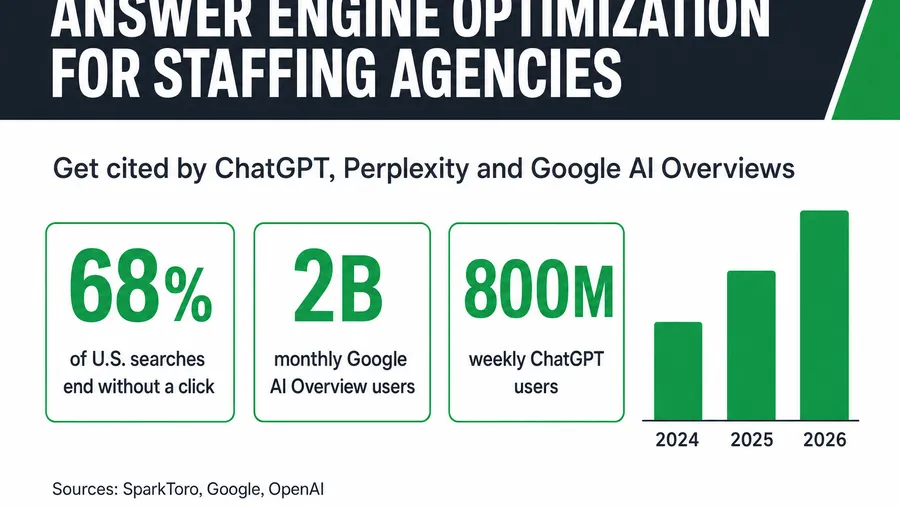
Short answer: Answer Engine Optimization (AEO) is the practice of structuring your staffing agency’s website and content so AI answer engines — ChatGPT, Perplexity, and Google’s AI Overviews — name and cite you when a hiring manager or candidate asks them a question. It matters now because the click is disappearing: roughly 68% of U.S. Google searches ended without a click in early 2026 (SparkToro), and when Google shows an AI summary, users click a result only about 8% of the time (Pew Research Center). If your agency isn’t inside the answer, you’re invisible — no matter how good your desk is. This is the operator’s playbook: what AEO and GEO actually are, why the numbers force the change, and the exact steps to make your recruiting agency citable.
Key takeaways
- Search stopped sending clicks. About 68% of U.S. Google searches ended without a click in early 2026, up from ~60% in 2024 (SparkToro).
- AI answers are the new front page. Google’s AI Overviews reached 2 billion monthly users across 200 countries by mid-2025 (TechCrunch), and ChatGPT hit 800 million weekly active users by October 2025 (TechCrunch).
- The AI Overview kills the click. When an AI summary appears, only 8% of users click any result (vs 15% without one), and just 1% click a source link inside the summary (Pew Research Center).
- Your buyers already do this. 45% of B2B buyers used generative AI in their buying process (Gartner), and 51% of B2B software buyers now start their research in an AI chatbot (G2 via PR Newswire).
- Citability is engineerable. Adding concrete statistics, quotations, and cited sources can lift a page’s visibility in AI answers by up to 40% (Princeton “GEO” study).
- The stakes are a $124B market. U.S. staffing sales were $124.0 billion in 2024, employing about 2.2 million temp and contract workers a week (American Staffing Association) — a lot of reqs decided by whoever the buyer finds first.
Table of contents
- What AEO is — and how it differs from SEO
- Why the click is disappearing
- Your candidates and clients already ask AI first
- How AI answer engines decide who to cite
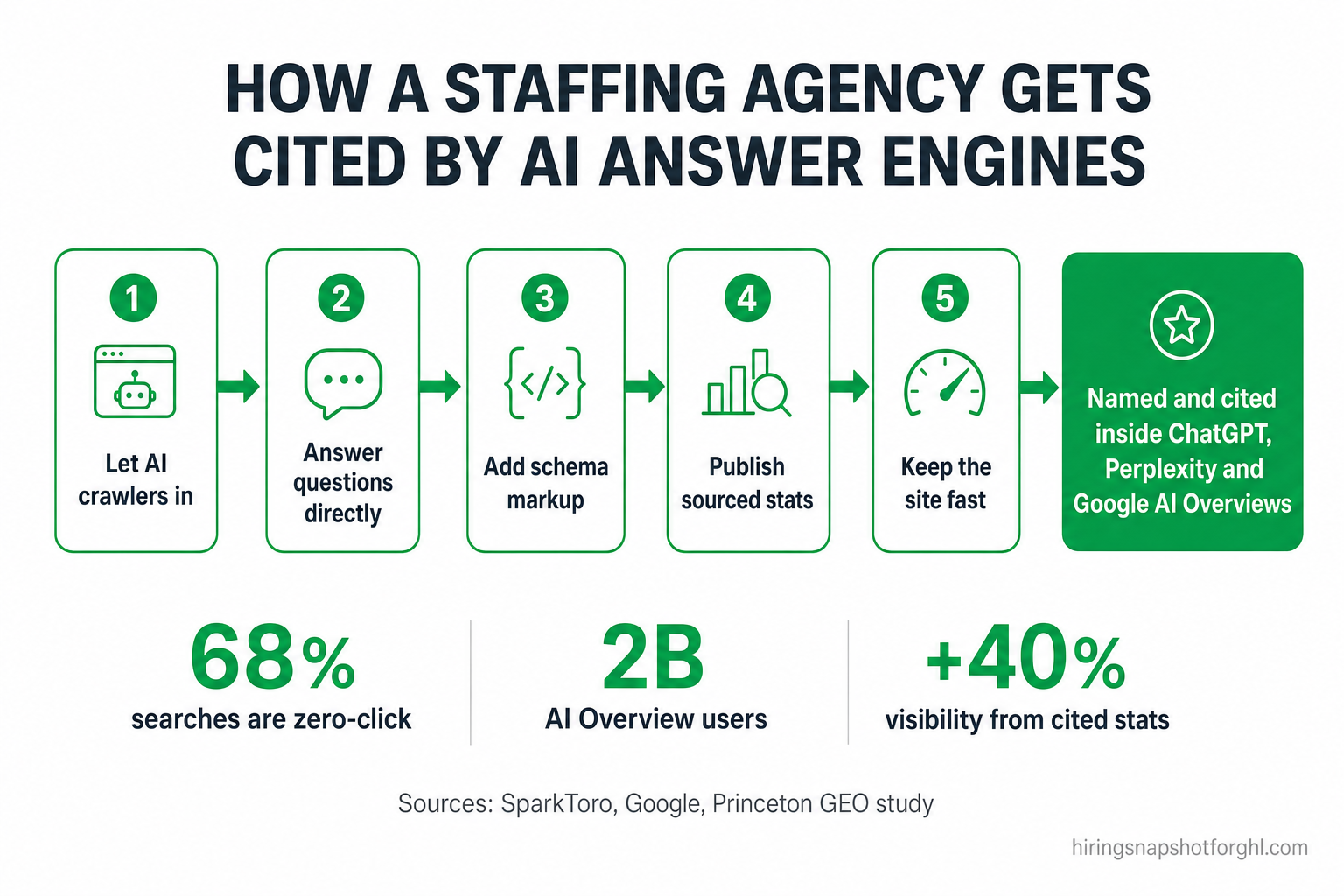
- The 6-step AEO playbook for a staffing agency
- What actually makes your content citable
- AEO, GEO, and local SEO are the same work
- FAQ
What AEO is — and how it differs from SEO
Classic SEO optimizes to win a ranking — position one on a page of blue links a human then clicks. Answer Engine Optimization (AEO) optimizes to win a citation — to be the source an AI assistant pulls from and names when it composes an answer. The related term GEO (Generative Engine Optimization) means the same thing academically: shaping content so generative engines surface it. In practice, for a staffing operator, AEO and GEO are one job — make your agency the answer, not just a result.
The difference isn’t academic. On a ranked results page, being fifth still earns clicks. Inside an AI answer, there is no “fifth” — the engine names one to three sources and paraphrases the rest into oblivion. A hiring manager who types “which staffing agency is best for high-volume warehouse hiring in the Midwest” into ChatGPT gets a written recommendation, not ten links. If your desk isn’t in that recommendation, the buyer never learns you exist. AEO is how you get into it.
Why the click is disappearing
The shift isn’t hype — it’s measurable, and it’s steep. Start with the headline: in early 2026, roughly 68% of U.S. Google searches ended without a click, up from about 60% in 2024 (SparkToro). Fewer than one in three searches now sends a visitor to any website. The rest are answered on the results page itself — increasingly by an AI Overview.
And those AI answers are now mainstream infrastructure, not a beta. Google’s AI Overviews reached 2 billion monthly users across 200 countries and 40 languages by mid-2025 (TechCrunch). ChatGPT crossed 800 million weekly active users by October 2025 (TechCrunch). Perplexity reported handling roughly 780 million queries a month as of May 2025 (Just Think AI). These are the surfaces your market now uses to decide things.
The clincher is what happens to the click when an AI answer shows up. Pew Research Center tracked the browsing of 900 U.S. adults and found that when a Google AI summary appeared, users clicked a traditional search result only 8% of the time — versus 15% when there was no summary — and only 1% clicked a link inside the AI summary itself (Pew Research Center):
Ahrefs, studying 300,000 keywords, found the same pattern from the other side: the presence of an AI Overview cut clicks to the top-ranking page by about 34.5% (Ahrefs). Ranking number one used to be the finish line. Now, if an AI answer sits above you and doesn’t cite you, first place leaks a third of its traffic. The only durable defense is to be in the answer.
Your candidates and clients already ask AI first
For a staffing desk this isn’t a far-off consumer trend — it’s your actual buyers, today. 45% of B2B buyers reported using generative AI in their buying process (Gartner), and in software buying specifically, 51% now start their research in an AI chatbot, up from 29% a year earlier (G2 via PR Newswire). The HR director evaluating whether to bring on a staffing partner behaves like every other B2B buyer: they open ChatGPT and ask.
Candidates do it too. A warehouse associate weighing offers, a nurse comparing travel agencies, a job seeker asking “is [agency] a good staffing company to work for” — these questions increasingly get answered by an AI that synthesizes reviews, your site, and third-party mentions into a verdict. That verdict is being written whether or not you participate in shaping it. AEO is how you participate.
The market is big enough that being named matters. U.S. staffing industry sales hit $124.0 billion in 2024, with agencies employing roughly 2.2 million temporary and contract workers in an average week (American Staffing Association). Every one of those placements started with someone deciding which agency to trust — a decision an answer engine is now quietly influencing.
How AI answer engines decide who to cite
Answer engines don’t rank pages the way a classic search index does. They retrieve passages and generate a synthesis, then attach citations to the sources they leaned on. Three things make a passage retrievable and quotable:
- Structure they can parse. Clean HTML, real headings, and structured data (schema) tell the model exactly what your page is, who you are, where you operate, and what you offer. Ambiguity gets skipped.
- Self-contained, answer-first passages. Models lift passages that stand on their own — a question-shaped heading followed by a direct, complete answer. A paragraph that only makes sense after three prior paragraphs is hard to quote, so it rarely gets quoted.
- Signals of authority. Concrete numbers, named sources, quotations, and consistent entity information across the web tell the model your content is trustworthy enough to cite.
There’s also a plumbing layer. AI crawlers need to be allowed to read you (a robots.txt that welcomes them, not one that blocks GPTBot or PerplexityBot), and your facts need to be consistent everywhere they appear. An emerging convention, llms.txt — a plain-Markdown file at your domain root that points AI tools to your key pages — is being adopted by a growing share of sites, though no major AI provider has formally committed to consuming it yet (Index Lab). Treat it as cheap insurance: easy to ship, harmless if ignored, potentially useful as engines evolve. (Every site we build ships one automatically — more on that below.)
The 6-step AEO playbook for a staffing agency
Here’s the sequence that makes a recruiting desk citable, in order. Each step compounds the next.
1. Let the AI crawlers in
Before anything else, make sure answer engines can actually read you. Check your robots.txt doesn’t block AI user-agents like GPTBot, PerplexityBot, ClaudeBot, or Google-Extended. Blocking them is like unplugging your phone and wondering why no one calls. Then ship a clean sitemap.xml and an llms.txt that lists your money pages and best content, so crawlers find your important pages fast.
2. Answer questions the way your buyers ask them
Restructure your key pages and posts to be answer-first: lead each section with the literal question a hiring manager or candidate would type, then answer it in the first two sentences, completely, before the supporting detail. “How much does a staffing agency charge?” “How fast can you fill a warehouse shift?” “Is [agency] good to work for?” Each becomes a heading with a self-contained answer underneath — the exact shape an engine can lift and cite.
3. Add structured data (schema) to every page
Schema is the machine-readable layer that removes ambiguity. An Organization block establishes who you are; LocalBusiness with your address and service area tells engines where you operate; Service blocks with areaServed spell out what you do and for whom; FAQPage markup makes your Q&A extractable. Most page builders make schema awkward or impossible to edit — which is exactly why so many agency sites are invisible to answer engines.
4. Publish citable, sourced content
Answer engines cite content that carries verifiable facts. Publish real placement statistics, quotable client outcomes, and niche playbooks — each with a source — instead of vague “we deliver results” copy. This is where a consistent content engine that ranks a staffing agency for local terms pays double: the same posts that win Google also feed the answer engines their raw material.
5. Build authority signals off-site
Models weigh consistency and reputation. Keep your Name, Address, and Phone identical everywhere; earn and respond to reviews (the same recency and volume that win the Google map pack also feed AI reputation summaries); and get named on relevant industry sites. Consistent entities across the web make a model confident enough to cite you by name.
6. Be fast, so you’re worth citing — and clicking
The rare click an AI answer does send is precious; a slow site wastes it. Page speed is also a Google ranking signal, and speed underpins the crawlability answer engines depend on. This is foundational enough that our Astro vs GoHighLevel website comparison breaks down why a page-builder site struggles to be fast, editable, and schema-rich at the same time — the three things AEO needs most.
What actually makes your content citable
The single most useful research for a staffing operator is Princeton’s “GEO: Generative Engine Optimization” study, which tested which content changes actually increase visibility inside AI answers. The winners weren’t keyword tricks — they were credibility signals. Adding concrete statistics, quotations, and cited sources boosted a page’s visibility in generative answers by up to roughly 40% (Princeton GEO study):
This maps perfectly onto how a good staffing agency already talks. Instead of “we reduce time-to-fill,” publish “we cut a light-industrial client’s time-to-fill from 14 days to 9.” Instead of “our candidates are reliable,” quote the client: “‘Their associates showed up at a 96% rate through peak season.’” Instead of unsourced claims, link the benchmark. Every concrete, sourced, quotable number you publish is a hook an answer engine can grab — and a reason to name you instead of a competitor.
AEO, GEO, and local SEO are the same work
Here’s the part that should relieve a busy operator: you don’t run three separate programs. The work that makes you citable by AI is the same work that wins the local map pack and the same work that ranks you in classic Google. Complete structured data, answer-first content, fast pages, consistent NAP, and steady reviews feed all three surfaces at once. Optimize for the answer engine and you optimize for everything.
What changes is the cost of neglecting it. When results were ten blue links, a mediocre site still caught some clicks. Now, with two-thirds of searches ending click-free and AI answers naming a handful of sources, the gap between “cited” and “invisible” is total. The agencies that win the next few years of inbound won’t be the ones with the biggest ad budget — they’ll be the ones whose website was built, from the ground up, to be the answer. That’s the whole thesis of how we build: fast Astro sites with the schema, the llms.txt, the answer-first structure, and the content engine that make a recruiting desk quotable. If you’d rather not assemble all of that by hand, that’s exactly what we ship — and it starts with a strong GoHighLevel recruiting foundation behind it.
FAQ
What is Answer Engine Optimization (AEO)? AEO is the practice of structuring a website and its content so AI answer engines — like ChatGPT, Perplexity, and Google’s AI Overviews — cite it as a source when they generate an answer. Unlike classic SEO, which competes for a clickable ranking, AEO competes to be named inside the answer itself, which matters more as search shifts to AI summaries that rarely send a click.
Is AEO different from GEO and SEO? AEO and GEO (Generative Engine Optimization) describe the same goal — being surfaced and cited by generative AI. Both overlap heavily with SEO: structured data, answer-first content, fast pages, and authority signals help you in classic search and in AI answers. For a staffing agency, it’s one program, not three.
Why does AEO matter for a staffing agency specifically? Because your buyers already use AI to research. About 45% of B2B buyers used generative AI in their buying process, and 51% of software buyers now start research in an AI chatbot. When an HR director asks an AI which staffing partner to use, or a candidate asks whether you’re good to work for, AEO determines whether your agency is named in the reply or left out entirely.
How do I know if AI can even read my website? Check your robots.txt for rules blocking AI crawlers such as GPTBot, PerplexityBot, ClaudeBot, or Google-Extended — if they’re blocked, engines can’t cite you. Then confirm you have a clean sitemap.xml, valid schema markup, and answer-first content. Slow, JavaScript-heavy, or schema-poor sites are the hardest for answer engines to parse and quote.
What content gets cited most by AI answer engines? Content with credibility signals. Princeton’s GEO study found that adding concrete statistics, quotations, and cited sources lifted a page’s visibility in AI answers by up to about 40%, while keyword stuffing did nothing. For staffing, that means publishing real, sourced placement metrics and quotable client outcomes rather than vague claims.
Written by Marcus Delgado, Staffing Agency Growth Lead for the Hiring & Staffing GHL Snapshot. Marcus ran a light-industrial staffing desk before joining the snapshot team, thinks in placement economics — fill rates, redeploys, and gross margin per requisition — and translates those numbers into the systems and visibility that actually move them.
Related reading