· Marcus Delgado · Growth · 26 min read
Recruiter Turnover in Staffing Agencies: The Real Cost and the System That Keeps Your Best Desk (2026)
Your best recruiter just gave notice, and their pipeline is walking out with them. Here is what one departure actually costs a staffing desk, why recruiters really quit, and the six-stage retention system that keeps them, from the 90-day ramp to desk continuity when someone does leave.
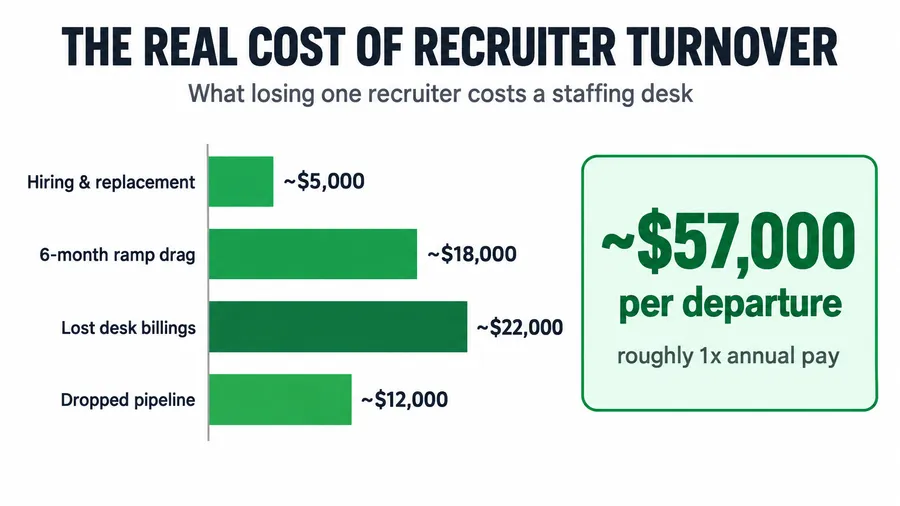
It is a Monday morning and your second-best recruiter, the one who owns two of your three anchor accounts, is standing in your doorway with that look. You already know. By Friday they are gone, and so is a live pipeline of eighteen candidates, a warm req from a client who trusts them and not you, and roughly six months of everything you spent teaching them the desk. You will spend the next quarter trying to get back to where you were last Thursday.
The short answer: recruiter turnover is not bad luck, it is an unmanaged system, and it costs a staffing desk far more than the recruiter’s salary. Losing one recruiter runs from half to two times their annual pay once you count the empty seat, the ramp of a replacement, and the pipeline that goes cold in between. You cut it the same way you cut time-to-fill: hire for the desk instead of the resume, ramp new people on a real 90-day plan, pay in a way that survives a slow month, strip out the busywork that burns people out, and build the desk so a resignation does not torch a pipeline. This is the whole retention system, with the real numbers, the copy you can steal, and the traps that sink desks that treat people as replaceable.
Key takeaways
- One departure costs 0.5 to 2 times salary. Gallup puts the cost of replacing an employee at one-half to two times their annual salary, and SHRM’s figure runs 50% to 200% depending on seniority. For a recruiter, the pipeline they take with them is on top of that.
- Early turnover is getting worse. New-hire 90-day retention across recruiting desks fell to 84.6% in 2025 from 93.9% the year before, so more of the people you hire are gone before they ever produce.
- The seat is empty for months either way. A new recruiter takes months to ramp, so every departure is a multi-month cash drag whether or not you fill the chair quickly.
- HR and recruiting churn hardest. LinkedIn’s analysis found human-resources roles had the highest turnover of any function at 14.6%, above the 10.6% all-role average. You are trying to retain people in the very function that leaves the most.
- Continuity is the real insurance. A shared, automated pipeline means the candidates and client history stay with the agency, not in one recruiter’s head and phone, so a resignation costs you a person, not an account.
Table of contents
- The turnover math nobody puts on the P&L
- Why recruiters actually quit
- The retention system, six stages
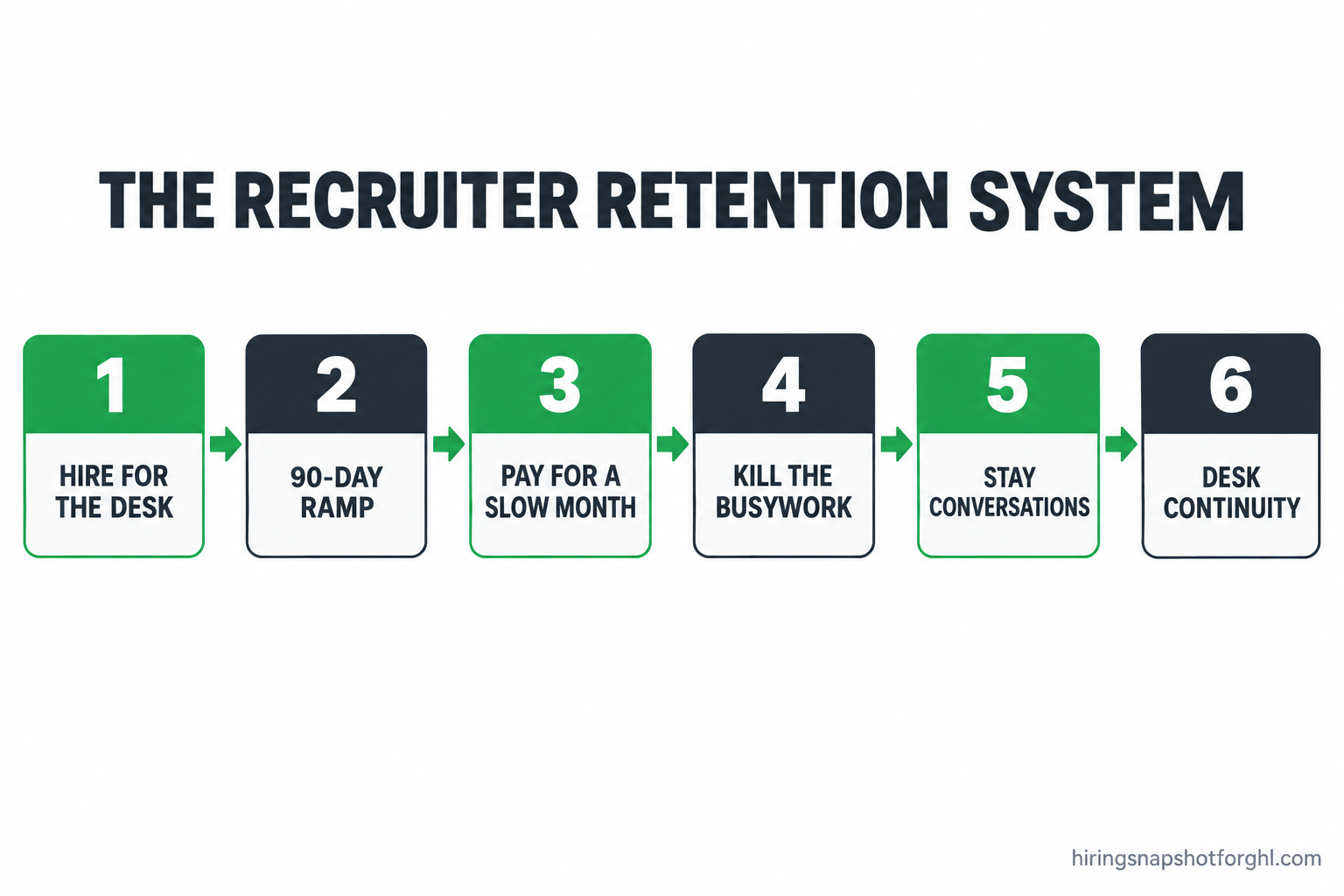
- Stage 1: Hire for the desk, not the resume
- Stage 2: Ramp on a real 90-day plan
- Stage 3: Pay in a way that survives a slow month
- Stage 4: Kill the busywork that burns people out
- Stage 5: Run stay conversations before exit interviews
- Stage 6: Build desk continuity so a resignation is survivable
- Three scenarios: solo, 8-seat, and 25-seat
- The legal side: non-competes, non-solicits, and what you can protect
- Common objections, answered
- FAQ
The turnover math nobody puts on the P&L
There are roughly 27,000 staffing and recruiting companies in the United States running about 54,000 offices, and together they put around 2.2 million temporary and contract workers to work in an average week (American Staffing Association). The industry obsesses over the turnover of those temps, and rightly so, because the ASA has measured temp and contract turnover at 419%. The turnover that quietly does more damage to a small desk is the one nobody puts a number on: your own recruiters walking out the door.
Start with the industry-standard cost. Gallup estimates that replacing an employee costs one-half to two times their annual salary, and SHRM lands in the same neighborhood at 50% to 200% of salary, with the top of the range reserved for senior and hard-to-replace roles. A recruiter is squarely in the expensive half of that band, because the job is relationship-heavy and slow to ramp, and because a recruiter carries revenue-producing assets in their head that a warehouse temp does not.
For a light-industrial desk, put the pieces together for a recruiter on a $55,000 base with commission on top. The pure hiring cost of a replacement, advertising, screening, and your own time, tracks close to SHRM’s average cost per hire. Then the seat sits half-productive for months while the new person ramps, the desk’s billings sag while it is uncovered, and the departing recruiter’s live pipeline goes cold because relationships do not transfer on a spreadsheet. Add those up and a single departure lands near the recruiter’s total annual pay, comfortably inside Gallup’s 0.5-to-2x range, and none of it shows up as a line item until the quarter ends soft.
The reason this matters more now is that early turnover is climbing. Across recruiting desks, 90-day new-hire retention slipped to 84.6% in 2025 from 93.9% a year earlier, meaning roughly one in six new recruiters is gone inside a quarter, before they have placed enough to cover their own cost. And the function you are hiring into is the leakiest one there is: LinkedIn’s data put HR and recruiting at the top of the turnover table at 14.6%, against a 10.6% average across all roles. Broad voluntary turnover has actually cooled, from a pandemic-era peak toward the 13% range in Mercer’s 2025 survey, but recruiting still churns above the pack. You are swimming against the current of your own profession.
Why recruiters actually quit
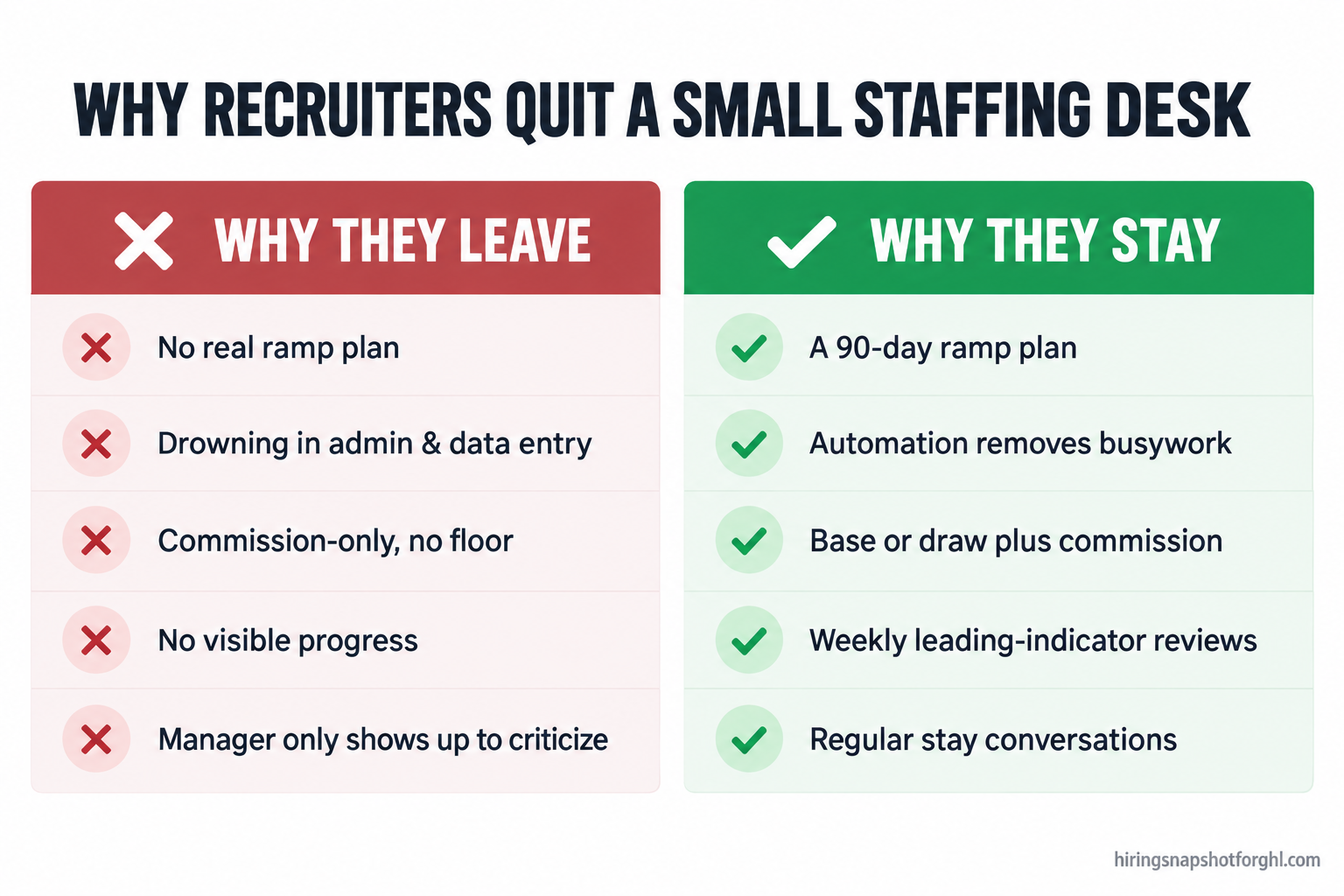
Owners love to blame comp, because comp is the easy story and the one that lets you off the hook. Sometimes it is comp. More often, in a small shop, it is three other things stacked on top of each other, and the exit interview never surfaces them because by then the person is already checked out.
The first is a bad ramp. A recruiter who gets tossed a job board login and a “go get ‘em” on day one, with no training and no protected pipeline, does not fail loudly. They grind for four months, miss quota because nobody set them up to hit it, feel like a failure, and leave for a competitor who at least pretends to have a plan. You did not lose a bad recruiter. You lost a fine recruiter to a bad onboarding.
The second is administrative drag. Recruiting is a relationship job that has quietly turned into a data-entry job, and the good ones can feel the difference between the work they love and the work that is eating their day. When a recruiter spends half their week copying candidate details between a job board, a spreadsheet, and a CRM, formatting resumes, and chasing timesheet approvals, the part of the job that made them good gets squeezed into the margins. Burnout in this business is rarely too many placements. It is too much friction around too few.
The third is invisibility of progress. A recruiter on a long search with nothing closed feels like they are drowning even when the pipeline is healthy, because nobody is showing them the leading indicators. No comp plan survives a person who cannot see that they are winning. Fix the ramp, the friction, and the visibility and you have addressed most of what actually drives a recruiter out, usually before you have touched base pay at all.
The retention system, six stages
Retention feels like a personality trait of good bosses and it is really a set of systems. The desks that keep recruiters are not the ones with the warmest owner. They are the ones that make it easy to succeed early, hard to drown in busywork, and safe to have an honest conversation before someone is halfway out the door. Six stages, and they compound: a great ramp makes comp go further, automation makes the ramp faster, continuity makes the whole thing survivable when someone leaves anyway.
Stage 1: Hire for the desk, not the resume
Most recruiter turnover is decided at the hiring stage, not the quitting stage. The mis-hire who is gone in 90 days was usually a mismatch you could have seen: a corporate recruiter dropped onto a high-volume light-industrial desk, an executive-search closer asked to run temp orders, a great salesperson with no stomach for the grind of sourcing. The resume looked right and the desk was wrong.
Hire against the specific desk. A high-volume hourly desk needs someone who is energized, not deadened, by pace and repetition and texting fifty candidates before lunch. A skilled or perm desk needs patience and a longer memory. Screen for the failure you actually see, which in staffing is almost always resilience and follow-through, not raw talent. Ask a candidate to walk you through the last placement that fell apart on them and what they did the next morning. The person who has a crisp answer has lived the job. The person who has never had one has not.
How it breaks. The classic failure is hiring in a panic because a desk is bleeding, which is exactly when you skip the screen and take the first warm body. That warm body becomes next quarter’s departure and you run the whole expensive cycle again. The other failure is hiring a clone of your best recruiter and expecting the same output on a different desk. Match the person to the work in front of them, not to the last person who sat there.
Steal this: the two recruiter-screen questions that predict tenure
“Tell me about the last search or order that completely fell apart on you. What happened, and what did you do the next morning?” (You are testing resilience and ownership, the traits that survive a slow month.)
“Walk me through a normal Tuesday at your last desk, hour by hour. Where did your time actually go?” (You are testing whether they know the real rhythm of the work and whether they can stand it. Vague answers mean they never did the volume.)
Stage 2: Ramp on a real 90-day plan
A new recruiter is a cash drain until they produce, and how long that drain lasts is mostly up to you. The desks that ramp people fastest do not have smarter hires, they have a written plan that turns the first 90 days into a sequence instead of a shrug. The widely used shape is simple: system and process fluency in the first month, supervised live work in the second, and independent ownership with lighter check-ins in the third.
The point of the plan is not paperwork. It is protecting a new recruiter from the two things that make them quit early: the feeling that they are failing, and the reality that they might be, because you gave them a cold desk and no coaching. Hand them warm, structured work early. Let them run a piece of a live req under supervision in week three, not month three. Show them a leading-indicator scoreboard, calls made, candidates submitted, interviews booked, so they can see progress weeks before a placement closes and the paycheck follows.
How it breaks. Two ways. The plan exists as a document nobody follows, so week one is orientation and week two is abandonment. Or the ramp has no numbers attached, so neither you nor the recruiter knows whether they are on track until the quarter ends and it is too late to correct. A ramp without a scoreboard is a wish. The scoreboard is what lets you catch a struggling new hire in week four, when a conversation still fixes it, rather than week fourteen, when they are already interviewing elsewhere. If you want the productivity side of this, the mechanics of shortening the whole cycle live in the guide to reducing time-to-fill.
Steal this: the recruiter 30-60-90 ramp plan
Days 1-30, learn the machine. CRM and pipeline fluency, your submittal and quality standards, shadow two recruiters, own candidate sourcing on one live req under a mentor. Target: X calls and Y candidate submissions per week, no placement pressure yet.
Days 31-60, supervised live work. Own two reqs end to end with daily standups and call reviews. First placements expected here. Target: full pipeline activity plus first submittals-to-interview.
Days 61-90, independent with a net. Own a full desk, weekly one-on-one instead of daily, coaching on the deals that stall. Target: first placements banked and a pipeline that projects to quota next quarter.
Attach a real number to every “target.” A ramp without numbers is decoration.
Stage 3: Pay in a way that survives a slow month
Commission-only feels efficient to an owner and reads as “you do not believe in me” to a recruiter, especially a new one who cannot control how long a ramp takes. The desks with the worst turnover are almost always the ones that put a green recruiter on straight commission and act surprised when they leave during the first dry spell, right before the pipeline they built would have paid off.
Pay a base or a recoverable draw during the ramp, then transition to base plus commission or a draw against commission once they are producing. The base is not charity, it is what keeps a good recruiter from bailing in month three of a six-month ramp, which is the single most expensive moment to lose someone because you have paid all the ramp cost and banked none of the return. Structure commission on things the recruiter controls, submittals, interviews, placements, and redeploys, and pay it fast. A recruiter who waits 90 days to see commission on a placement has a cash-flow problem that looks a lot like a reason to quit. Whether the numbers work at all comes back to your spread, and the real math of markup, burden, and what is left to pay people is walked through in the bill rate and markup guide.
How it breaks. The draw with no clear recovery terms, so a recruiter racks up a “debt” they did not understand and quits owing you money and resenting it. Or a comp plan so complicated nobody can predict their own check, which kills the motivation the plan was supposed to create. And clawbacks that punish a recruiter for a candidate who quit a placement for reasons they could not control, which is a fast way to lose your best people to a competitor with a cleaner plan.
Steal this: the comp-plan explainer line for a new recruiter
“For your first 90 days you are on a base of $X so you can learn the desk without worrying about your rent. Starting month four you move to base plus commission: you earn [rate] on every placement and [rate] on every redeploy, paid the pay period after the client is invoiced, not when they pay us. Here is a sheet showing what a normal month and a strong month look like in take-home. Any surprise in your check is a mistake, and I want you to tell me.”
Stage 4: Kill the busywork that burns people out
This is the stage owners underrate, and it is the one your recruiters would put first. Ask a recruiter what they hate about the job and they will not say “sourcing” or “closing.” They will say the copy-paste. The moving of a candidate from Indeed to the spreadsheet to the CRM. The manual resume formatting. The chasing of a timesheet approval. The forty texts sent one at a time. That friction is where burnout actually lives, and it is almost all automatable.
The fix is to take the low-value, high-frequency work off the recruiter’s plate so the desk gives back the hours to the part of the job they are good at. New applicants get captured, texted, and pre-qualified automatically instead of by hand. Interview reminders and no-show follow-ups fire on a schedule. Redeploy nudges go out to candidates rolling off assignment without a recruiter remembering to send them. The recruiter spends their day on judgment and relationships, which is the work that keeps them, instead of data entry, which is the work that drives them out. Turning GoHighLevel into a real recruiting pipeline is how a lot of small desks pull this off without buying a heavyweight ATS, and desks that do not want to run it themselves often add a trained GoHighLevel virtual assistant to own the admin so recruiters never touch it.
How it breaks. The tools exist but live in one person’s head, so the automation is really just that one recruiter, and when they leave it leaves with them. Or the agency buys software and never configures it, so the recruiters keep doing everything by hand next to an empty CRM they resent. Automation only reduces turnover when it is actually installed and actually used, which is a process problem, not a purchase.
Stage 5: Run stay conversations before exit interviews
The exit interview is the most useless meeting in staffing, because it happens after the decision. By the time someone is telling you why they are leaving, you have already lost them and every dollar of their departure cost. The retention move is to have the same conversation months earlier, while it can still change something, and to have it on a schedule rather than only when you sense trouble.
A stay conversation is short, regular, and honest. Once a quarter, ask a recruiter what is working, what is grinding them down, and what would make them look at another job. Then, and this is the whole point, fix one thing they name. A stay conversation where nothing changes is worse than none, because it teaches people that you ask and do not listen. The magic is not the questions, it is that the recruiter watches you act on the answer.
How it breaks. The conversation turns into a performance review, so the recruiter gets defensive and tells you nothing true. Or you ask the questions, nod, and change nothing, which converts a retention tool into a trust destroyer. Keep it separate from reviews, keep it about them and not their numbers, and close the loop visibly on at least one thing every time.
Steal this: the quarterly stay-conversation questions
- “What part of the job are you enjoying most right now, and what part are you dreading?”
- “If you had a magic wand for one thing about this desk, what would you fix?”
- “Is there anything that would make you take a recruiter’s call from another agency? I would rather hear it now than in an exit interview.”
- “What is one thing I could do in the next 30 days that would make your job easier?”
Then pick one answer and fix it before the next conversation. Tell them you did.
Stage 6: Build desk continuity so a resignation is survivable
You will lose recruiters no matter how well you run stages one through five, because people move, change careers, and get poached. The final stage accepts that and makes it survivable, so a resignation costs you a person instead of an account. The difference between the two is whether the desk lived in the recruiter’s head and personal phone, or in a shared system the agency controls.
Continuity means every candidate relationship, client note, and open req sits in a shared pipeline that does not walk out the door on a Friday. When a recruiter gives notice, you should be able to reassign their desk in an afternoon: the incoming recruiter sees the full history, the candidates in flight, the client’s quirks, and the next action on every req, because none of it was trapped in someone’s inbox. This is also why a shared, automated pipeline is a retention tool and not just an ops tool. It protects the people who stay from inheriting a black hole, and it removes the hold a departing recruiter has when the accounts only exist in their own contacts.
How it breaks. The candidates live in the recruiter’s LinkedIn and personal cell, the client relationship is a friendship the owner was never part of, and the pipeline is a spreadsheet only that recruiter updated. Now a resignation is an account loss and maybe a lawsuit. Continuity is built before you need it, in how the desk runs every day, not scrambled together the week someone quits. If a departing recruiter tries to take clients or candidates with them, what you can actually do about it is a legal question, covered next.
Three scenarios: solo, 8-seat, and 25-seat
The system is the same at every size. The pressure point moves.
The solo contingency recruiter, perm placements, 20 to 25% fees. You have no recruiters to retain, so retention becomes two other things: not burning yourself out, and building continuity so the desk survives a week of flu or a two-week vacation. Stage 4 is your whole game, because you are the one drowning in admin, and every hour automation gives back is an hour you spend on searches or on not quitting your own business. Stage 6 matters more than it looks: if every client relationship and candidate lives only in your head and phone, you have built a job you can never step away from and can never sell. Put the pipeline in a shared system now, even as a team of one, so the business is an asset and not a hostage.
The 8-recruiter light-industrial agency, temp and temp-to-hire, 40 to 80% markup. This is where recruiter turnover does the most damage, because one departure is 12% of your desk and often an anchor account. All six stages are live and Stage 2 is the one that pays back fastest, because at your size you are hiring often enough that a repeatable 90-day ramp is the difference between a machine and a revolving door. Watch your early turnover number specifically: if new recruiters keep leaving inside 90 days, the problem is your ramp and your hiring screen, not the labor market. The metrics worth tracking are in the 2026 staffing benchmarks.
The 25-recruiter healthcare or high-volume shop. Here turnover is a finance and systems problem, not a people-manager’s chore. At this scale you can and should measure recruiter turnover as a KPI, segment it by tenure to find where people actually leave, and treat the ramp as standing infrastructure with a dedicated trainer. Desk continuity is non-negotiable, because at 25 seats you will have several departures a year and none of them can be allowed to threaten an account. The half-point of turnover you shave off at this size is a six-figure number, which is exactly why the automation and continuity investment is easiest to justify here.
The legal side: non-competes, non-solicits, and what you can protect
When a recruiter leaves and tries to take clients or candidates, owners reach for the non-compete, and the ground under that has shifted. The FTC’s nationwide ban on non-competes never took effect: a federal court struck it down in Ryan LLC v. FTC, and in September 2025 the FTC formally dropped its appeals and acceded to the rule’s vacatur. So there is no federal non-compete ban, and enforceability falls back to the states, which is the opposite of the “non-competes are dead” headline a lot of owners half-remember.
State law is where it actually lives, and it varies hard. California, North Dakota, Oklahoma, and Minnesota broadly do not enforce employee non-competes at all, and a growing list of other states cap them by salary or ban them for lower earners. So a non-compete that is routine in one state is void in another, and a template you copied off the internet may be worthless where you operate. Do not rely on one you have not had checked against your own state’s current law.
The more useful tools for a staffing desk are usually narrower and more defensible: a non-solicitation clause that stops a departing recruiter from poaching your clients and candidates for a period, and confidentiality terms that protect your candidate database and client list as trade secrets. Those hold up in far more places than a blanket non-compete, and they target the actual harm, a recruiter walking off with the pipeline, rather than trying to stop someone from working at all. Have an employment attorney in your state draft them, because the enforceable wording changes by jurisdiction and by year.
Steal this: a plain non-solicitation clause to take to your attorney
“For twelve (12) months following the end of employment, Employee agrees not to directly or indirectly solicit, for a competing staffing or recruiting purpose, (a) any client the Employee served or learned confidential information about in the final twelve months of employment, or (b) any candidate actively in the Agency’s pipeline during that period. Employee further agrees not to retain, copy, or use the Agency’s candidate database, client list, or pricing after employment ends.”
This is a starting point for a conversation with counsel, not legal advice. Enforceability depends on your state and how the clause is tailored, so do not use it unreviewed.
Common objections, answered
“Isn’t high turnover just part of staffing? Everyone churns recruiters.” Some churn is real, and recruiting does run hotter than most functions, with HR and recruiting topping LinkedIn’s turnover table. But “part of the business” is the story owners tell to avoid fixing the ramp and the busywork, which are the two biggest controllable drivers. You cannot get to zero. You can absolutely get from a revolving door to normal, and the gap between those two is most of your recruiting cost and most of your lost billings.
“I can’t afford a base. Commission-only is all the margin supports.” Then the honest question is whether the desk’s markup supports a recruiter at all, which is a margin problem to solve before a hiring one, and the math is in the bill rate and markup guide. But most desks that “cannot afford a base” are really funding turnover instead, paying the 0.5-to-2x replacement cost over and over. A modest ramp base that keeps a good recruiter through month three is almost always cheaper than the departure it prevents.
“If I invest in ramping someone and they leave anyway, I’ve wasted the money.” You have not, for two reasons. A well-ramped recruiter who stays 18 months instead of quitting at month four produces far more than the ramp cost, so the average pays even with some losses. And Stage 6 means that when one does leave, the pipeline stays with the agency, so you keep the accounts you paid to build. The waste is not investing in ramps. It is investing in nobody and losing the account too.
“Aren’t non-competes illegal now? What’s the point of any of this?” No. The FTC’s federal ban was struck down and abandoned in 2025, so non-competes are governed by your state, and many states still enforce reasonable ones while a few ban them entirely. More importantly, the tools that actually protect a staffing desk are non-solicitation and confidentiality clauses plus real desk continuity, not a blanket non-compete. Retention beats litigation every time, which is the whole point of stages one through six.
FAQ
What is the cost of losing a recruiter at a staffing agency?
Between one-half and two times their annual pay, following Gallup’s and SHRM’s replacement-cost ranges, and often near the high end for a recruiter because of the pipeline they take with them. For a recruiter on a $55,000 base, a single departure commonly runs near their full annual compensation once you add the hiring cost, the months the seat is uncovered, the ramp of a replacement, and the live pipeline that goes cold. Most of that never appears as a line item, which is why owners underestimate it.
Why do recruiters quit staffing agencies?
In small shops it is usually a bad ramp, administrative drag, and no visible progress, more than base pay. A recruiter thrown onto a cold desk with no training feels like a failure and leaves; one drowning in copy-paste and timesheet chasing burns out on friction, not workload; and one who cannot see leading indicators feels like they are losing even when the pipeline is healthy. Comp matters, but fixing the ramp, the busywork, and the visibility addresses most departures before pay is even the issue.
How long does it take a new recruiter to become productive?
Months, not weeks. A common structure is process fluency in the first 30 days, supervised live reqs from day 31 to 60, and independent ownership from day 61 to 90, with full productivity often taking longer than a quarter. That ramp is a cash drag the entire time, which is why losing a recruiter mid-ramp, around month three, is the most expensive moment: you have paid the ramp cost and banked none of the return.
How do I stop a departing recruiter from taking clients and candidates?
Build desk continuity so the pipeline lives in a shared system rather than one person’s head and phone, and use a tailored non-solicitation and confidentiality clause reviewed by an attorney in your state. Non-competes are now governed state by state after the FTC’s federal ban was vacated in 2025, and several states do not enforce them, so a non-solicit that protects your specific clients and candidate database is usually the stronger and more portable tool.
Are non-competes for recruiters still enforceable in 2026?
There is no federal non-compete ban. The FTC’s rule was struck down in court and the agency dropped its appeals in September 2025, so enforceability is set by each state. California, North Dakota, Oklahoma, and Minnesota broadly do not enforce employee non-competes, and other states limit them by salary. A non-compete that is routine in one state can be void in another, so have any clause reviewed against your current state law rather than relying on a template.
What is a good recruiter turnover rate to aim for?
Lower than the recruiting-function average, which LinkedIn put around 14.6%, and specifically low early turnover, since new-hire 90-day retention across desks recently fell to about 84.6%. Rather than chase a single benchmark, track your own turnover segmented by tenure: high turnover inside the first 90 days points at your hiring screen and ramp, while turnover among tenured recruiters points at comp, workload, or management. Fix the stage the number points to.
About the author
Marcus Delgado is the Staffing Agency Growth Lead behind the Hiring Snapshot. He ran a light-industrial staffing desk before joining the team to focus on agency growth, and he thinks in placement economics: fill rates, redeploys, recruiter productivity, and gross margin per requisition. His posts lean on real desk math, not vanity metrics.
Related reading
- Staffing Industry Benchmarks 2026: The Recruiting Metrics That Actually Matter
- Staffing Agency Bill Rate & Markup: The Margin Math That Keeps a Desk Profitable
- How to Reduce Time-to-Fill: The GoHighLevel Playbook to Cut Days-to-Fill in Half
- How to Use GoHighLevel as an ATS: Build a Recruiting Pipeline That Fills Reqs Faster
- Contractor Redeployment: The Automation That Turns One Placement Into Three