· Marcus Delgado · Growth · 26 min read
Placement Fall-Off: Why New Hires Quit in the First 30 Days (and How to Stop It)
You filled the order, invoiced the fee, and three weeks later the client calls to say your placement just walked. Here is why placements fall off inside the guarantee period, what each one really costs you, and the six-stage system that keeps the start.
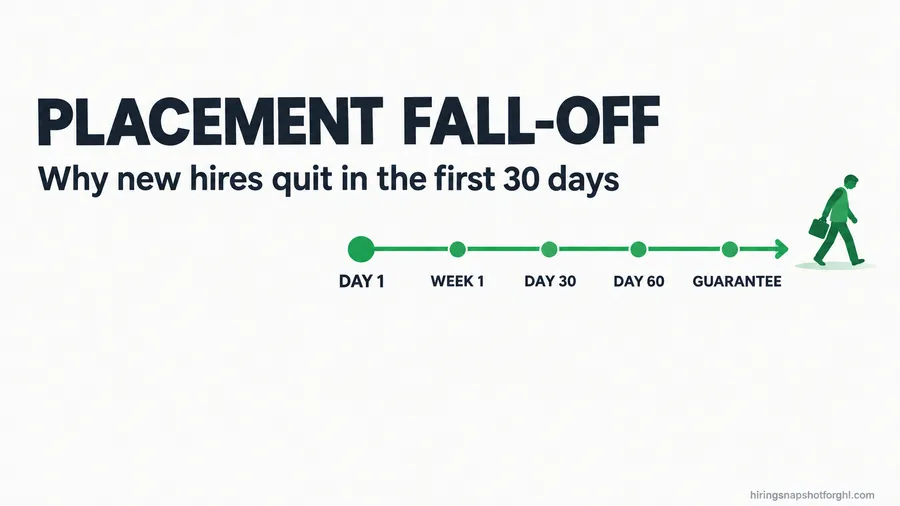
It is a Thursday afternoon, three weeks after a placement you were proud of. The phone rings, it is the client, and before they say a word you already know. Your placement quit this morning. No notice, no warning, just a worker who stopped showing up and a hiring manager who is now short a person and annoyed at you. You filled that order. You invoiced the fee. And now, inside the guarantee window, the whole thing has come undone and you are either refunding the money or sourcing a replacement for free. That is a fall-off, and for most staffing desks it is the quietest, most expensive leak they have.
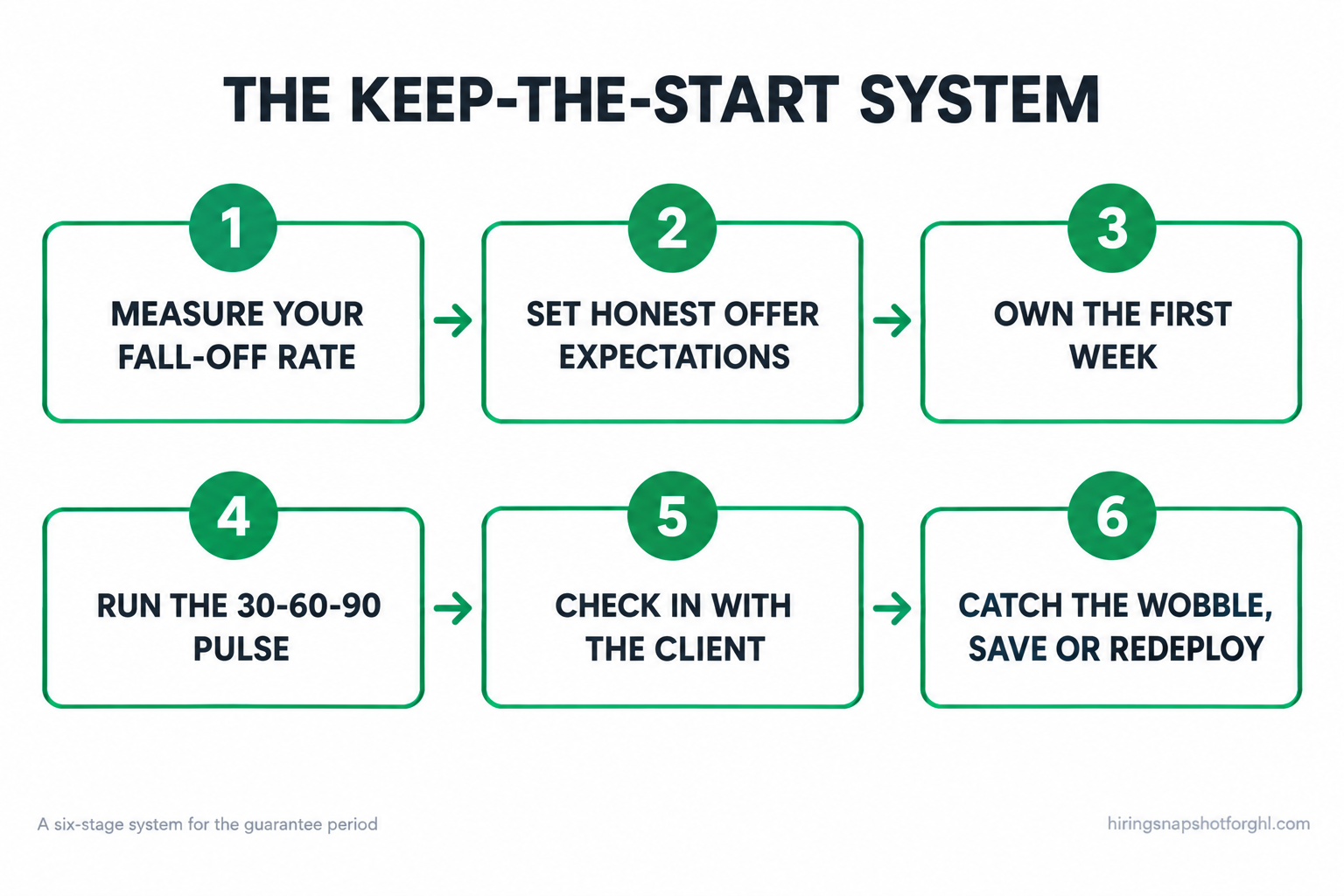
The short answer: placements fall off in the first 30 days because the job was oversold, the first week was silent, and nobody was watching for the early warning signs on either side. You fix it by treating the guarantee period as something you actively manage, not something you cross your fingers through. Measure your real fall-off rate and know when and why people go, stop selling a job that does not exist, own the first week with real check-ins, run a pulse-check cadence with the worker through day 90, run a parallel check-in with the client so you hear about problems before they become a termination, and catch the wobble early enough to save it or redeploy. This is the whole keep-the-start system, with the exact copy you can steal, the desk math on what a fall-off really costs, and the places it quietly breaks.
Key takeaways
- New hires decide fast. In BambooHR’s 2023 survey of 1,565 US workers, 70% decided whether a job was the right fit within the first month and 44% had second thoughts in the first week. The guarantee window is exactly when the decision gets made.
- Onboarding is almost universally bad, which is your opening. Gallup found only 12% of employees strongly agree their organization does a great job of onboarding. A desk that fills the gap keeps placements nobody else would.
- A fall-off is not one cost, it is three. You lose the fee or the margin, you source the replacement for free, and you spend goodwill with a client who is now short a person. SHRM put the average cost per hire for nonexecutive roles at $5,475 in its 2025 benchmarking report.
- The manager, and you, are the lever. Gallup found employees are 3.4 times as likely to feel onboarding was successful when a manager takes an active role. Check-ins are not fluff, they move the number.
- Catch the wobble, do not wait for the quit. Most fall-offs give you days of warning if you are listening on both sides. The desks that keep placements are the ones running a cadence, not hoping.
Table of contents
- What a fall-off actually is, and why 30 days
- What one fall-off really costs you
- The keep-the-start system, six stages
- Stage 1: Measure your fall-off rate and know when and why they go
- Stage 2: Stop selling a job that does not exist
- Stage 3: Own the first week
- Stage 4: Run the 30-60-90 pulse check with the worker
- Stage 5: Run the client-side check-in in parallel
- Stage 6: Catch the wobble, then save it or redeploy
- Three real scenarios: solo, 8-seat, and 25-seat
- Common objections, answered
- FAQ
What a fall-off actually is, and why 30 days
A fall-off is when a placed candidate leaves, for any reason, before your guarantee period closes. On a perm placement that usually means a 30, 60, or 90-day guarantee, and a fall-off triggers a refund or a free replacement. On a temp or temp-to-hire desk it shows up as a worker who completes the first shift, works a week or two, and then walks off the assignment while the order is still live. Different shapes, same wound: you already earned the placement, and now it is unwinding on your dime.
Thirty days matters because that is when the decision gets made. BambooHR surveyed 1,565 US workers in 2023 and found that 70% decide whether a job is the right fit within the first month, 44% have regrets or second thoughts in the first week, and on average people make up their minds in just 44 days. Korn Ferry framed the same data as companies having 44 days to influence a new hire’s long-term retention. Your guarantee period and the worker’s make-your-mind-up window are the same stretch of calendar. Whoever owns that stretch owns whether the placement sticks.
Here is the part most desks miss. There are around 27,000 staffing and recruiting companies in the US running close to 54,000 offices, and together they put nearly 2.0 million temporary and contract workers to work in an average week (American Staffing Association). Nearly all of them hand a placement off at the start date and go quiet. Gallup found only 12% of employees strongly agree their organization does a great job of onboarding new employees. That silence is not just the client’s problem. It is your fall-off rate, and it is the gap a sharp desk walks straight into.
What one fall-off really costs you
Put a number on a fall-off and you will stop treating it as bad luck. It is three costs stacked on top of each other, and the third is the one that hurts.
First, the fee or the margin you give back. On a perm placement with a prorated or full guarantee, a fall-off in week two can mean refunding a five-figure fee. A contingency recruiter billing 20% on a $65,000 hire just watched $13,000 evaporate because the candidate quit on day 18. On a temp desk, every shift that seat sits empty is spread you are not billing, plus any overtime you promise a backfill to cover the hole fast.
Second, you source the replacement for free. The guarantee means you are now re-running the whole sourcing, screening, and submittal process at your own cost, for a requisition you already filled once. SHRM’s 2025 benchmarking report put the average cost per hire for nonexecutive roles at $5,475. You are paying that twice and billing it once.
Third, and this is the expensive one, you spend trust you cannot easily earn back. A client who gets burned by a fall-off remembers it at renewal, remembers it when a competitor calls, and remembers it the next time they decide whether to send you the good reqs or the leftovers. The fee you refund is a number on a spreadsheet. The account you quietly lose six months later because they stopped trusting your placements to stick is the real bill.
The keep-the-start system, six stages
Fall-off feels like luck when you run the guarantee period by hope and like a machine when you run it as stages. The desks whose placements stick are not luckier. They close the gap at every step: they know their numbers, they set honest expectations before the start, they own the first week, they run a pulse cadence with the worker, they run a parallel check-in with the client, and they catch the wobble early enough to act. Six stages, in order. Skip one and the rest have to cover for it.
Stage 1: Measure your fall-off rate and know when and why they go
You cannot fix a number you do not track. Most desks “know” they have a fall-off problem the way they know summers are hot, by feel, which means they have no idea whether anything they try is working. So count it. For a rolling quarter, log every placement, every fall-off, when in the guarantee window it happened, and who ended it: did the worker quit, or did the client terminate? Those are two different failures with two different fixes.
Split your rate into buckets. Worker-initiated fall-offs, where the candidate walks, usually point at an oversold job, a better offer, or a first week that left them adrift. Client-initiated fall-offs, where the manager ends it, usually point at a skills or fit gap you missed in screening, or a performance problem nobody flagged early. Split again by week: a week-one fall-off is almost always an expectations or onboarding failure, while a week-four fall-off is more often a genuine fit or performance issue. For context on how fast the decision forms, remember that 44% of new hires have second thoughts in the first week, so an early cluster is a signal you can act on.
How it breaks. The usual failure is tracking the overall rate and doing nothing with the split. If you only know “we lose about one in six,” you will throw onboarding texts at a problem that is actually a screening miss, and wonder why the number will not move. Separate worker from client and week-one from week-four, and the right fix for each becomes obvious. The second failure is not logging the reason, which throws away the single most useful data you own. A cluster of “the pay was not what I expected” is a job-order problem. A cluster of “could not do the work” is a screening problem. Both are fixable once you can see them.
Stage 2: Stop selling a job that does not exist
The most expensive fall-offs are the ones you caused at the offer stage by selling a job the worker never actually got. When the shift, the pay, the commute, the supervisor, or the work itself turns out different from what you described, the worker does not file a complaint. They just leave, and they usually leave inside the first two weeks when the gap between the pitch and the reality is freshest. Among job seekers who admit to ghosting, 22% did it by accepting an offer and then not showing up for the first day (Indeed, 2023). Over-promising buys you a start date and a fall-off.
The fix is boring and it works: tell the truth at the offer, in writing, and confirm the worker heard it. Spell out the real pay, the real schedule including any mandatory overtime or weekend work, the real commute, what the work is actually like on a hard day, and anything about the site a reasonable person would want to know. A candidate who takes the job with eyes open stays. One who takes a fantasy quits when reality shows up.
Steal this: the honest offer-confirmation message
“Hi [Name], great news, [Client] wants to move forward and I want to make sure this is a real fit before you say yes. Here is exactly what you are signing up for:
💵 Pay: [$X/hr], paid [weekly/biweekly] on [day] 🗓️ Schedule: [days and hours], including [mandatory OT / weekend coverage, if any] 📍 Location: [address], about [X] minutes from [area], park in [lot] 🧰 The work: [one honest sentence about what the day is really like]
If all of that works for you, reply YES and I will lock in your start for [date]. If anything there gives you pause, tell me now, that is a normal conversation and far better than finding out in week one.”
That last line is the whole point. You are inviting the objection now, while it costs you a reschedule, instead of in week two, when it costs you the placement. The desks that keep placements treat the offer as the first retention step, not the finish line. If a counteroffer or a competing bid is the risk, the full playbook for locking the start is in the guide to what to do when a candidate backs out after a counteroffer.
Stage 3: Own the first week
The first week is where placements die. A worker who has just started has no relationship with the job, no face they feel accountable to, and the lowest switching cost they will ever have, and this is exactly the week 44% of them are already having second thoughts. Most clients do nothing to counter that, because Gallup found only 12% of employees strongly agree their employer onboards well. That is your opening. You cannot run the client’s onboarding, but you can run yours, and a staffing desk that checks in during week one is doing something 88% of employers are failing at.
Run three touches in the first five days. Day one, after the shift, catch problems while they are small. Day three, when the honeymoon is wearing off and the real friction shows up. Day five, to close the week and reset for week two. Keep each one short, human, and built to surface a problem, not just to say hi. Gallup found employees are 3.4 times as likely to feel onboarding succeeded when a manager takes an active role. You are not the manager, but you are the voice that checked in, and in week one that is worth a lot.
Steal this: the first-week check-in cadence
Day 1, after the shift, text: “Hi [Name], how did day one go at [Client]? Anything confusing, anything you need, anything that was not what you expected? I would rather hear it now while it is easy to fix. Reply 1 for good, 2 for a few questions, 3 for we need to talk.”
Day 3, text: “Hey [Name], you are through the first couple of days, which is usually when the real questions show up. How is the work, the schedule, the people? Be straight with me, I am on your side here.”
Day 5, text or call: “Hi [Name], you made it through week one, nice work. Before the weekend: is this feeling like the right fit, and is there anything I should square away with [Client] before Monday so week two is smoother?”
The reply scale on day one matters. A worker who taps “3” is a save you can still make. A worker who would have quietly quit instead now has a path that is not vanishing. For the full pre-start-to-week-one build, see the candidate onboarding automation guide.
How it breaks. Two ways. The cadence is manual, so it depends on a recruiter remembering to text every new starter on exactly the right day while they are buried in the next req, which is exactly what slips. Or the texts go out but nobody acts on a “2” or a “3,” so the one worker who raised their hand gets ignored and quits anyway, which is worse than never asking. Both are fixable by letting the system send the touches on schedule and flag the ones who need a human. Get written SMS consent and honor opt-outs, because the rules are real. The consent mechanics are covered in the guide to TCPA-compliant recruiting texts.
Stage 4: Run the 30-60-90 pulse check with the worker
Week one is the danger zone, but the guarantee period runs to 30, 60, or 90 days, and placements fall off across the whole window. The fix is a light pulse cadence that keeps you in the loop without becoming a nuisance: a check-in at the end of week two, at day 30, and at day 60, each one a quick read on whether the placement is still solid.
Keep these shorter than the first-week touches and make them easy to answer honestly. You are listening for drift: the pay that is landing late, the schedule that quietly changed, the supervisor who turned out to be difficult, the second offer that is circling. Any of those, caught at day 30, is a conversation. Caught at the exit interview, it is a fall-off you are refunding.
Steal this: the day-30 pulse check
“Hi [Name], you are a month into [Client], which is a real milestone, most of the early bumps are behind you now. Quick honest read for me: on a 1 to 5, how is this going? And if it is not a 5, what is the one thing that would make it one? No wrong answers, this is exactly the stuff I want to know while I can still help.”
A number plus “the one thing that would make it a 5” gives you a specific, fixable item instead of a vague “it’s fine.” A 2 or a 3 at day 30 is your early warning, and acting on it is Stage 6.
How it breaks. The pulse turns into spam if you send too many or make them feel like surveys instead of a person checking in. Keep them spaced, keep them human, and always tie them to a milestone the worker actually feels (“a month in,” “you are past the first paycheck”). The other failure is collecting the scores and never acting, which trains workers that your check-ins are theater. If you ask, you have to be ready to move on the answer.
Stage 5: Run the client-side check-in in parallel
Half of fall-offs do not start with the worker. They start with a client who is unhappy, says nothing to you, and then terminates. By the time you hear about it, the decision is made and you are sourcing a replacement. The fix is a parallel check-in with the hiring manager on roughly the same schedule you run with the worker, so you hear “they are a little slow on the line” at day 10, while it is coachable, instead of “we let them go” at day 25.
Run a client touch at the end of week one, at day 30, and at day 60. Ask a direct question that is easy to answer and hard to dodge. You are protecting the placement and, honestly, you are also protecting the account, because a client who feels looked after sends you the next req.
Steal this: the client week-one check-in
“Hi [Name], checking in on [Worker] now that they are through the first week at [Client]. Are they showing up on time, picking up the work, and fitting the team? If anything is off, even something small, tell me now and I will get on it. I would much rather fix a wrinkle this week than have it become a problem later.”
When the client flags something small, you get to coach the worker, reset an expectation, or fix a logistics issue before it compounds. When they say “all good,” you have a documented, happy client at the exact moment you might ask for a testimonial or the next job order. The parallel cadence is how you turn the guarantee period from a liability into a retention and growth loop, and it ties straight into the broader levers in the guide to improving your fill rate.
How it breaks. Clients are busy and a vague “how’s it going?” gets a vague “fine” that tells you nothing, right up until the termination. Ask the specific question (on time, doing the work, fitting in) and you get a specific answer. The other failure is running the worker cadence but not the client one, which leaves you blind to exactly the fall-offs you cannot see coming. Both sides, every milestone.
Stage 6: Catch the wobble, then save it or redeploy
All five stages feed this one. A pulse that flags a 2, a client who mentions a problem, a worker who goes quiet when they used to reply fast, these are wobbles, and a wobble is a fall-off you still have time to prevent. The desks that keep placements are the ones that treat a wobble as an alarm and act the same day, not the ones that notice it and hope it passes.
When you catch a wobble, triage it fast. Is this a fixable friction, a pay-timing issue, a schedule clash, a misunderstanding with the supervisor, that you can solve with a phone call to the worker or the client? Then solve it, today, and log what it was. Is it a genuine mismatch that is not going to work no matter what you do? Then get ahead of it: have the honest conversation, and if the placement cannot be saved, move the worker to a role that actually fits rather than letting them walk off and vanish. A redeployed worker who already knows your desk is retained margin, not a lost one, and the cadence for that is in the contractor redeployment playbook.
Steal this: the save-the-placement call opener
“Hi [Name], you mentioned on your check-in that things are not quite clicking at [Client], and I did not want to let that sit. Walk me through what is going on. If it is something I can fix with them, I will get on the phone today. And if this just is not the right spot for you, that is okay too, let’s talk about where you actually want to be so we land you somewhere that sticks, not somewhere you are white-knuckling it.”
That framing does two jobs. It gives the worker permission to be honest, which is the only way you find the real problem, and it keeps them inside your network even if this particular placement does not survive. A saved placement protects the fee. A clean redeploy protects the relationship and often the fee too. A silent quit loses both. For the systemic view on why placements leak at every stage, the guide to why recruiters lose candidates maps the full funnel.
Three real scenarios: solo, 8-seat, and 25-seat
The system is the same at every size. The shape of the fall-off changes.
The solo contingency recruiter, perm placements, 20 to 25% fees. Your fall-off is a candidate who starts, then quits inside a 30 to 90-day guarantee, and it is brutal because one fall-off can be a month of income refunded. You have no volume to absorb it. Your whole game is Stages 2, 4, and 6: set ruthless honesty at the offer so you never place a fantasy, run the 30-60-90 pulse yourself because there is no one else to run it, and act on the first wobble like your mortgage depends on it, because it does. The parallel client check-in matters too, because a quiet, unhappy client who terminates on day 25 costs you the entire fee. Never treat the invoiced placement as money in the bank until the guarantee closes. The whole point of the guarantee clause lives or dies in these 90 days, which is why it belongs in your fee agreement.
The 8-recruiter light-industrial agency, temp and temp-to-hire, 40 to 80% markup. Here fall-off is a worker who completes a few shifts and then walks, and the volume means you need the cadence automated or it simply will not happen. All six stages are live, but Stages 1, 3, and 5 carry the weight: track fall-off by client so one bad site does not quietly wreck your number, own the first week hard because that is where temp placements leak most, and run the client check-in across every account so you catch the terminations before they happen. Manual does not scale to forty new starters a week, so the first-week touches and the pulse have to fire on their own and flag the exceptions for a human. This is the desk the whole system was built for.
The 25-recruiter healthcare or high-volume shop. At this scale a fall-off can mean an unstaffed unit and a compliance exposure, not just a lost margin, and the guarantee math is large enough that a two-point improvement in fall-off rate is real money. Your cadence is layered on top of credentialing, the client check-in becomes a formal account-management function, and the Stage 1 data turns into a client-by-client scorecard you use in quarterly reviews. The root-cause logging is the asset here: when you can show an account exactly why placements fell off and what you changed, you keep the account and you win the expansion.
Common objections, answered
“Once they start, retention is the client’s job, not mine.” On paper, maybe. On your P&L, no. Your guarantee means a fall-off inside the window costs you the fee or a free replacement regardless of whose “job” retention was. And the data says the client is probably not doing it: only 12% of employees strongly agree their employer onboards well. You are not taking over the client’s job, you are protecting your own fee by filling a gap the client is leaving wide open. The desk that checks in keeps placements the desk that disappears loses.
“Won’t all these check-ins annoy the worker and the client?” Not if they are useful and human instead of nagging. A worker who gets a real “how is it going, what do you need” in week one feels looked after, not spammed, which is exactly why it works when 88% of employers offer silence. The line that matters is spacing and tone: keep the touches tied to milestones the person actually feels, keep them short, make them easy to answer honestly, and always give an easy out. Done right, the cadence is the thing that makes a worker pick up when you call about the next assignment. Keep it compliant with TCPA consent rules and it is an asset, not an irritant.
“I already check in on my placements.” Most desks that say this mean they text once in week one and then go quiet, which is better than nothing and nowhere near a system. The difference is the cadence running on both sides through the whole guarantee window, the reply scale that surfaces the worker who needs help, and the client check-in that catches terminations before they happen. “I check in” is a habit that fails under pressure. A cadence that fires on schedule and flags the exceptions is infrastructure.
“Do I really need software for this? My recruiters can text people.” They can, until it is a busy week and twelve new starters across five clients all need a day-three touch, a day-30 pulse, and a client check-in on different calendars, and a human is the single point of failure. The wins here are boring and automatable: send the touches on schedule, collect the reply scores, flag the 2s and 3s, prompt the client check-in, alert a recruiter when someone wobbles. That is exactly the kind of reliable, unglamorous routine a person does well for a week and then drops, which is why the Hiring Snapshot ships these cadences pre-built on GoHighLevel, and why a desk without a dedicated ops person often adds a trained GHL virtual assistant to own the follow-through.
FAQ
What is a fall-off in staffing?
A fall-off is when a placed candidate leaves, for any reason, before the guarantee period in your agreement expires. On a perm placement that typically means a 30, 60, or 90-day guarantee, and a fall-off triggers a refund or a free replacement. On a temp or temp-to-hire desk it shows up as a worker who starts, works a short time, and then walks off a live assignment. Either way, you have already earned the placement and now it is unwinding at your cost, which is why the guarantee window needs to be actively managed, not hoped through.
Why do new hires quit within the first 30 days?
Usually because the job was oversold, the first week was silent, or a problem nobody addressed early grew into a reason to leave. New hires decide fast: BambooHR found 70% make up their mind about fit within the first month and 44% have second thoughts in the first week. If the pay, schedule, commute, or work turns out different from the pitch, or if they start and hear nothing from anyone, the easiest path is to leave. Honest expectations at the offer and real check-ins in the first weeks counter both.
How do I reduce my fall-off rate?
Treat the guarantee period as a system. Track your fall-off rate split by worker-initiated versus client-initiated and by week, set honest written expectations at the offer, run first-week check-ins on day one, three, and five, run a 30-60-90 pulse with the worker, run a parallel check-in with the client, and act on the first wobble instead of waiting for the quit. The common thread is that you stay in the loop on both sides through the whole window, so problems surface while they are still fixable.
What does a fall-off cost a staffing agency?
Three things stacked. First, the refunded fee or lost margin. Second, the cost of sourcing the replacement for free, with SHRM’s 2025 benchmarking putting the average cost per hire for nonexecutive roles at $5,475. Third, and hardest to recover, the client trust you spend, which shows up later as reqs that go to a competitor. A fall-off you prevent with a few check-ins costs almost nothing. A fall-off you let happen costs the fee, the re-source, and sometimes the account.
How long should my guarantee period be?
Thirty, 60, and 90 days are all common, and the right length depends on your market and your risk tolerance. A longer guarantee is a stronger selling point to clients but a bigger exposure to you, so it only makes sense if you can actually manage retention through that window. That is the real argument for a check-in system: a 90-day guarantee is a liability if you go silent at the start date and an advantage if you run a cadence that keeps placements sticking. Spell the exact terms out in your fee agreement so a fall-off and its remedy are never a dispute.
How does GoHighLevel help prevent fall-off?
A platform like GoHighLevel can send the full keep-the-start cadence automatically: the honest offer confirmation, the first-week day-1, day-3, and day-5 touches, the 30-60-90 worker pulse, and the parallel client check-in, each on its own schedule per placement. It can collect the reply scores, flag the workers and clients who signal a problem, and alert a recruiter to act on a wobble the same day. That turns fall-off prevention from a manual chore that fails under pressure into a system that runs on its own across every active placement.
About the author
Marcus Delgado is the Staffing Agency Growth Lead behind the Hiring Snapshot. He ran a light-industrial staffing desk before joining the team to focus on agency growth, and he thinks in placement economics: fill rates, redeploys, and gross margin per requisition. His posts lean on real desk math, not vanity metrics.
Related reading
- Candidate Backed Out? The Counteroffer Fix for Staffing
- Candidate Onboarding Automation: Close the Gap Between ‘Offer Accepted’ and ‘First Shift Worked’
- No-Call No-Show in Staffing: Stop Workers Ghosting Your Shifts
- Contractor Redeployment: The Automation That Turns One Placement Into Three
- Staffing Agency Fee Agreement: 7 Clauses to Protect Your Fee