· Neha Chandra · Playbooks · 21 min read
Healthcare Staffing Compliance in 2026: The Credentialing and Exclusion Checks That Keep a Medical Staffing Desk Legal
Place one excluded nurse or one lapsed license into a facility that bills Medicare and the penalty lands on your agency, not the hospital. Here's the credentialing, license-verification and OIG exclusion-screening system that keeps a medical staffing desk out of a settlement, plus the checklist and candidate copy you can steal.
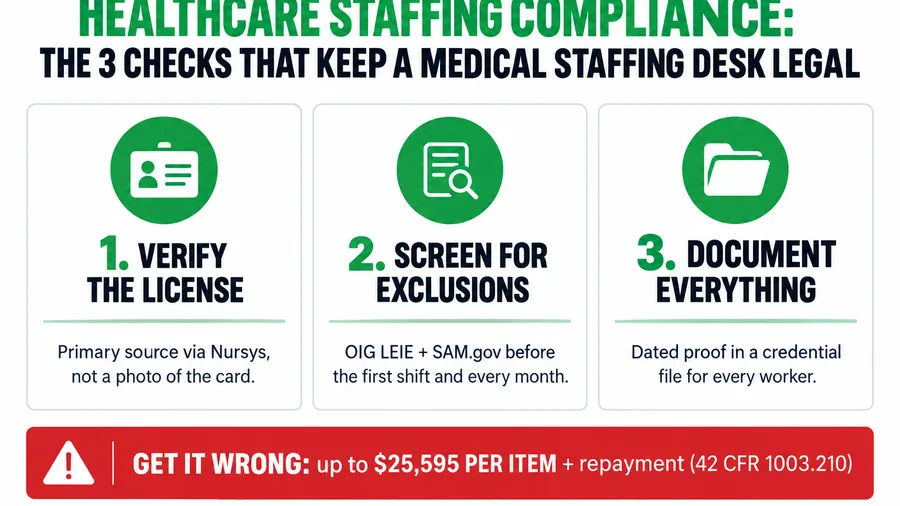
If you staff clinical workers into facilities that bill Medicare or Medicaid, your compliance job is three checks done right, every time, forever: verify the license at the primary source, screen the person against the federal exclusion lists before they work and every month after, and keep a credential file that proves you did both. Miss any one of them and the penalty follows the money, which means it lands on your agency. A healthcare facility that lets an excluded nurse touch a billed patient can be fined roughly $25,595 per item or service, and that liability flows straight back to the staffing agency that sent the worker. This is the operator’s guide to the credentialing, license verification, and exclusion screening that keep a medical staffing desk legal in 2026, the exact checklist and candidate messages you can copy, and the three settlements that show what getting it wrong actually costs.
Key takeaways
- Healthcare staffing is a $39.4 billion segment in 2026, up 63% from $24.2 billion in 2019 (Staffing Industry Analysts). More agencies are entering, and more of them are placing clinical staff without a real compliance system.
- Verify the license at the source, not the card. For nurses, Nursys QuickConfirm pulls licensure and discipline straight from participating boards, for free. A photo of a license proves nothing.
- Screen every clinical worker against the OIG exclusion list (LEIE) and SAM.gov before the first shift and monthly after. The OIG advises monthly screening to limit your exposure (OIG Special Advisory Bulletin).
- Employing an excluded person is agency-ending math. A Pennsylvania staffing agency paid $24,775.56 over one excluded LPN; a hospital paid $253,671.20 over one excluded RN sent by a staffing agency.
- The repeatable part is the hard part. Licenses expire, immunizations lapse, and exclusions get added mid-assignment. The agencies that stay clean automate the expirable tracking so a lapse blocks a shift before a worker clocks in.
Table of contents
- It’s Friday and a travel nurse starts Monday
- What healthcare staffing compliance actually covers
- License verification: why “I saw the card” is not verification
- Exclusion screening: the check that ends agencies
- What the four lists are, and who keeps them
- Credentialing beyond the license
- The expirable problem, and the automation that fixes it
- Three scenarios: solo locum, per-diem nurse agency, travel shop
- Steal this: the checklist, the candidate message, the monthly SOP
- Common objections, answered
- FAQ
It’s Friday and a travel nurse starts Monday
It’s 4:30pm on a Friday. A hospital client calls: they need an ICU nurse on the floor Monday morning, and you have a great one ready to go. Her resume is clean, her references check out, and she texts you a photo of her RN license. You send the confirmation, she starts Monday, and the hospital bills Medicare for the care she gives. Three weeks later the hospital’s compliance team runs a routine exclusion screen and finds her name on a federal list. She was excluded two years ago over a billing matter at a previous job. Now the hospital has a repayment problem, and every claim tied to her work is in question. The first call they make is to you.
Here’s the short version before the fear sets in. Healthcare staffing compliance is not vague “best practice.” It is a small set of concrete checks with real penalties attached, and almost all of the risk sits in two of them: proving the license is real and current, and proving the worker is not barred from federal health programs. Get those two right, every time, and document them, and you have removed most of the exposure that sinks small medical staffing agencies. The rest of this guide is how to build that into a repeatable system instead of a Friday-afternoon gamble.
What healthcare staffing compliance actually covers
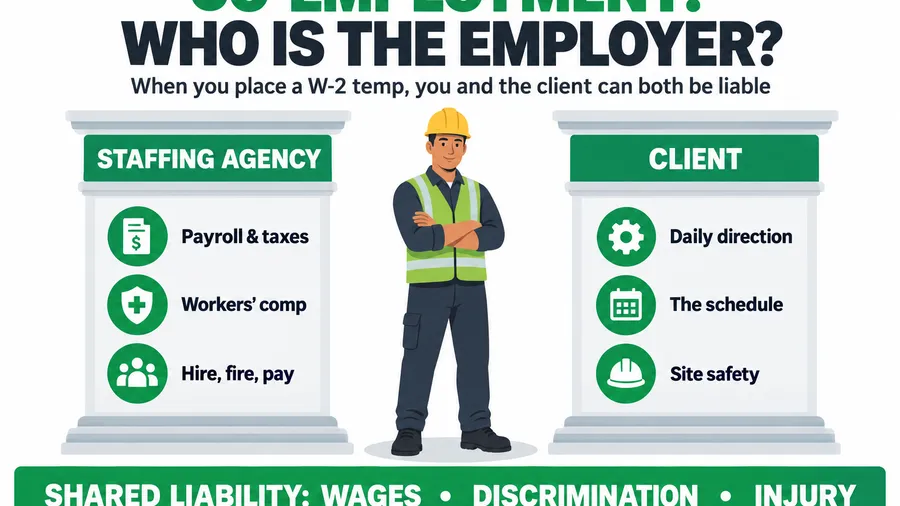
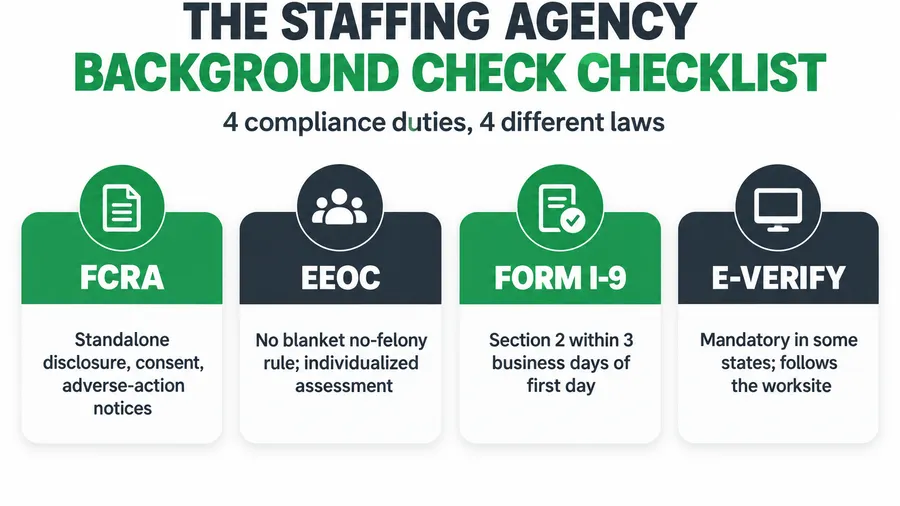
Healthcare staffing compliance is the set of rules that say who you can place, into what setting, with what verified credentials, and what records you have to keep to prove it. It stacks on top of the general staffing compliance you already deal with, like FCRA background-check rules and I-9 verification and co-employment risk, and adds a clinical layer that the light-industrial side never touches.
That clinical layer has five parts. License and certification verification, confirming the person holds a current, unrestricted credential to practice. Exclusion screening, confirming they are not barred from Medicare, Medicaid, or any federal program. Background and health requirements, the criminal check, drug screen, immunizations, and TB test a facility requires before a clinician works. Competency and skills validation, the checklist that says this nurse can actually run the unit you are sending them to. And documentation, the credential file that proves every one of the above, kept current for the life of the assignment.
The reason this matters more than it looks: in clinical placements, your client bills the government for the care your worker delivers. That single fact turns a paperwork miss into a federal money problem, and federal money problems do not stay with the hospital. They flow back along the chain to whoever supplied the non-compliant worker. You.
License verification: why “I saw the card” is not verification
A license photo texted from a candidate’s phone is worth exactly nothing in an audit. It can be expired, restricted, suspended, or edited, and none of that shows on a photo. Real verification means checking the credential directly against the issuing authority, which the industry calls primary source verification. The Joint Commission, whose Health Care Staffing Services certification is the quality standard many hospitals require of their agency vendors, defines verification as confirming the credential with the state licensing board or an agency officially designated to provide that confirmation.
For nurses, the primary source is usually Nursys, the national license database run by the National Council of State Boards of Nursing. Boards of nursing feed their licensure and discipline data into it, and participating boards treat a Nursys result as primary-source equivalent. The tool you want is Licensure QuickConfirm. It is free, it pulls current license status and any discipline in one place, and you search by name, license number, or NCSBN ID. For physicians you verify against the state medical board; for allied health, the relevant state board or certifying body.
How it breaks. The most common failure is not a fake license, it is a stale one. You verify a nurse in January, place her on a 13-week assignment, and her license renews in March. If your process only checks at hire, you have an unverified clinician on the floor for ten weeks and no record that you caught it. The second failure is the compact-license trap: a multistate (eNLC) license lets a nurse practice in member states, but not in every state, and not if the nurse’s primary residence changes. Placing on a compact license without confirming the destination state accepts it is a quiet, common miss. The third is discipline that lands after you verify. A clean QuickConfirm in January does not stay clean.
The fix for all three is the same: re-verify on renewal and subscribe to change alerts. Nursys offers e-Notify, a free service that emails you when a license on your roster changes status, renews, expires, or has discipline resolved. Enroll your whole clinical roster in it and the system tells you about a lapse instead of a hospital auditor telling you.
Exclusion screening: the check that ends agencies
This is the one that puts small agencies out of business, and it is the one most new medical staffing desks have never heard of.
The Office of Inspector General (OIG) maintains the List of Excluded Individuals and Entities, the LEIE. People land on it for healthcare fraud, patient abuse, license revocation, and defaulting on health-education loans, among other reasons. The effect of exclusion is blunt: no federal health care program will pay for any item or service that an excluded person provides, orders, or prescribes. Not the care itself, not the supervision, not the paperwork. If your worker is excluded and your client bills Medicare for that worker’s shift, the claim is improper.
Here is the penalty structure that should change how you run your desk. Under the federal civil monetary penalty rules, a provider that employs or contracts with an excluded person can be fined roughly $25,595 per item or service the excluded person furnished (the 2025 inflation-adjusted figure at 42 CFR 1003.210), plus repayment of what the government paid, plus a damages assessment. OIG-initiated cases typically settle at a multiple of damages; self-disclosed ones settle lower. “Per item or service” is the phrase that does the damage: a nurse working a 13-week assignment generates hundreds of billed items, and the penalty can attach to each.
These are not hypothetical. Three real OIG settlements make the point better than any warning:
In 2014, a Pennsylvania staffing agency, ePeople Healthcare, paid $10,204 over an excluded LPN. In 2015, another Pennsylvania agency, OneSource Medical Staffing, paid $24,775.56 to resolve allegations that it employed an excluded LPN who worked at nursing facilities that billed federal programs. And in 2018, the University of Chicago Medical Center paid $253,671.20 because an excluded registered nurse, supplied through a staffing agency, provided care that was billed to federal programs. Read that last one twice. The hospital paid a quarter of a million dollars because of a nurse an agency sent. Every contract you sign with a clinical client has an indemnification clause, and that clause points the recovery at you.
The LEIE is updated monthly. There is no statute that forces a provider to check it, but the OIG’s Special Advisory Bulletin is explicit that screening employees and contractors at hire and then monthly is the way to limit your overpayment and penalty exposure. Monthly is not gold-plating. It is the baseline your clients are already holding themselves to, and it is what they will expect from you in the vendor audit.
What the four lists are, and who keeps them
“Check the exclusion list” is really four separate checks, and a worker can be clean on one and barred on another. Here is the whole picture so you screen all of them, not just the famous one.
| List | Who maintains it | What it catches | Cost | How often |
|---|---|---|---|---|
| OIG LEIE | HHS Office of Inspector General | Exclusions from all federal health programs | Free | At hire + monthly |
| SAM.gov Exclusions | GSA (2 CFR 180) | Government-wide debarment from federal awards | Free | At hire + monthly |
| State Medicaid exclusion lists | Each state Medicaid agency | State-level exclusions not always in the LEIE | Free | At hire + monthly |
| Nursys (license + discipline) | NCSBN / state boards | License status, expiration, restrictions, discipline | Free | At hire + on renewal |
The LEIE is the healthcare-specific list and your first stop. SAM.gov is broader: it records government-wide debarment, so a worker barred for a non-healthcare reason, like defaulting on a federal contract, can show clean on the LEIE and still appear in SAM. State Medicaid lists matter because a person excluded by a state program is not always mirrored in the federal LEIE, and many of your placements bill Medicaid. Screen all three exclusion sources, plus the license source, and keep the dated result of each. The dated screenshot is the proof; a check you ran but cannot evidence did not happen, as far as an auditor is concerned.
Credentialing beyond the license
License and exclusions are the legal floor. The credential file your facility actually demands goes further, and getting it complete before the start date is the difference between a clean placement and a worker turned away at the door on day one.
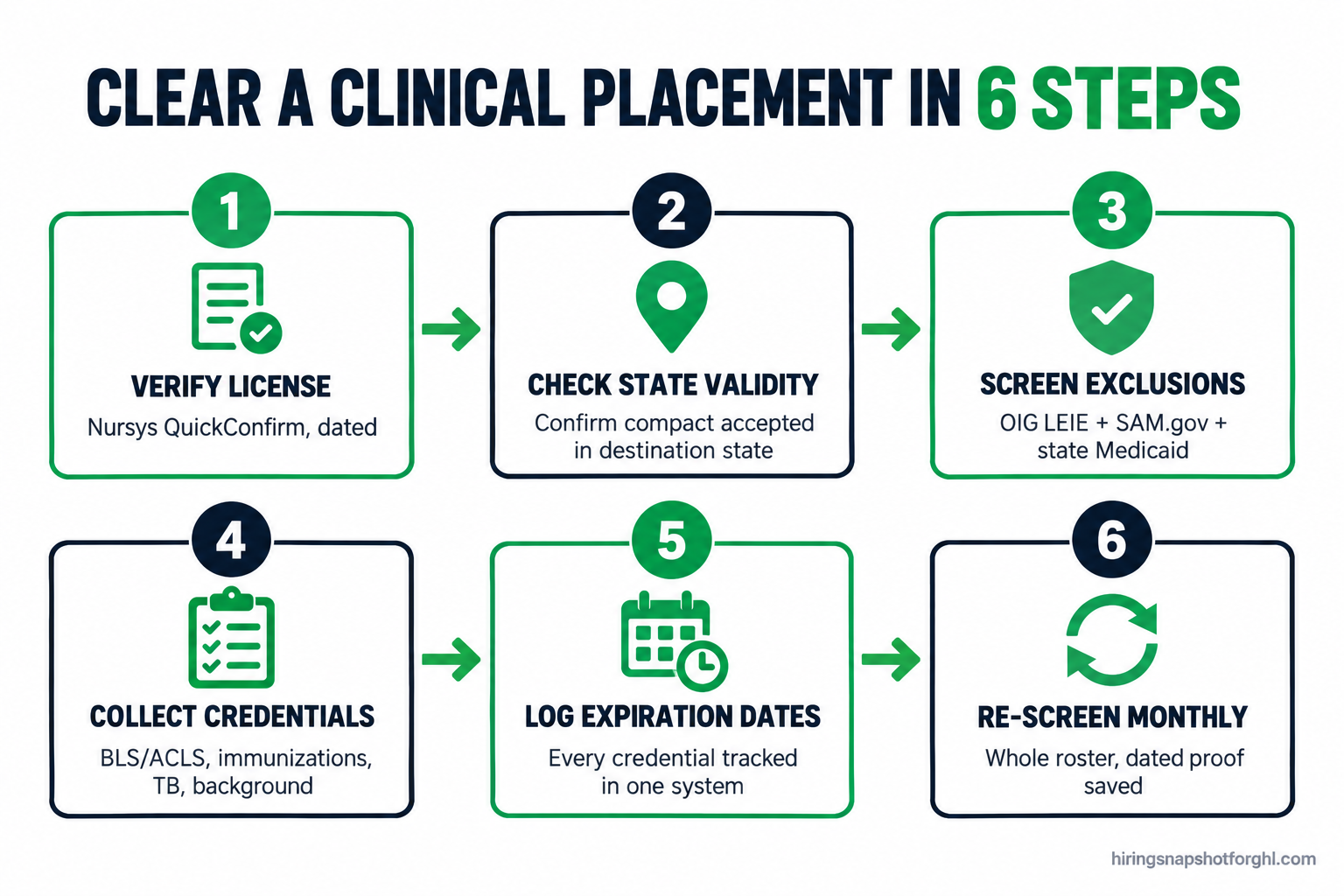
A typical acute-care credential packet includes the verified license, current BLS/ACLS/PALS certification cards as the role requires, a criminal background check, a drug screen, proof of immunizations (commonly MMR, varicella, hepatitis B, Tdap, and seasonal influenza), a current TB screen or chest X-ray, a skills checklist signed by the clinician, and often a competency test for the specialty. Facilities set their own specifics, and they do not bend them for a Friday-afternoon placement. The Joint Commission’s Health Care Staffing Services certification exists precisely to give hospitals a way to trust that an agency’s credentialing is real, and carrying it is increasingly a condition of winning hospital contracts at all.
Reference verification sits inside this stack too, and it carries its own trap in clinical settings: you are confirming competence and fitness, not fishing for protected information. The reference-check system that verifies a candidate without killing the placement applies here, with the extra care that clinical references touch patient-safety history. Keep the questions job-related and documented.
Put the whole clearance sequence in one place and it looks like this:
The expirable problem, and the automation that fixes it
Here is the operational truth nobody tells a new medical staffing owner: credentialing is not a one-time event, it is a maintenance job, and the maintenance is where agencies fail. A license renews. A BLS card expires every two years. An annual TB screen comes due. A flu shot is required each season. An exclusion can be added the month after you cleared someone. Every one of those is a date, and every date is a point where a compliant worker silently becomes a non-compliant one while still clocking in.
Track that on a spreadsheet across 40 clinicians and you will miss one. Not because you are careless, but because a spreadsheet does not call you. The agencies that stay clean do two things. They store every credential with its expiration date in one system, and they let the system block a worker from being scheduled once anything in the file lapses. That is a workflow problem, and it is exactly the kind of thing a GoHighLevel automation build or a custom candidate and client portal handles well: a credential record per worker, an automatic reminder sequence to the clinician at 60, 30, and 7 days before each expiration, an internal alert to the recruiter, and a status flag that trips to “do not schedule” the moment a date passes. Pair that with Nursys e-Notify for license changes and the same discipline you would use for onboarding automation that closes the gap between offer and first shift, and the expirable problem stops being a problem.
Three scenarios: solo locum, per-diem nurse agency, travel shop
The compliance load is the same in kind at every size, but the system you need to carry it is not.
The solo locum or allied recruiter. You place a handful of clinicians at a time, maybe physicians or therapists on short contracts. Your risk per placement is high because each one bills a lot, but your volume is low enough to run by hand if you are disciplined. The non-negotiables: primary-source verify every license, screen LEIE plus SAM plus the relevant state Medicaid list before the start date, and keep a dated folder per clinician. The mistake at this size is treating it casually because the numbers are small. They are not. One excluded placement is a five-figure problem whether you have 3 clinicians or 300.
The per-diem and local nurse agency. You are running 20 to 60 nurses into local facilities, often on short notice. Now the enemy is speed-versus-compliance pressure, the exact Friday-afternoon scenario that opens this piece. You cannot verify under pressure and stay clean, so you verify in advance: a nurse is not “available” in your system until license, exclusions, and the core credential packet are confirmed and current. Build the roster so only cleared, in-date clinicians show as placeable. This is also the size where monthly exclusion screening across the whole roster stops being feasible by hand and the automation earns its cost.
The travel-nurse or multistate shop. You place across state lines on 13-week contracts, which stacks two compounding problems: compact-license rules that change by destination state, and credentials that expire mid-assignment because the assignment is long. Your system has to verify the license is valid in the destination state specifically, re-verify on renewal during the contract, and run monthly exclusion screens for the full assignment length. At this scale, Joint Commission certification is often required to win the hospital systems you want, and the credential automation is not optional, it is the operating model.
Steal this: the checklist, the candidate message, the monthly SOP
Copy these verbatim and adapt the specifics to your facilities.
The pre-placement clinical compliance checklist
Before a clinical worker is marked placeable:
- Primary-source license verification complete (Nursys QuickConfirm for nurses, state board for others), dated and saved
- License valid in the destination state (confirm compact acceptance if multistate)
- OIG LEIE screen, clear, dated screenshot saved
- SAM.gov exclusions screen, clear, dated screenshot saved
- Relevant state Medicaid exclusion screen, clear, dated
- Criminal background check complete and adjudicated per FCRA
- Drug screen complete
- Immunizations current: MMR, varicella, hep B, Tdap, flu (per facility)
- TB screen or chest X-ray current
- Required certs in date: BLS / ACLS / PALS as role requires
- Signed skills checklist / competency for the specialty
- Expiration dates for every item entered into the tracking system
The candidate credential request (SMS or email)
“Hi [Name], great news, [Facility] wants to move forward. To get you cleared to start, I need a few documents by [date]: a clear photo of your current license, your BLS/ACLS cards, your immunization record (MMR, varicella, hep B, Tdap, flu), and your most recent TB test. I’ll verify your license directly with the board, that part’s on me. The faster these come in, the sooner I can lock your start date. Reply here and I’ll send a secure upload link.”
The monthly exclusion-screening SOP
On the first business day of every month:
- Pull the current active roster (everyone on assignment plus anyone placeable).
- Screen each name against the OIG LEIE, SAM.gov, and your states’ Medicaid lists.
- Save a dated result for every name, clear or not.
- On any hit: immediately pull the worker from all federally billed assignments, notify the affected client, and document the date and action.
- Log the run as complete with the date and who ran it.
The dated records in steps 3 and 5 are the whole point. In an audit, “we screen monthly” means nothing; “here is the dated result for every worker, every month” means everything. If you only automate one thing in your agency, automate this run so it happens on schedule and files its own proof.
Common objections, answered
“The hospital does its own credentialing and screening. Isn’t this their job?” They do, and it does not protect you. The facility screens to protect itself; your agency contract almost certainly makes you responsible for supplying compliant workers, with an indemnification clause that lets the client recover from you when a worker you sent causes a problem. Two of the settlements above were paid by the facility, and the recovery path runs back to the agency. Do your own checks and keep your own proof, independent of whatever the client does.
“We’re small and only place a few nurses. Do we really need all this?” The penalty does not scale down with your size, and the per-item structure means a single long assignment can generate a large number. The Pennsylvania agencies that settled were small. What changes with your size is the tooling, not the obligation: a solo desk can run this in disciplined folders, but every desk has to run it.
“Monthly screening across the whole roster sounds like a full-time job.” By hand, across 40-plus clinicians, it nearly is, which is exactly why it gets skipped and why skipping it is dangerous. It is also a clean automation target: pull the roster, screen the lists, file dated results, flag hits. Set it to run on the first of the month and the “full-time job” becomes a report you review.
“A candidate sent me a photo of a current license. Isn’t that enough?” No. A photo shows what the license looked like when the photo was taken, nothing about current status, restrictions, or discipline, and it can be edited. Primary-source verification through Nursys or the state board is the only version that survives an audit, and it is free, so there is no reason to accept the photo as proof.
“We also use AI tools to screen applicants. Does that change anything?” It can. If you use automated tools to screen or rank clinical candidates, you may be touching AI-in-hiring rules on top of the clinical ones. We cover those in AI hiring laws for staffing agencies in 2026; the short version is that the compliance layers stack, they do not replace each other.
FAQ
What is the difference between license verification and exclusion screening?
License verification confirms a clinician holds a current, unrestricted credential to practice, checked at the primary source such as Nursys or a state board. Exclusion screening confirms the person is not barred from federal health programs, checked against the OIG LEIE, SAM.gov, and state Medicaid lists. They are separate checks that catch different problems, and a worker can pass one and fail the other. You need both before a clinical placement.
How often should a staffing agency run OIG exclusion screening?
Before the first shift and then monthly for everyone on a federally billed assignment. The OIG’s guidance advises screening at hire and monthly after to limit overpayment and penalty exposure, and the LEIE is updated monthly, so a worker clean in January can be excluded by February. Save a dated result for every name every month as your proof.
What happens if a staffing agency places an excluded nurse?
Any federal claim tied to that worker’s care becomes improper, the facility faces repayment plus civil monetary penalties of roughly $25,595 per item or service, and the staffing agency is typically on the hook through its contract’s indemnification clause. Real settlements have run from about $10,000 for a small agency to over $250,000 for a hospital that used an agency-supplied excluded nurse.
Is Nursys free, and is it good enough for primary-source verification?
Yes on both. Nursys Licensure QuickConfirm is free and pulls licensure and discipline data submitted by participating boards of nursing, which treat it as primary-source equivalent. Pair it with the free e-Notify alert service so you are told when a license on your roster renews, expires, or has discipline resolved, instead of finding out in an audit.
Do I need Joint Commission certification to run a medical staffing agency?
Not legally, but practically it is often how you win hospital contracts. The Joint Commission’s Health Care Staffing Services certification evaluates whether your firm’s credentialing, verification, and competency processes are sound, and many hospital systems require it of their agency vendors. Smaller per-diem and local placements may not demand it; larger systems and travel contracts frequently do.
What is the difference between the OIG LEIE and SAM.gov?
The LEIE is the healthcare-specific exclusion list maintained by the HHS Office of Inspector General and is your first stop for clinical placements. SAM.gov records government-wide debarment from federal awards and is maintained by the GSA, so it catches exclusions for non-healthcare reasons that may not appear on the LEIE. Screen both, plus the relevant state Medicaid lists, because a worker can be clean on one and barred on another.
About the author
Neha Chandra keeps the Hiring Snapshot honest. With a background in HR operations and contingent-workforce compliance, she audits every cadence against TCPA, EEOC, and FCRA realities so automation never outruns the rules. She writes the compliance notes and the operations deep-dives that keep agencies fast and defensible at the same time.
Related reading
- The Staffing Agency Background Check Checklist: FCRA, I-9 and E-Verify Without a Lawsuit
- Co-Employment Risk for Staffing Agencies: What You’re Actually Liable For in 2026
- Reference Checks for Staffing Agencies: The System That Verifies a Candidate Without Killing the Placement
- Candidate Onboarding Automation: Close the Gap Between Offer Accepted and First Shift Worked
- AI Hiring Laws for Staffing Agencies in 2026: What NYC, Illinois and Colorado Now Require
Compliance is a tracking problem before it is a legal one. See how the Hiring Snapshot automates credential expirables and monthly screening, then get the full build for a one-time $997, installed within one business day and flat no matter how many clinicians you place.